The result of the elections in Hungary is not yet certain. Polls independent of the government show a clear advantage of the currently opposition Tisha, and those dependent on the government show an advantage of the still ruling Fidesz. The average of the surveys according to the Politico report is 10 percentage points. Tisza's advantage.
Read also: The Hungarian forint is strengthening before the elections. This is what investors are counting on
Even a victory, however, will probably not give this group an advantage large enough to change the constitution. This would be possible thanks to 133 seats in the 200-seat parliament. Ebury analysts gave the constitutional advantage scenario just 10%. chances.
“In the absence of a constitutional majority, a deep revision of the changes introduced over the years of Orban's rule seems unlikely. According to most forecasts, Hungary will see at best moderate economic growth this year (2.1% according to the IMF),” PIE economists comment.
This is much lower than the growth forecast for Poland in 2026, which was 3.8% a month ago and has now dropped to an average of 3.2%. according to Fitch and the World Bank.
“It would be crucial for investors vision of quick release of funds frozen by the EU (nearly EUR 18 billion)which could constitute a significant growth stimulus for the Hungarian economy. Tisza's better-than-expected result should mean a significant strengthening of the forint, significant increases on the Hungarian stock market and a decline in the yield of Hungarian government bonds,” comments Michał Jóźwiak, an Ebury analyst.
Read also: Viktor Orban calls an extraordinary meeting of the defense council. He is afraid about Russian gas
Let's look at how close Hungarian growth would be to Polish growth if these blocked funds were added to GDP.
Poland, Hungary, Czech Republic and Slovakia – who is developing faster?
Hungary, Poland, the Czech Republic and Slovakia started from a similar level after communism. They all entered the EU at the same time. Slovakia adopted the euro, the rest stayed with their currencies. Hungary has followed the path of friendly relations with Russia, while Poland and the Czech Republic have a confrontational attitude after Russia's attack on Ukraine. Which country fared better in similar circumstances? We adopted 2010 as the time line, when Viktor Orban came to power and has been in power since then.
If we compare the change in the value of GDP expressed in euro, Poland is the leader in growth, because since 2010 we have increased our GDP by 154.5%. up to EUR 918 billion. Hungary ranks second with a dynamics of 119.8%. (up to EUR 219 billion), the Czech Republic third with an increase of 117.3%. (up to EUR 347 billion), and Slovakia fourth with 99 percent. (EUR 137 billion) – according to Eurostat data.
However, Hungary is “missing” blocked EU funds, i.e. those calculated by the analyst at EUR 18 billion, which did not flow into the economy, while they did flow into ours. In these 18 billion euros:
- Okay. EUR 8 billion – these are still blocked cohesion funds in December 2022 due to allegations of lack of rule of law, and specifically the lack of effective combating of corruption, irregularities in public procurement, weakening the independence of courts and prosecutors' offices. EUR 2 billion of cohesion funds have already been permanently lost.
- EUR 10.4 billion (including EUR 5.8 billion in grants) – this is the result of failure to meet KPO milestones, including insufficient independence of the judiciarylack of effective implementation guarantees EU Charter of Fundamental Rights i insufficient anti-corruption safeguards when spending funds.
Read also: Orban talked to Putin. “I am available for any matter”
If we add these EUR 18 billion to GDP for 2025, then… instead of an increase of less than 120 percent. for Hungary compared to 2010 it would be 137.9%. However, we do not take into account that this money could have already been working in the economy from 2023, and therefore could have provided additional growth.
Real growth
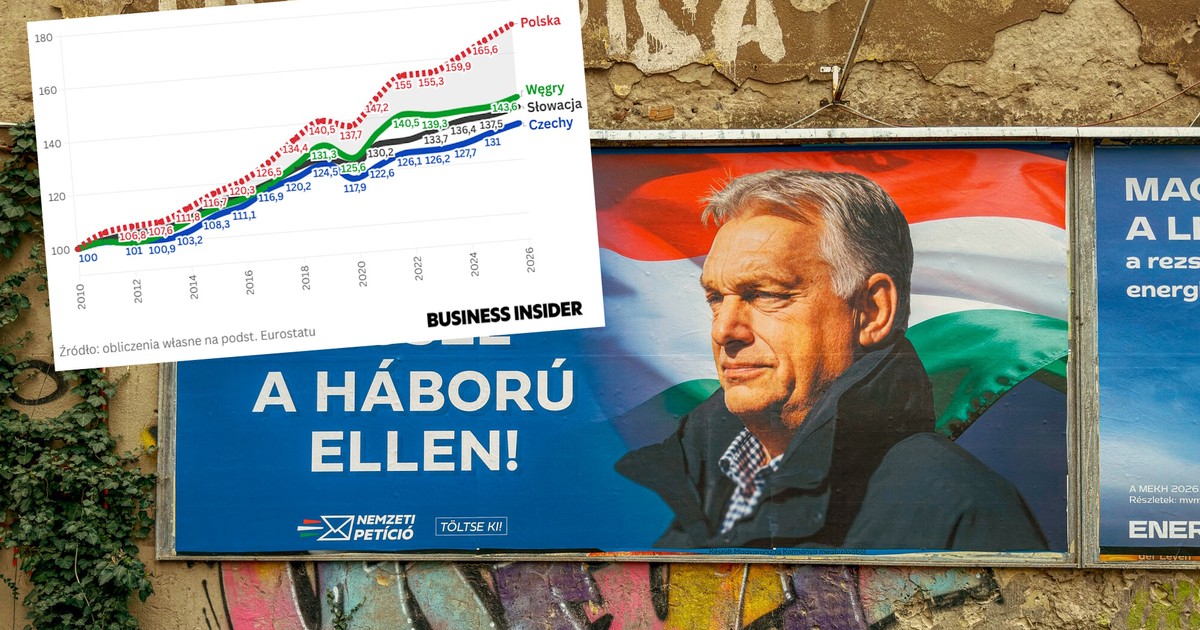
We also compared GDP growth not in euro, but according to dynamics in constant prices from 2010 to 2025 for the four countries mentioned. And here too, Poland is in first place with a dynamics of 65.6%. compared to 2010. In second place is Hungary with 40.7 percent, followed by Slovakia with 37.5 percent. and then the Czech Republic with 31 percent.
However, since the pandemic of 2020, we have significantly moved away from the other three. Since then, our GDP has increased in constant prices by 20.3%, the Hungarian GDP by 12%, the Slovak GDP by 11.6% and the Czech GDP by 11.2%.
The above chart shows that from 2024 we have clearly moved away from Hungary. Well, Hungarian GDP without these 18 billion euros, but with them it is something else. The difference in dynamics, as we estimated, may amount to 4.3 percentage points. GDP. In this way, Hungary might not be as tall as us, but it would be significantly closer to us and differentiate us from the Czech Republic and Slovakia.
Additionally, we cannot forget that we are paying for this with an increase in the level of debt. And so, while since 2010 our level of public debt (general government) has increased by 4.4 percentage points by September 2025. GDP 58.1 percent GDP (by the end of 2025 by another 1.9 percentage points), is in the case of Hungary it decreased by 5 percentage points. up to 75.2 percent GDP. In the Czech Republic it increased by 6.4 percentage points. (up to 43.1 percent of GDP), and in Slovakia by as much as 21.6 percentage points. GDP (up to 62.3% of GDP).
Standard of living
Let's take a closer look at the indicator that shows the approximate standard of living of the country's inhabitants. What is important is not only GDP per capita, but also the prices that apply in this country. If you earn a thousand euros a month in two countries, what does this amount mean differently if the price level in one of them is half as much as in the other. In the cheaper one, the standard of living is twice as high. And what does it look like in Hungary compared to Poland, the Czech Republic and Slovakia?
We are interested in GDP per capita measured according to the purchasing power standard (PPS according to Eurostat). And so last year there were 38.4 thousand per Czech. euro GDP according to PPS, per Pole 33.7 thousand euro per year, for a Hungarian 31.6 thousand, and for a Slovak 31.1 thousand. euro.
We were neck and neck with Hungary until 2019. We rebounded from the pandemic year, and in 2025 our advantage increased to 2.1 thousand. euro per capita. Here, however, we must again make a reservation about the state's indebtedness. Since Q4 2019, Poland's debt level has increased by 12.9 percentage points. GDP, and Hungary by 10.2 percentage points.
Author: Jacek Frączyk, editor of Business Insider Polska