Iran's Islamic Revolutionary Guard Corps broadcast radio messages on Saturday, warning ships against passing through the Strait of Hormuz. “No ship is allowed to pass through the Strait of Hormuz,” says a message sent by Tehran.
Look: Iran closing the strategic strait? “No Ship Will Pass”
“A long-term closure of the Strait of Hormuz is a guaranteed global recession” – said Bob McNally, founder and president of Rapidan Energy, on CNBC.
This section is only 30 km wide, but it is crucial from the point of view of the global economy. The attacks on Iran may make this clear to us.
Already in mid-February, Iran announced a temporary restriction of access to a part of the Strait of Hormuz, which connects the Persian Gulf with the Gulf of Oman and through which one fifth of the world's oil production is transported. The reason for this decision were military exercises using live ammunition conducted in a water area closed by Iran.
The rest of the article is below the video
Closing the Strait of Hormuz? The expert evaluates
“The consequence of closing one of the most important areas of global oil trade by sea would be a drastic increase in the price of the raw material on world markets. – said a few days ago in an interview with the Polish Press Agency, the head of the Department of International Relations of the Naval Academy, Dr. Łukasz Wyszyński.
See also: “Difficult” Ukraine-Russia talks affect oil prices
— In the event of a long-term conflict with Iran, maintaining security in the Strait of Hormuz would be very difficult, he added.
Strait of Hormuz. What does it mean for the oil market?
The Strait of Hormuz is the only maritime export route for crude oil from Iran, Saudi Arabia, the United Arab Emirates, Bahrain, Kuwait and Iraq. Qatar also sends most of its liquefied natural gas there. Oil transported through the strait goes, among others, to China, which is currently the only recipient of Iranian raw material on the Asian market.
Although Saudi Arabia and the United Arab Emirates have pipelines, the U.S. Energy Information Administration (EIA) emphasizes that there is no alternative route for most of its oil exports beyond the Strait of Hormuz. In the past, any threat to free navigation in this region resulted in higher global energy prices.
See also: The US asks China to stop Iran from closing the Strait of Hormuz
Łukasz Wyszyński noted that the blockade of the strait would affect all recipients, including Poland, which imports all its imported oil by sea, also from the Middle East. “For us, this raw material would be more expensive” – noted the expert.
The Persian Gulf countries that export oil would have to look for alternative, more expensive transport methods than sea in the event of a blockade, which would pose a serious challenge for them.
According to the expert, the Russian Federation could benefit from a possible blockade, as it would be able to continue exporting oil despite the sanctions, using the so-called shadow fleet.
The United States, currently the world's largest oil exporter, could only benefit from the blockade “economically and in the short term,” according to Vyshinsky.
Strait of Hormuz. The United States protects navigation safety
The United States Fifth Fleet, based in Manama, Bahrain, is currently responsible for the safety of navigation in the region. The expert recalled that since the presidency of Dwight Eisenhower, the United States has played the role of a guarantor of the security of the region's countries and freedom of navigation.
“Therefore, in the event of a blockade, there would be great political pressure on the US to quickly end its actions against Iran and restore traffic in the strait,” said Łukasz Wyszyński.
The Strait of Hormuz is narrow and winding, and at its narrowest point is approximately 20 nautical miles wide.
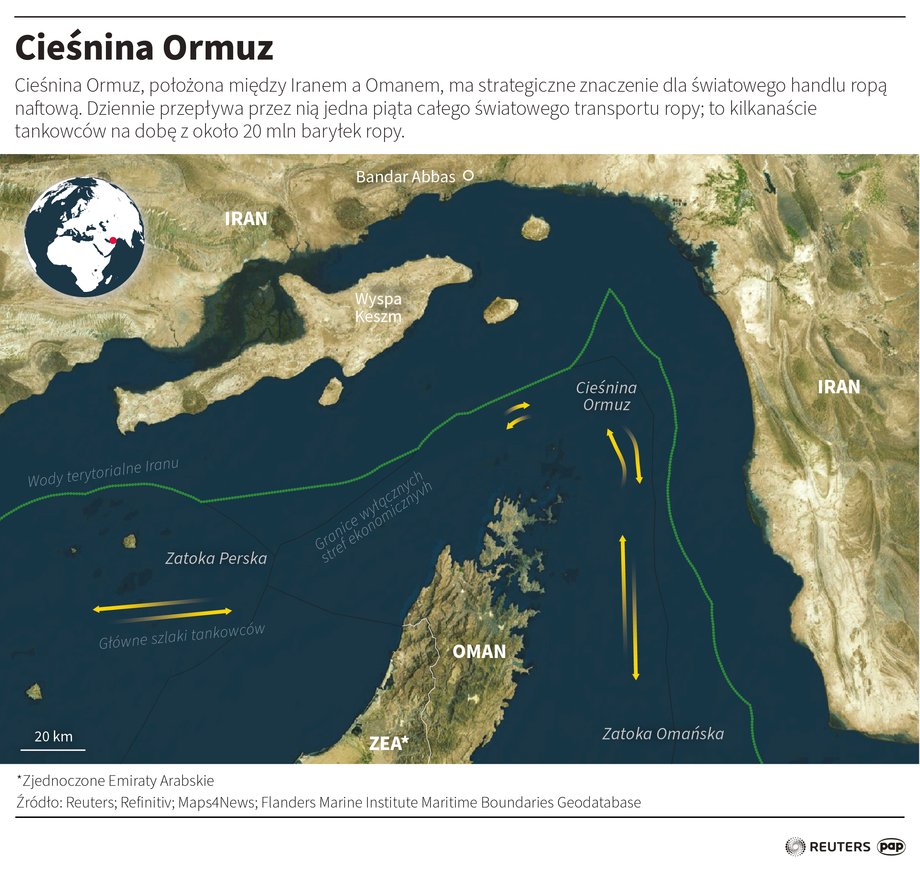
The Strait of Hormuz separates Iran and Oman, creating an “entrance” and “exit” to the Persian Gulf
|
Adam Ziemienowicz / PAP / photos
“This place itself is burdened with increased risk, even without warships and geopolitical tensions,” said Dariusz Jelonek, director of the Shipowner's Department of Maritime Practices at the Gdynia Maritime University and captain of high seas, who got to know the strait from the deck of a tanker. He admitted that there is a lot of cross traffic and the need to maneuver there.
According to Dariusz Jelonek, if the strait were closed, ships heading to the Persian Gulf would be directed to other ports in the world, which would mean that there would be no significant increase in traffic from the ocean. But In a short time, several hundred ships could be detained and “trapped” in the Persian Gulf.
Strait of Hormuz closed. What then?
Jan Masny, captain of large shipping, has experience in sailing through the strait on tankers with a displacement of 80,000 to 300,000. ton, also during the Iran-Iraq war, explained that traffic in the strait takes place in special separation zones. Ships entering the Persian Gulf use one two-nautical-mile-wide lane, while ships leaving use a second one, separated by a two-nautical-mile separation zone.
“Swimming there was very safe and there were no threats or dangers,” he emphasized. According to him, in the event of a blockade, ships could wait in anchorages.
He mentioned, among others, the world-famous Fujairah, located on the coast of the United Arab Emirates, with 174 sites, located before the entrance to the Persian Gulf, as well as Sirri Island on the other side of the strait.
These anchorages have previously been used during periods of geopolitical tension. Last June, after Iran announced retaliation for US airstrikes on nuclear facilities, two tankers – the Marie C and the Red Ruby – moored near Fujairah. According to Reuters, Japanese shipping companies Nippon Yusen and Mitsui OSK Lines then advised their ships to “limit to a minimum” the time spent in the Persian Gulf, even though Iran did not announce a complete closure of the Strait of Hormuz at the time.
Orlen calms down
Polski Orlen, meanwhile, said that it currently sees no threats to the continuity of crude oil supplies from the Middle East to the Group.
Orlen emphasized that it “continuously monitors the geopolitical situation in the Middle East and its potential consequences for global energy raw material markets.” “We currently do not identify any threats to the continuity of crude oil supplies to the Orlen Group” – the company said