— With these tariffs, we managed to reduce the trade deficit. We were losing trillions of dollars every year, argued Donald Trump in Davos.
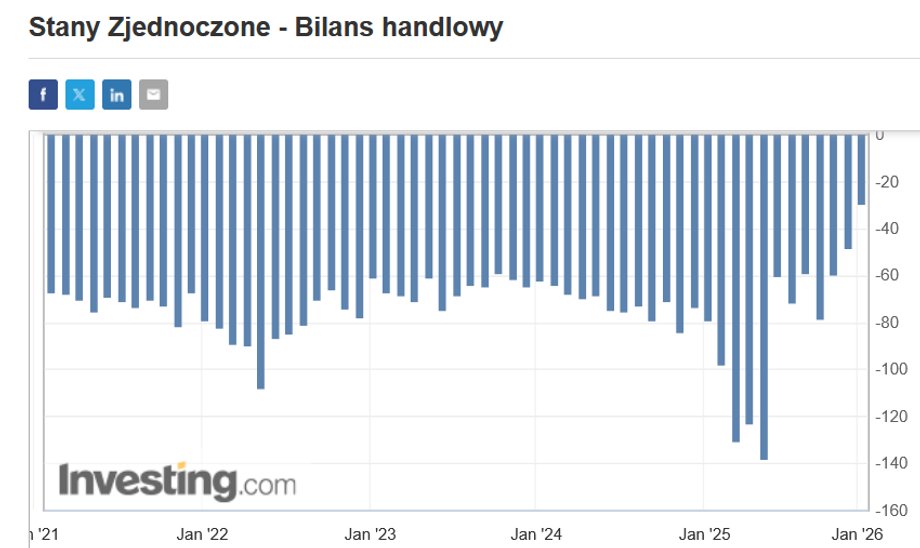
It is true that the US had a deep deficit in trade in goods, which was only partially offset by exports of services. However, the effects of customs policy became visible only in October last year, when the deficit dropped to USD 29 billion. However, in March, a record was broken and the minus amounted to as much as USD 138 billion. This means that more goods were imported to the United States than exported.
Importers made such large stocks that they lasted until September. In fact, it is now only the fourth month when imports have decreased significantly and exports have increased, and more and more goods on the American market come from domestic producers. It is not known whether the US Supreme Court will question the tariffs, and then… the money obtained from them will have to be returned to importers and the entire operation will mean a loss, not a profit, or equal opportunities in international trade for the world's largest economy.
US trade deficit
|
Investing.com
Inflation in the USA
Donald Trump also alleged that “America was being played” during Biden's presidency. He boasts that “inflation was defeated after only a year of his rule.”
“We did all this without inflation, which everyone said we couldn't do,” Trump went on to say.
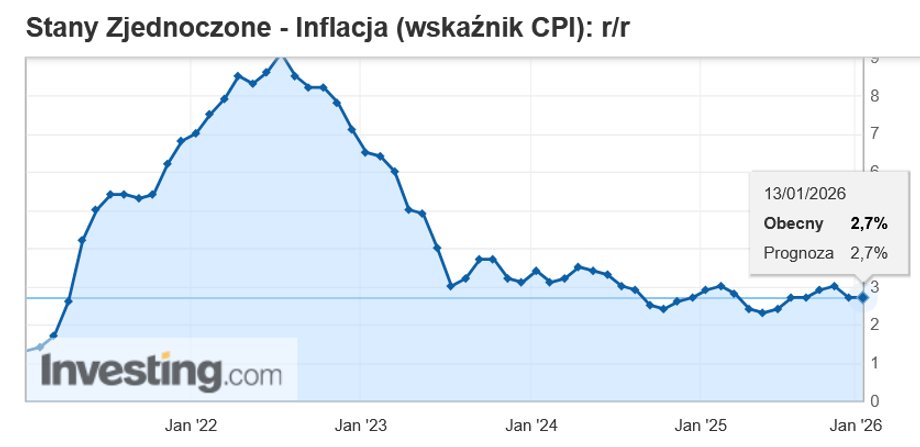
Here, of course, you need to translate from the language of the speech, the journalistic language, into the normal language. Inflation, of course, in the US is like in most countries of the world. In December it was 2.7 percent. year to year. The point of the US president is that he managed to bring it down to normal levels within the target of the central bank. It worked because the Fed's target is 2%. +/— 1 percentage point
Inflation in the USA
|
Investing.com
“The best developing country in the world”
– A year ago we were a dead country, now we are the best developing country in the world – argues Trump.
Of course, that's not true here either, unless “best” doesn't mean “fastest.” There are other countries that are developing faster. According to the IMF's January forecast the US economy grew last year by 2.1 percentso these are not insurmountable peaks. The global average growth is 3.3%, which is higher than the growth of the United States.
As many as 16 countries around the world grew faster, i.e. those covered by the IMF's forecasts. According to this forecast, the fastest growing countries included: India (+7.3% yoy), Kazakhstan (+6.2%), the Philippines (+5.1%), China (+5% yoy), Indonesia (+5%), Malaysia (+4.6%) and Argentina (+4.5%). Among the EU countries, Poland (+3.3%) and Spain (+2.9% y/y) grew faster than the USA.
100 percent on NATO?
The US president's speech also included information that the US paid 100% before his presidency. for NATO. And that's obviously not true either. Unless you want to round it up a lot.
The US covers only 14.9% of the civilian budget. from this year, and from March 2024 to December 2025 it was 15.9 percent.
However, the president probably meant spending on the armies of individual countries, which creates NATO's real strength. Thus, according to the latest available data from 2024, the USA spent USD 997 billion on the army, and all Alliance countries in total USD 1 trillion and 434 billion. – according to SIPRI data. In other words, USA accounted for almost 70 percent NATO's total defense budget. Much up to 100 percent. a lot is missing. Donald Trump's words show how much he feels that the entire Alliance “runs” on the strength of the United States.
In NATO, Germany was in second place in military spending in 2024 with USD 88.5 billion, Great Britain was third with USD 82 billion, and France was fourth with USD 64.7 billion.
The USA also spends the most per capita, i.e. PLN 2.9 thousand. hole. in 2024. The next places are: Norway ($1.9 thousand), Denmark ($1.7 thousand) and Luxembourg ($1.3 thousand). The following people spend more than a thousand dollars per capita: the Dutch, the British, the Germans and the Estonians (in no particular order).
NATO without the US is a much smaller military force, and it is the US army that constitutes the strength of the Alliance. Apart from the issues of modernity and expenses, the US army has 1.3 million soldiers, followed in NATO by: Turkey with about 400,000, Poland with 216,000, France with 200,000. and Germany with 186,000.