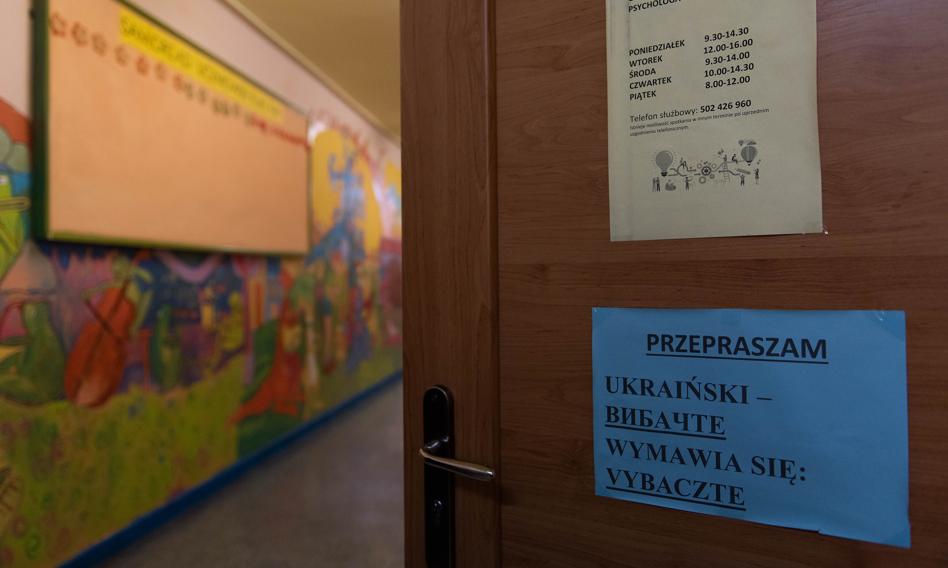
353 thousand attend Polish educational institutions. students-students, of which 237 thousand He studies in primary and secondary schools. Most of them, or over 202,000, come from Ukraine – according to the latest data analysis report of the Citizens' Education Center.
The introduction of a school obligation for Ukrainian children caused an increase in the number of students who encounter problems with integration in the Polish educational environment. According to experts, it is necessary to introduce, among others compulsory Polish language learning as the second and cooperation of schools.
In the light of the report, “Students-Middle Ages in Polish schools in the 2024/2025 school year, prepared by the Citizens' Education Center in cooperation with the International Rescue Committee Polska Foundation (IRC), 237,000 are studied in Polish schools for children and youth. people from other countries. Most of them are students from Ukraine – refugees (148.6 thousand) and migrants (54.1 thousand).
In all Polish educational institutions, including kindergartens, schools of all educational stages, post -secondary schools and adult departments, 353,000 are studied. students-students. Among them, 295.5 thousand They are people from Ukraine (84 percent), 31 thousand from Belarus (9 percent) and 4.2 thousand from Russia (1 percent). Other 22.3 thousand (6 percent) comes from other countries. From other European countries, most students came from Moldova (1113), Bulgaria (873) and Germany (694). From outside Europe, students from Vietnam (2243), India (2058) and Georgia (1322) dominate.
– The question of how students from different countries find themselves in the Polish education system, this is something that bothers us all. We talk about it and do research on this topic. Undoubtedly, we emphasize the words of the students themselves that this is the best place they stay, regardless of the fact that we as entities supporting the school, as well as the ministry, are dealing with various challenges and problems. Some things do not work – says Newseria agency Elżbieta Świdrowska, a researcher and expert of educational integration, author of the report.
The most important reason for concern is “falling out” from the education system of older students. The CEO and IRC report shows that many students do not continue their education to graduate, especially between the 3rd and 4th grade of high school and after the first grade of technical school and industry schools. Even 35 percent disappear from the system then year.
– Teenagers finish their adventure with the Polish education system before obtaining the final exams or before graduating. Perhaps it is a matter of leaving Poland, a matter of earning, and maybe they simply do not receive support at the school they need – says Jędrzej Witkowski, president of the Citizens' Education Center. – This is a challenge that we should face as soon as possible as a system of education, because school is the best place for young people to function and develop. As a society, we are guilty of young people to give them the best experience of the school as possible.
One of the challenges for the integration of students from Ukraine is the limited scope of use of Polish language lessons as the second language. In April 2025, 36 percent benefited from additional classes. all students-students, and this percentage among children-children from Ukraine amounted to 48 percent. This percentage is systematically decreasing – in April 2024 it was 59.2 percent, and in April 2023 – 67.2 percent.
– How much knowledge of the Polish language is enough to learn individual subjects – here is a question mark. Analysis of SIO data shows that fewer and fewer students learn Polish. The question is whether they have already reached a certain level, or because they are not lessons adequate to their level – notes Elżbieta Świdrowska.
– We pay attention to the fact that it would be an important step forward to make Polish lessons as the second compulsory classes. We know that the educational success of young people depends on the language proficiency in Polish, so we should want as a society that schools offer support, and we can expect young people to use this support – says Jędrzej Witkowski.
Students-students constitute 4.8 percent. all students and in Polish schools in dispersion – in 43 percent Their schools do not exceed 10 students.
– The challenge we face is that schools, teachers and directors who are already doing a huge job, respond to the needs of young people from Ukraine. We must be able to teach with the awareness that in our class there is one, two, several people who do not speak Polish as smoothly as others. We also need learning skills in a class in which the diversity of subject skills is greater, we need an idea for assessing, which he treats everyone fairly, but not necessarily evenly, because it is also needed in a class that is varied – says the president of CEO.
From September 1, 2024, children from Ukraine were covered by the obligation to pre -school, school obligation and the obligation to study (secondary schools) in the Polish education system. This caused an increase in the number of pupils-pupils from Ukraine, especially in older classes, although experts, due to the inconsistency of the analyzed SIO, ZUS, and PESEL data, are not able to clearly determine how effectively this obligation was introduced. The largest increase in April this year. was recorded in grades VII, which attended 14.7 percent. More children than in the same period last year.
– introducing a school obligation and linking it to the use of 800+ subsidies was a very good step. We noticed that students, especially teenagers, from Ukraine joined the Polish education system. So there was a group that developed outside the school system – about 18 thousand. students have joined the education system and function. We do not see that this flow of new students causes some additional challenges – emphasizes Elżbieta Świdrowska.
According to the CEO and IRC report, there are 21 thousand in Poland. schools, and in 67 percent of them are present students (in Gdańsk, Zielona Góra and Wrocław, this percentage reaches 95-96 percent). In total, over 4 million Polish children study in schools, which are attended by students of other nationalities. Therefore, most Polish students have a variety of diversity in everyday science. About every third student spends at least a few hours a day with children from Ukraine.
– This is everyday life in which we have to develop a new way of communication, a new way of dialogue, learning and being together. The school is this place – says an expert in educational integration.
– If someone lives for a year or two in a smaller city or in the countryside, they integrate with a peer group – says Anita Rucioch -Gołek, a teacher, an educator from the Primary School A. Fiedler in Zbąszyń. – In small centers and schools we notice that Ukrainian children in elementary school are liked. They have Polish friends, friends, there is no hate because someone is a Ukrainian. On the other hand, we notice that most often these children do not integrate, they have their friends and colleagues.
In this context, the functioning of the so -called foreign departments, i.e. classes in which only students from Ukraine learn. There is no available research on this subject, but this may affect the level of their integration with Polish colleagues and marginalization of classes by teachers. There are about 500 such departments in Polish schools.
– There is definitely a problem with the fact that the house is sometimes poor support. They are often lonely mothers who work a lot because they have to support themselves and children.
A barrier to communication also on the parent – teacher can be knowledge of the language.
– It's hard to talk to my mother when I can't talk about delicate, sensitive things about the child and I can't call it. Here it would be useful to support – adds Anita Rucioch -Gołek.
The recommendations of the Citizens' Education Center include the support of educational integration, which should serve all students and students in Polish schools. Its course is to affect the educational results and the well -being of members of all school communities. This, however, requires priority treatment in the state's educational policy. Experts also recommend a comparison of data collected in various bases, e.g. SIO, PESEL and ZUS, and deepening the analysis of the situation of older students.
– It is important to cooperate and learn schools from each other. Over the past three years, when there are more Ukrainian students in Polish schools, schools have developed good practices in this area, how to assess how to teach how to integrate. Sometimes, however, we have the impression that this exchange of experience and mutual support is a bit lacking, especially now, when in many institutions these practices are at a very high level – believes Jędrzej Witkowski.
Support for schools is to be the government program “Friendly school” scheduled for 2025-2027.