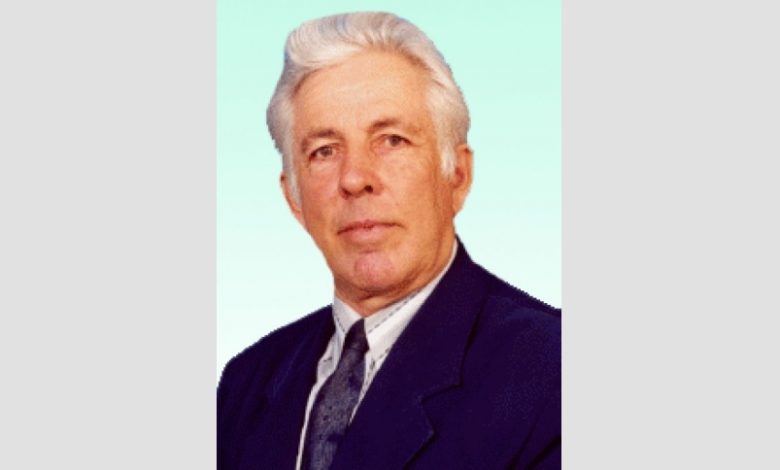
Pishchura Boris Alexandrovich
Photo: Heritage of EAO
April 23, 1937
On this day, Boris Alexandrovich, an honorary citizen of the EAO, was born in a peasant family of the village of Otokarevsky district of the Tambov region.

In 1945, he, an 8-year-old boy, brought food to the farm, from 13 years old he worked on haying with adults. After the end of the seven classes, he joined the collective farm team, which conducted repair and construction in the village. Then he studied for two years at the turner.
After graduation, he entered the Voronezh Engineering Institute. At the end of the institute, he was sent by distribution to the Far East. From 1962 to 1998 he worked in the Birobidzhanagropromstroy system. He went from a master-builder to the general director.
Under the leadership of Boris Aleksandrovich and with his personal participation, rural objects of the social and cultural sphere were built, the production base of the agro -industrial complex in most regions of the region was created and strengthened, livestock farms, potatoes and grain cleaning complexes, schools, kindergartens, cultural houses and residential buildings, and professional houses were erected. Leninsky.
Boris Alexandrovich has always enjoyed a well -deserved authority among workers in construction enterprises and residents of the region, he was repeatedly elected People's Deputy and a member of the Executive Committee of the Birobidzhan District Council.
In 1997, by the Decree of the Legislative Assembly of the Jewish Autonomous Region, he was awarded the title of “Honorary Citizen of the EAO”.
Until 2005, he worked as the chief specialist of the Birobidzhan City Court in the Technology Court for construction.
B.A. Pishchura was awarded the Order of the Badge of Honor, the Medal “Veteran of Labor”, the sign “Excellent border guard” – for assistance in organizing and participating in the detention of saboteur.
On April 9, 2019, Boris Alexandrovich passed away.

Memorial board to Boris Pishchur. Photo: Photo: Archive of IA EAMEDIA
On the house st. Parkovaya 14, where Boris Aleksandrovich Pishchur lived, on March 4, 2020, a commemorative board was installed.
April 23, 1938

Cutting from the newspaper “Birobidzhan Star”. Photo: Photo: Regional Library
The newspaper “Birobidzhan Star” (12+) under the heading “To help agitators and propagandists” published the continuation of the article “Ten Birobidzhan”, this issue describes the development of agriculture in the Jewish Autonomous Region from 1928 to 1938. What was and how agriculture developed with the arrival of the first immigrants here, how much labor was invested in the first 10 years of development of this territory.
Socialist agriculture of the Jewish Autonomous Region
“… Agriculture and today remains the most important sector of the region’s economy. The party and the government in its multiple instructions and directives on the socialist construction of the region constantly emphasized the necessity and importance of creating in the field of their food base.”
On the fields of the region 10 years ago
“When the first immigrants arrived in the Birobidzhan district, agriculture was concentrated here mainly in the Amur Cossack villages. The sown area was 15.9 thousand hectares, of which only 188 hectares of collective farm sowing were carried out. Agriculture was carried out in the most primitive and predatory way, without an insignificant number of vehicles. The same primitive nature. There was livestock.

The collective farmers (from left to right) Sholem Rosenblit, his wife Esther and Moishe Dunaevsky receive bread on an advance on time. Photographer X. Greenberg. 1936. Photo: Heritage of EAO

Stakhanov El Eigel (migrant 1930). The collective farm Valdheim. Photo: Heritage of EAO
Migrant collective farms
“Agricultural relocation to the Jewish Autonomous Region from the very beginning went along the collective farm path …”.
State allocations for collective farm relocation and the construction of resettlement collective farms grew from year to year. Significant funds were allocated for housing construction and the mainstream of collective farmers – immigrants, for Korchevka and reclamation, etc. From year to year, technical armed for agriculture grew in the region. Now we have 17 Jewish migrant state farms, numbering 516 collective farm families by January 1, 1938. The sowing area of resettlement collective farms amounted to 7147 hectares in 1937. “
For 10 years of socialist labor
“In 1937, the actual sowing area in the region reached 36.776 hectares, that is, over 10 years of Jewish relocation to the area of the sowing area, more than doubled.
The number of collectivized courtyards, which reached 1.8 % of the total number of farms in 1928, reached 78 % in 1934 and in 1937 95 %.
A large grain-hazard in Stalinsk also works in the region (Stalinfeld in the 1950s ceased to exist-auth.), Created mainly on the newly developed lands.
The collective farms planted 97.8% of the total sown area in 1937, the collective farmers in their personal farms – 2% and only 0.1% of the sowing area belonged to solers.
Significantly grew crops of technical cultures of soy, potatoes and vegetables. SOI sowing in 1928 199 hectares, and in 1937 – 4925 hectares – an increase of 2480 %. “
The socialist agriculture of our region is equipped with rich equipment that grows from year to year. In 1934 there were three MTS, serving 30 collective farms, now there are eight MTS serving 53 collective farms.
In 1934, eight tractors of the Chelyabinsk Tractor Plant (ChTZ) and 53 tractors of the Stalinist Tractor Plant (STZ) worked on the socialist fields of the region. In 1937, 106 ChTZ and 111 stz worked. On the collective farms served by MTS, the harvesting of combines amounted to 66 % of grain crops in 1937, and in the grain -zoom – 97 %.
A predatory, primitive way of cultivating the Earth has long been a thing of the past. A pair of chillers, ovarization, varietal sowing, fertilizer of fields – all this deeply introduced into the agriculture of the region. If in 1932 a total of 689 hectares of steam were plowed, then in 1937 11660 hectares were plowed; Zyabi was raised in 1932 5606 hectares, and in 1937 22,475 hectares. In 1937, for the first time, 590 hectares were sown with ovalized seeds and 3.609 varietal crops. “

Shepherd Caminer with a collective farm herd of cows. The collective farm “Rooter October”. Photographer V. Girshovich. 1937. Photo: Heritage of EAO

Commune “Corgoches” (Youth). Communists with their horses. 1930. Photo: Heritage of EAO
Socialist livestock
“Starting since 1934, the number of cattle almost doubled in the region, the number of pigs almost tripled, the number of goats increased almost five times. The growth of livestock is generally accompanied by the rapid growth of socialized livestock – the number of collective farms and the number of cattle in them is growing.”
Birobidzhan honey

Collective farm apiary in with. Birofeld. 1937 Photo: Heritage of EAO

Valdheim's apiary of the collective farm 1938. Photo: Gosarchive EAO
“The forests and meadows of our region are rich in plants, which are an excellent base for the development of such revenue as beekeeping. Already in 1930 there were 8538 beeings in the region, including in collective farms 6512. And in 1936 we already had a beekeeper in the field of 19395, including 12111 on the collective farms. The prospects for beekeeping in the field are huge …”.
April 23, 1985
By the decision of the Birobidzhan City Executive Committee No. 199, in the marks of the 40th anniversary of the victory of the Soviet people in the Great Patriotic War, West Street was renamed the street 40 years of Victory.
April 23, 1999
The Central Children's Library moved to a new premises at 34 Sholom Aleicham and the center of the children's and youthful books (CDUK) became called. The history of the children's library began in 1949. In September 1966, the children's library allocated a premises at the Palace of Culture. And now, after 50 years, the children's library moved to its, separate premises from other institutions, where it is located to this day.
In 2020, the Center for the Children's and Youth Book became the second model library in the EAO.
The library is a leisure center, a center for the development of intellectual and creative abilities of children and youth. The center is a lot of work to promote literature among all age groups of users. A variety of mass events take place here, which contribute to the development of artistic and aesthetic taste, creative abilities, respect for the historical past of our Motherland, and form an environmental culture.