“Vanity” on the spit: what happened
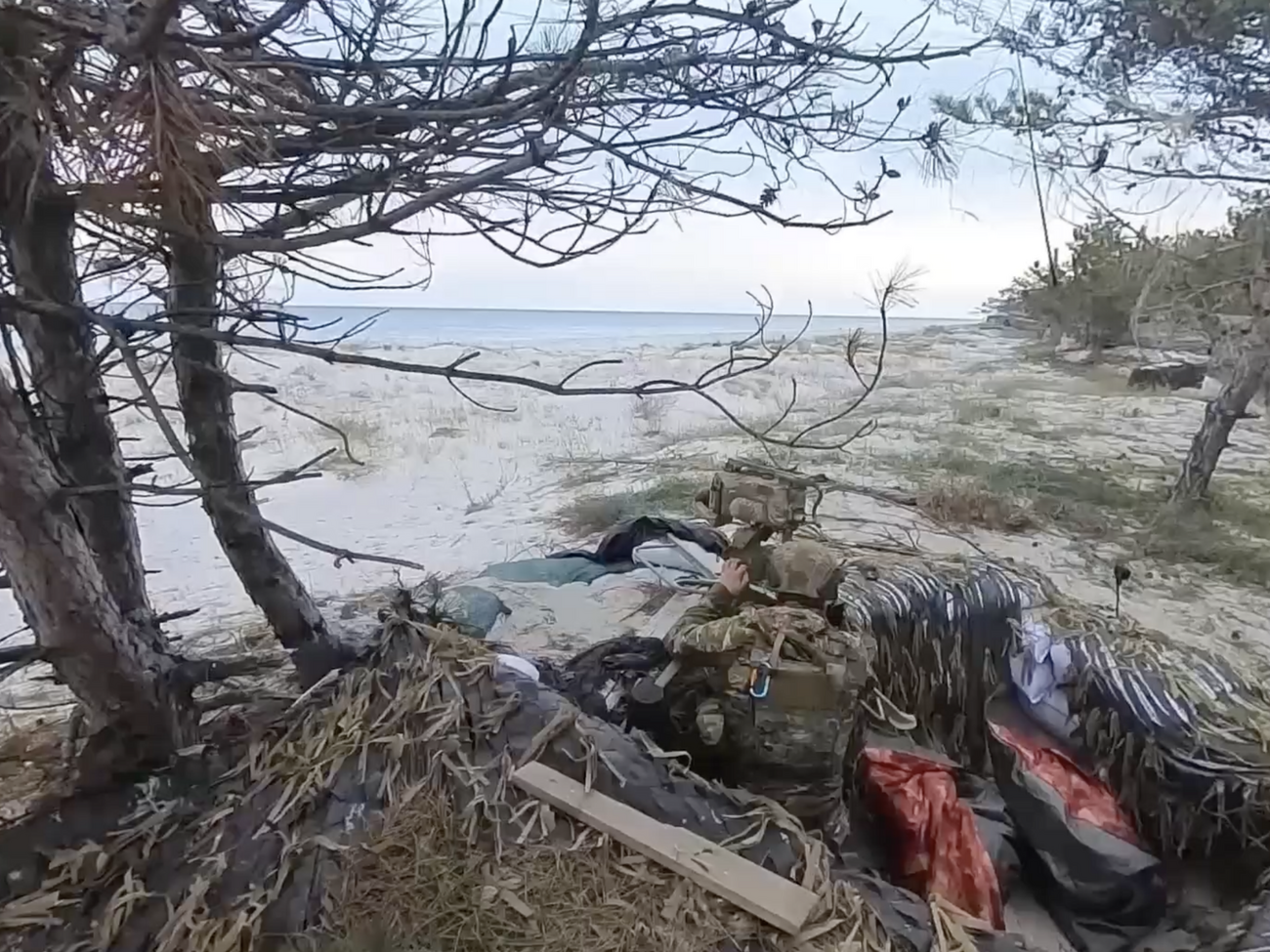
On June 8, the Atesh partisan movement reported, citing its own agent at the headquarters of the Russian military grouping “Dnepr”, that the occupation forces were leaving the Kinburn Spit – the only territory of the Nikolaev region that remained occupied after the fall of 2022.
Read also
Agents reported that units of the 337th regiment were being withdrawn from the coastline from the northern and western parts of the spit, the reason was significant losses, as well as a completely stopped supply; they allegedly found themselves without ammunition, fuel and food. Following Atesh, the American Institute for the Study of War (ISW) wrote about the likely retreat of the Russians. The report cited data from the partisan movement.
This information was not confirmed, the representative of the southern defense forces, Vladislav Voloshin, told Interfax-Ukraine and DW the next day. According to him, Ukrainian intelligence data indicate that a regrouping and rotation of units of the occupation army is now taking place on the spit: units of the 137th Airborne Regiment of the 106th Parachute Division are replacing the 74th Separate Motorized Rifle Regiment of the 58th Army.
The defense forces, Voloshin added, are trying to cut off the logistics routes to the spit and keep them under attack. As the speaker explained, there are two roads leading to the Kinburn Spit: an asphalt road (in the north of the spit) and a dirt road, which cannot be used in bad weather. “We're trying to constantly hit the paved road, keep it under control, try to cut it,” he said. According to Voloshin, the invaders are rotating in the north and east (and not in the west, as the Atesh agent reported), redeploying their units to more protected positions in the interior of the peninsula, away from the coast of the Dnieper estuary.
“The situation on this spit itself is not very happy for the enemy, but he is not going to leave there voluntarily,” the speaker stated, promising that the defense forces will make efforts to oust the invaders from there.
The press secretary of the Ukrainian Volunteer Army and the commander of its Odesshchyna unit, Sergei Bratchuk, said on Channel 5 that his unit participated in the Kinburn Operation. According to him, there are places on the Kinburn Spit where the invaders are “well buried in the ground,” but the defense forces are reaching them.
“There are certain rotational events taking place there. So far, we cannot state that the enemy has definitely left or is going to leave. They are trying to sit in those holes. Logistics [оккупантов] very difficult. Accordingly, our strikes are constantly being delivered there, but for now… Well, it will probably still take some time. Yes, it’s hard to get out of there, but the defense forces have enough patience,” he noted.
Military officer and blogger Kirill Sazonov said that the Ukrainian military cut off supplies to the occupiers with drone strikes, and the 337th regiment, which was being withdrawn from the spit, was “knocked down.” “They took everything they could from it and threw it to Zaporozhye. And, of course, few people returned, and they themselves hold positions on the spit. Drones periodically fly in, they write that there are not enough personnel. The management is trying to pretend that there are more of them than there are, constantly transferring from one position to another, but this fuss is unlikely to deceive anyone. But without ammunition, without food, without water, there is no point in holding positions there, there is no possibility. And, of course, they leave them. Well, what should they expect? This is a trend,” he said on June 10.
How the scythe becomes a burden for the occupiers
The Kinburn Spit is a strip of land located near Ochakov. It is a continuation of the Kinburn Peninsula and partially separates the Black Sea from the Dnieper-Bug estuary. Its length is approximately 100 km, width – 4 km; before the full-scale war this place was called the Ukrainian Maldives. After the occupiers blew up the Kakhovskaya hydroelectric power station in 2023, the road near the village of Gvardeyskoye was flooded, and the spit was cut off from the mainland.
The gradual movement of the Russian army from the Kinburn Spit is a direct consequence of Ukraine’s asymmetric strategy, when the logistics routes of the Russians in the south are methodically destroyed – fuel tankers, railway routes, fuel depots, says veteran of the Russian-Ukrainian war, reserve major of the Armed Forces of Ukraine Alexey Getman.
“When a unit is left without support, it is forced to retreat to where supplies can still be brought in. Even if there are no combat operations, fuel is constantly consumed. The vehicle needs to be warmed up every day, for at least half an hour. Whether it drives or not, it must be ready to start. The same goes for armored personnel carriers. And drone operators work from generators, so there is simply nothing to connect to,” he explained, emphasizing that because of this, the spit, which is strategically important for shelling of Nikolaev and highways to Kherson, is gradually turning into a burden for the occupiers themselves.
Each weakening of the presence of the invaders on the spit seriously relieves the defense forces, potentially opens up shipping to Nikolaev and weakens the enemy’s rear in the Kherson region, added the head of the Ukrainian Center for Security and Cooperation, Sergei Kuzan. He explained that the spit is actually a dead-end ledge with extremely limited supply routes, and any violation of logistics here immediately affects the combat effectiveness of the units stationed there, which is confirmed by data on fuel delays and limits on shells.
“It’s simply impossible to keep anything there or bring it under the fire control of the Ukrainian defense forces unnoticed. Now either they completely leave there, or they need significant reinforcement – serious replenishment of units in order to continue to hold positions and be stable under our potential strikes at medium depth,” he added.
What does its liberation mean for Ukraine?
Although this strip of territory remains under the control of the occupiers, Western media are already analyzing how Ukraine will benefit from its liberation. France24 points out that at the beginning of a full-scale war, the capture of the Kinburn Spit was called one of the largest successes of the invaders in the south. Due to the fact that the Russians still control it, the sea corridor cannot be extended to the port of Nikolaev, for the same reason this port was not included in the “grain corridor”, which was launched under the coordination of the UN. But this is economics. There is also a safety factor. Kosa is a springboard that the invaders could use to attack the mainland of Ukraine and try to capture Odessa.
The spit is so important that last year Kyiv asked the United States to include it in any version of the peace plan that Washington could present to Russia, media write. Having captured the spit, Russia gained the opportunity to control the Dnieper-Bug estuary and the approaches to Kherson, say experts interviewed by the channel. And although its strategic importance has declined over the years of the war, if Ukraine manages to free the spit, this will be an important victory and a significant strengthening of the safety of navigation in the Black Sea.
The most important will probably be the symbolic meaning – Ukraine will finally be able to announce the complete de-occupation of the Nikolaev region, media write. As long as the left bank of the Dnieper is occupied, the liberation of the spit will have no practical significance, says Frank Ledge, a military intelligence officer and professor of military strategy and law at the University of Portsmouth in the United States. Ukraine will be able to show “what it wants others to see.”
It would also demonstrate the defense force's growing ability to launch medium-range strikes and force the enemy to retreat on its own by cutting vital supply lines “without a direct attack,” said Norwegian military expert Thor Bukkvoll. This is also evidence of how vulnerable supply lines have become in the drone war, the media writes. According to Bukkvall, the Russian command could come to the conclusion that protecting these lines on the spit is more expensive than simply leaving it.
If so, one question remains: will Ukrainian troops occupy the liberated spit, because then they will become a target for drones, or will it remain “no man’s land.” It is known for sure that if Ukraine decides to conduct a ground operation, it will first need to clear the spit and ensure reliable air defense.