How do we protect our children: helps alerts on parents groups or more creates panic? What a forensic psychologist says

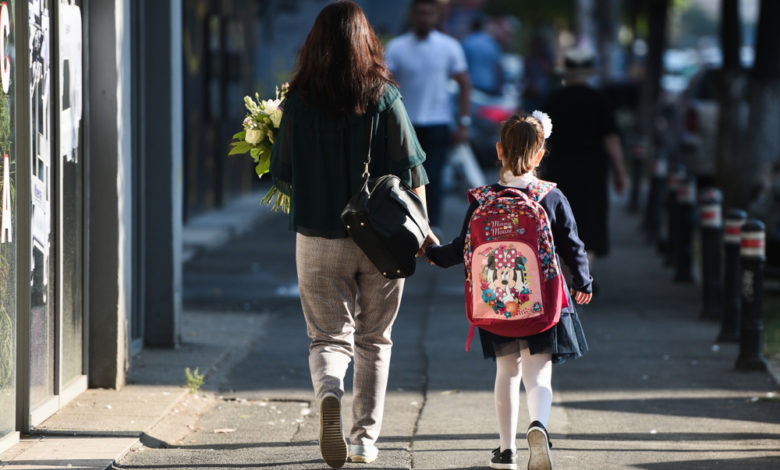
A man with suspicious behavior near some educational units in Sector 5 triggered a strong reaction and a wave of messages that have been circulating massively on the parents groups. The mobilization surprised the community and the authorities, and Hotnews asked two psychotherapists, one of them specialized in forensics, how the parents and representatives of the schools in such situations should answer.
A terrifying message circulated, two weeks ago, on the groups of parents from several educational institutions in Rahova. People were warned of a suspicious man who follows children and has a history of sexual aggression.
The police were notified, identified the individual and established that he does not have such facts, but is rather a psychiatric patient. However, several parents told groups that they had violent interactions with the man.
“It was a scare”
“It was quite unpleasant, the parents agitated a lot, because it is not okay to be such an element in the proximity of the school. It was a discomfort. We were interested in seeing if it was real, because it could have been an invention. We warned the parents through the representatives and, in a short time, I received the information. School no. 280 of sector 5.
The teacher says that the school has not faced such situations, but advises parents to talk to children about how they react when they interact with strangers.
“We have a panic button”
Roxana Haiden, Director of kindergarten no. 178, in the area, said that the parents reported his situation, but the person was not seen in the vicinity of her educational unit.
“The parents received, I do not know where, and we received a signal. We did not see the man. We only saw the messages, and then that the police have caught. We told the parents that our guard is vigilant, and the gates are permanently closed. kindergarten.
Criminal psychologist: “It is the kind of reaction we want in a responsible society.”
Gabriela Groza, a forensic psychologist, considers the reaction of the adequate parents, but emphasizes that the authorities must maintain the balance between vigilance and rationality. “It is very good that the parents reported a behavior that seemed suspicious. It is the kind of reaction we want in a responsible society.”
However, says the specialist, not every “weird” behavior is the proof of a dangerous intention.
“A person with a psychotic disorder or maniacal symptoms can attract attention, without being a paraffin.
How does the status of social alert appear
“There are people with paranoid predispositions, who imagine their suspicious scenarios and quickly form beliefs about the danger that others represent. When it comes to children, the mind runs quickly to extremes, especially in relation to sexual abuse. Thus, a state of social alert appears,” explains Gabriela Groza.
She stresses that the authorities must take into account both the possibility of a justified notification and that of a false alarms: “Monitor the person, verify her antecedents, legitimize and evaluate the behavior. If there are suspicions, a psychiatric evaluation may be ordered. If not, no intervention is required.”
“If adults react with anxiety or panic, children will learn that the world is insecure.”
On the other hand, psychotherapist Andreea Chiru-Maga points out that parents' fear directly influences the perception of children on the world: “Children learn how to perceive the world looking at parents, and their reaction can convey the idea that the world is not a safe place.”

“Fear is normal. It is a healthy emotion that has the role of protecting us. But when it becomes collective and gets out of control, it turns into anxiety and panic. If adults react with anxiety or panic, children will learn that the world is uncertain, even if they do not notice any danger to their own eyes.”
The psychotherapist adds that collective reactions of this kind reflect a deeper fear, which does not always have to do with a real danger: “At the collective level, such reactions tell us something important: that there are in us, as a society, a latent fear. Deeply hidden. Fear that the world is dangerous, that we are not protected, that the authorities are not enough.”
“When it explodes fear, it is not only because of a concrete danger, but also as a manifestation of a loss of control over the safety of their own children. The collective reaction thus becomes a mirror-it shows us what we feel as a group, what it hurts,” says Andreea Chiru-Maga.
Parents have a double role
A major challenge for parents, says the psychotherapist, is to handle the child's care and his own emotions simultaneously. “Often, discussions about danger focuses on what is outside the family. But the danger can also come from inside the house: an abusive adult, a relative, a neighbor, a power relationship that scares the child. Therefore, the relationships between adults matter as much as the external borders.”
Chiru-Maga emphasizes that a collaboration relationship between adults, based on open communication is essential. “Where there is fear, rigid authority or silence, the child will hesitate to say what he lives, even if he is in real danger.”
How do we talk about safety with children
The psychotherapist offers some concrete recommendations for parents:
- To create a “simple safety plan”, which includes who the child is allowed to leave, what he does if he wanders and how he asks for help.
- The child must memorize the phone numbers, address and names of parents.
- To know that no one is allowed to touch him without his consent and that he can say “no”, even to an adult.
- Be encouraged to talk about what was happening to him and how he felt during the day.
- To learn to distinguish between a “good secret” and a “bad secret”.
- To use role -playing games or stories to practice appropriate reactions in uncomfortable situations.
- To listen to their intuition and ask for help when he feels something is wrong.