Oil slick seen from satellite off the coast of Kharg Island in Iran. The blockade imposed by Trump would lead to oil spills in the Gulf of Pears

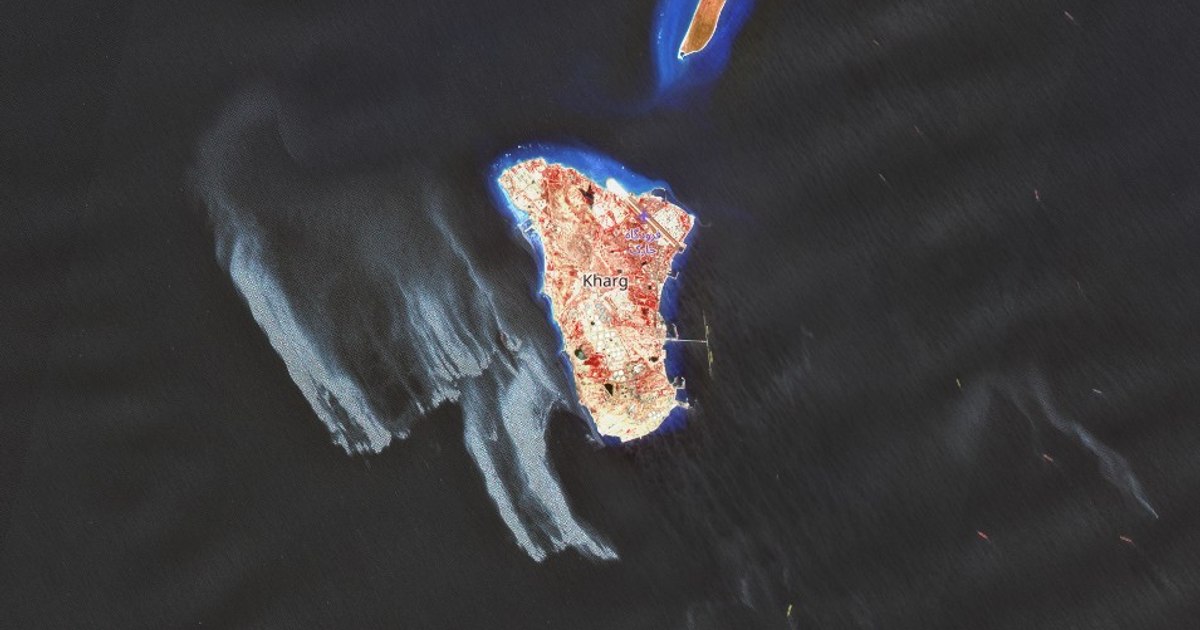
An oil slick has been detected in the Gulf, off the coast of Iran's Kharg Island, the country's main oil terminal.
Oil slick seen from satellite PHOTO: X
Satellite images have revealed a large oil slick suspected to have spread near Kharg Island, Iran's main oil export terminal, which experts say could be evidence that Tehran's oil infrastructure is caving in under increasing pressure from the US, writes Fox News.
The oil slick, seen in images from the Copernicus Sentinel satellite, covered about 45 square kilometers west of the island, according to analysts cited by Reuters.
The incident looms as a potential sign that Trump's maritime pressure campaign is achieving one of its central goals: overwhelming Iran's export system to the point where Tehran can no longer transport or store crude oil fast enough to sustain normal production.
The suspected leak near Iran's main oil hub raises concerns that mounting US pressure is overwhelming Tehran's ability to store or export crude, potentially forcing risky trade-offs with environmental consequences in the Persian Gulf.
“At this point, I see two plausible explanations, which are not mutually exclusiveMiad Maleki, an Iran sanctions and energy expert at the Foundation for Defense of Democracies, told Fox News Digital.
“One is operational: they simply didn't reduce production fast enough relative to their actual onshore capacity, and they were betting too much on empty tankers getting through the blockade,” he said.
“Now they have effectively delivered an excessive volume of crude into the export system, having more oil at or near the terminals than they can actually load, and the 'solution' is to dump some of that excess into the water.”
Maleki said another possible explanation is a mechanical failure related to Iran's use of the aging tanks as floating depots or sanctions-violating carriers.
“They have re-commissioned old and marginal ships, using them as floating warehouses or as transport vessels designed to evade sanctions, and some of these decommissioned or poorly maintained ships are now leaking,” he said.
“Project Freedom” failed: 1,600 ships are stuck in the Persian Gulf
“Either way, the common denominator is the same — storage and withdrawal capacity is out of sync with upstream production, and the Gulf is paying the price for this mismatch.”
The incident comes as the Trump administration continues to exert pressure through its campaign “Economic Fury” against Iran, combining the imposition of sanctions with a growing US naval presence around the Strait of Hormuz aimed at restricting Iran's oil exports.
Before the conflict, Iran exported about 1.5 million barrels of oil a day, much of it to China. Analysts say the blockade and the threat of sanctions on shipping companies and financial institutions have made it increasingly difficult for Tehran to transport crude from Kharg Island.
Reuters reported that the oil slick appeared as a “grey and white” cloud west of the 8 kilometer long island.
Leon Moreland, a researcher at the Conflict and Environment Observatory, told Reuters the stain was “visibly similar to oil”while Louis Goddard, co-founder of consulting firm Data Desk, said it could be the biggest oil spill since the start of the US-Israel war against Iran some 70 days ago.
Kharg Island handles about 90 percent of Iran's oil exports and has become a flashpoint in the Trump administration's efforts to cut off the regime's main source of income during the ongoing war.
Energy analysts say Iran now faces a dangerous dilemma. If Iran cannot export oil or find additional storage capacity, it could be forced to either shut in wells, risking long-term damage to oil fields, or dispose of surplus crude in ways that could cause negative environmental consequences throughout the Persian Gulf.
“They have already reduced production. In a real scenario of a blockade, the problem is not production at the wellhead, but the inability to load tankers at the export terminals,” Maleki stated.
“Once onshore storage capacity approaches its maximum limit, production must be reduced to accommodate the available space, or the wells will be shut down”he added. “In the case of Iran, this period is approximately 13 days.”
The environmental implications are also raising alarm bells across the Gulf region.
Windward, a maritime risk intelligence firm, estimated the oil slick was moving southeast at about 2 kilometers per hour and warned it could reach Qatar's exclusive economic zone within days and drift toward the United Arab Emirates within two weeks.
The Gulf's desalination infrastructure, upon which millions of people across the region depend, remains particularly vulnerable to major oil contamination events.
The oil spill also comes amid heightened military tensions in the Gulf. The war has grounded hundreds of ships in the region and caused one of the biggest disruptions to global crude oil and liquefied natural gas supplies in years.