Three minutes walk from the famous monument to PSA Hachikō and Shibuya Station is the Ichiran restaurant, specializing in Ramena. I recognized the premises after the red sign. I went down with narrow stairs to the underground of the office building. The restaurant operates around the clock, but the queue is set up at peak hours. Before me stood a boy watching movies about fish dancing Breakdance, and behind me girls dressed as strawberries. I waited less than an hour. After entering, I bought a ticket in the machine, filled the preference form: broth intensity, pasta hardness, level of focus, amount of fat. The monitor with the map showed me boxing.
Ichran sits in solo – in cabins, where as in the classroom it is not appropriate to look into the neighbors. The partition on the left. A partition on the right. Straight – a blind. I pressed the readiness button. The roller blind rose for a moment, someone gave me a bowl of ramen tonkot and immediately left the bamboo curtain. The whole order took place without direct contact with other people. If necessary, I could reach for wooden plates hanging in the corner of the box. One asks for silence, the other about more pasta, and the third let you know that you will disappear and the place will be free. I didn't see the face of anyone from the service. I didn't say a single word. I ate in silence and also disappeared – behind the steaming soup.
In Japan, lonely food is not a margin, but an important branch of the gastronomic market. Designers come up with separate furniture for her, chefs separate pace, and marketers separate slogans. You don't need to reserve. You don't need friends. Just have an appetite. Then the dinner in the solo version is not a problem to solve, and becomes an option in the menu.
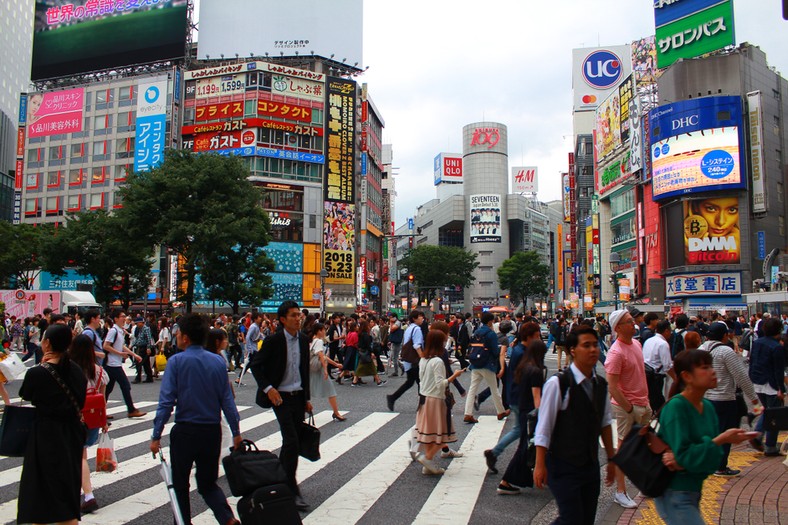
I went out to the streets of Tokyo, straight to Shibuya Crossing – the most famous intersection of the world. Green light. Several thousand people move at the same time – from each side and from every angle. I joined the wave that spilled in all directions. And I disappeared among many people as I had previously disappeared behind the ramen bowl. The disappearance even has the name: jouhatsu – “Evaporation” and is a social phenomenon with its own history, but without a specific statistics. In Japan you can disappear without a trace, or rather evaporate like water. People jouhatsu They leave their homes, families and careers. Sometimes they use the help of companies that offer “quiet removal” and even help in breaking with the current identity. Clients yonige-ya – escape companies – there are both people experiencing domestic violence and those who do not want to explain to their family because of losing their jobs.
In a culture where facial behavior and social peace are the highest value, jouhatsu It can be a form of silent escape – from financial problems, burnout, shame, violence or pressure. There is a lack of accurate data, because “evaporated”, as a rule, leave no traces and share statistics with other missing. But disappearance is not always dramatic. Sometimes it is enough to start with others at the intersection and become unnoticed.
Masaphoto / Shutterstock
Tokyo, Japan
In the light and in the mirror
In Japan you can disappear differently. Not in the crowd or restaurant, but in a space that physically blur the boundaries between the body and light.
Teamlab Planet is a digital art museum in which visitors become part of interactive installations. Art reacts to the presence and movements of people – provoking the question: where does the body end and the projection begins?
When entering, I took off my shoes, went through cool water and drifted among black mirrors, light corridors, orchid fragrances and sounds more like impulses than music. The space around it changed or dissolved. Sometimes I only saw myself not to see it in a moment. In one of the rooms, the flowers danced on the walls, reacting to my movement. In another I bounced off the huge, luminous balls that marked my way. In the mirror space you could disappear physically – but also symbolically. Even standing in the center, I was invisible. The light moved over my skin and was just a light. I – only the body. And yet together we created a picture. And it was a form of harmony. One that does not need the center
In excess
Don Quijote – A shop where time is lost and common sense disappears. This is the most characteristic of Japanese chain stores – giant, multi -story stores can be found in almost every, larger district of Tokyo, Osaki or Kyoto. It is often open around the clock, illuminated like a lunapark, with a neon logo and a penguin-mascot, which encourages to enter. Seemingly it is an ordinary store in cheap products, but in practice – a separate universe. I left it once at 3:00 in the morning and I don't know if jet lag is a form of justification.
Donki [w skrócie]it is a maze that begins with cosmetics (Korean brands can be half as much as in Poland), then it surprises with sweets, Japanese snacks and electronics. In the endless alleys, the shelves are packed tightly with cartoons, souvenirs, socks with a separate place for a large finger, matcha, dryers, wigs, masks, cat ears and rolex in display cases. All with background music and shouting advertisements from the speakers. Everything happens there at the same time, and the melody and the atmosphere are bothering in the head long after leaving. You can enter your nose handkerchiefs and go out three hours later with a suitcase full of unnecessary, absolutely fascinating objects. I left with a hat for drying hair (one with ears) and with a seal -shaped bottle – as befits a person who was supposed to look “only for a moment”.
In Donki, time is blurred, so there are also those who do not leave at all. At night, crowds are wandering between the shelves with such focus, as if there – between the lip gloss and the karaoke set – you could find saving or disappear in excess, in a flash and in saturation.
In the monastery
Kōyasan is the Wakayama prefectures hidden in the mountains, a small town and a monastery complex, to which a journey from Osaka takes about two hours. The tracks narrow, the train slows down, and a denser forest is climbing up the windows. The last episode is covered by a cable car, which is passengers to a height of about 800 meters above Shingon – With dozens of temples, gardens and monasteries, many of whom accept guests at night.
My bus stopped near the gate of the monastery where I was to sleep. I went uphill. The building was growing in front of me – dark, spreading, without a clear entrance. As if he was not quite intended for someone from the outside. Stone courtyard, low fence, and in the middle a tree – naked, with moss on the bark, looked like everything was survived. There were nowhere people. There was silence – one that no one has to watch. After a while, a monk came out of one of the side paths and without a word he pointed to the slippers lying on the threshold. I went inside behind him and no one expected that I would say anything.
The corridor was long, with a wooden floor that creaked quietly under the feet. On one side the garden, closed between the walls of the building. After the second, sliding panels. All the same. The monk walked calmly, he didn't turn around. He stopped at one of the rooms, nodded slightly and opened the door. In the middle, the fur spread over tatami, a low table, tea kettle and two cups. There was a piece of garden through a thin paper window. Nothing happened. Only in the morning someone knocked on my door. It was 5:30. At 6:00, morning meditation began. I founded Yukat And I headed towards the prayer hall, where the monks sang the sutra, burned incense and beat in the bell.
Filedimage / Shutterstock
Tokyo, Japan
Tourists from around the world come here to experience a flat in a monastery, getting up to morning ceremonies, eating vegan breakfasts and walking around the old cemetery. Some are looking for spirituality, others peace, and others something completely different from everything they know. In Kōyasan it is calm, soothing and quiet – without talking.
In the landscape
It was supposed to be when I came to Japan for the first time. It was supposed to be. In the pictures it was always – lonely, perfect, almost geometric – Mount Fudżi – an icon of Japan. She was to emerge from behind the clouds somewhere around Odawar. She was also supposed to dominate the landscape, hang over the hakone and bounce in the water of Lake Ashi. It was supposed to be – but she disappeared. I drove for a few days looking for her contours. I looked at where it should be – between heaven and hills. Once I saw something that could have been her shadow. Another time the fog that had its shape. But never her. There was no mountain. And no one was surprised by this – except me.
The Japanese know that Fudżi does not have to show up because there is a holiday. It may disappear in the clouds or in the fog, because it is ubiquitous anyway. In poetry, in painting, in woodcuts, in ceramics, in the imagination. In culture. It may disappear – and still be. I understood this when I stopped waiting for her. And just then, in mid -July – when the chance to see her in full glory is the smallest – it suddenly revealed. No announcement – on the route between Tokyo and Kyoto. She was standing because she was there all the time – she was just waiting for her to disappear from the list of my expectations.
In a kimono
In Japan, you can disappear in the kimono – but not the one borrowed for an hour for photos – only the real one – worn with full understanding of the rules. IN Gion – old district of Kyoto – you can still meet real geiko [artystka japońska] and mailo [jej uczennica]. Some emerge from behind the corner, like ghosts. Others run through the street in wooden Okobo [wysokie sandały]completely looking for looks. Contrary to what tourists think – geiko and mailo They don't want to be visible. Their work consists in subtlety, understatement and disappearance. Every step, every move, every smile means something. In their world there is no place for randomness, but there is a lot of space to disappear in form.
I saw once mailo In a taxi – stationary, with an abandoned eyes. Other times I met geiko In a narrow street ponto-chō-she wasn't alone-she walked quickly surrounded by suit characters. She crossed my eyes, as if she wasn't there. Her presence was so discreet that I wondered if it really happened. Geiko and mailo They appear suddenly and disappear equally quickly – because their presence is not intended for passers -by.
I waited for the moment when meeting with artists will not be just a fleeting picture. And when he finally came, I had the impression that time was slightly open. On stage Gion Kagai Art Museumin Kyoto, during the performance of a classic Japanese dance – kyō-mai – mailo and geiko They moved slowly, synchronously, without rush. With elegance learned by generations. They did not try to attract attention – on the contrary – they seemed to disappear in dance. And maybe that's why you can't take your eyes off them – because they disappear exactly when you would like to look for a moment.
But not in PKP
On the return plane I missed Japan again. Then I got on the train from Warsaw to Gdynia and when Irena entered the compartment, the 70s, I knew that it would not be a return in the Japanese style. She had a bag like a handy bar: glasses wrapped in a newspaper, something for glasses and a cake in an ice cream box. Marcelina and Tosia came behind her, from various places and worlds and a gentleman who hates trains. Before we passed Ciechanów, we knew almost everything about ourselves. Irena asked Marcelina, for help in putting on earrings, and then offered everyone wine. And it was already known who was in scouting, who became the Polish champion, who goes to the grandson and who is missing for medicine. Who buys sunflowers for the graves of loved ones, who was recently in Chile and who returns from Japan. Whoever finished the economy, but wanted the Academy of Fine Arts, who always warmly and who dresses in layers.
I stopped missing. Because you have to balance – in life and on the map.
There may be something soothing, even luxurious in disappearance – if it is temporary. In Japan in 2021 a minister for loneliness was appointed. It sounds like a joke, until you realize that it is a country where loneliness is not only the effect of harmony and choice, but a necessity.
The disappearance may be a relief. But it's good when someone notices that we are not there.
And we? We will meet in Puck. Irena lives there and invites us all for cards.
I’m Ashley Davis as an editor, I’m committed to upholding the highest standards of integrity and accuracy in every piece we publish. My work is driven by curiosity, a passion for truth, and a belief that journalism plays a crucial role in shaping public discourse. I strive to tell stories that not only inform but also inspire action and conversation.