
China: The Second Strike Doctrine and Desert Fortification Fever. “I've never seen anything like it before”

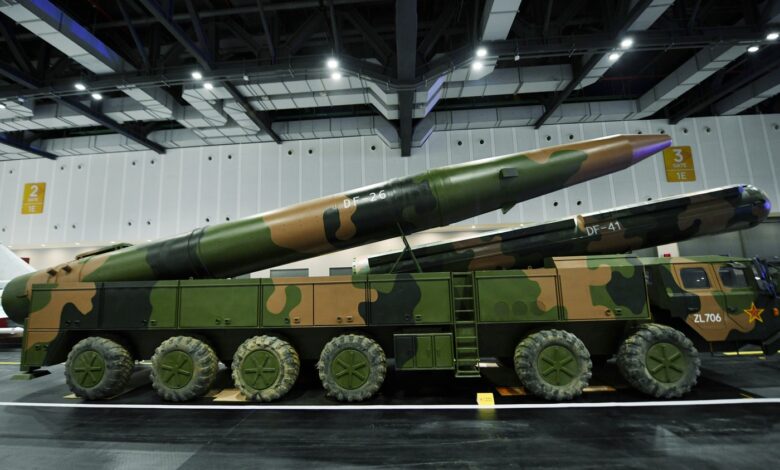
Military projects of unprecedented scale hidden in the desert reveal the extent of China's nuclear modernization. Building an extensive defense network around the existing ones confirms the Asian superpower's intention to protect its arsenal, ensuring its ability to respond immediately to any external threat.
Ensuring the ability to deliver a second strike (that is, the ability to apply devastating nuclear retaliation even after a massive and sudden attack from the adversary) is the central objective of the new desert fortification projects, the Greek press writes.
It should be noted that China's nuclear missiles can already hit any city in the United States.
Recent satellite images obtained by Reuters reveal that Beijing is building an extensive network of launch pads, shelters and communications centers near existing nuclear depots that house the Chinese military's longest-range missiles.
What is China trying to achieve?
A huge military complex is taking shape in a remote Chinese desert that security analysts believe is being built to ensure that any US attack on China's nuclear arsenal would not neutralize Beijing's ability to strike back.
The images reveal more than 80 remote locations that could be used by China's mobile missile launchers and air defense batteries. They also feature facilities that could serve electronic warfare, satellite communications and command operations, according to three security analysts.
Projects of this magnitude, previously unknown, suggest a vast expansion of the infrastructure designed to protect and operate China's land-based nuclear forces. Overall, the network marks a significant improvement in Beijing's efforts to secure a second-strike capability, underscoring its growing nuclear competition with the United States as tensions rise over issues such as Taiwan's sovereignty.
“The infrastructure covers thousands of square kilometers of desert,” said Alexander Neil, a British analyst specializing in geopolitics, security and defense in the Indo-Pacific region, with a focus on China. Depending on the precise capabilities, he added, “a strengthening and diversification of China's nuclear deterrence strategy is envisaged.”
The ability to protect desert stockpiles is central to China's stated goal of building a credible nuclear deterrent.
Failure to use the first strike doctrine
A cornerstone of China is its “no first strike” doctrine, meaning its forces would not initiate a nuclear conflict. However, senior Western diplomats and analysts believe China could use its nuclear arsenal as a foothold to limit outside intervention in a potential conflict over Taiwan.
Xi warned US President Donald Trump that mishandling disputes over Taiwan, which China claims as its territory, could bring the two countries to a dangerous tipping point. Taiwan's government rejects Beijing's claim to sovereignty.
China's Defense Ministry did not respond to questions about its nuclear program and the developments revealed in the satellite images. The Pentagon said it would not comment on classified information.
Development of 1,000 nuclear warheads by 2030
US officials and arms control analysts say China is expanding and improving its nuclear capabilities faster than any other nation. The Pentagon's latest report on China's military modernization shows that the country's production of nuclear warheads has slowed, but the country is on track to develop 1,000 nuclear warheads by 2030. The December report estimated that China has installed perhaps 100 intercontinental ballistic missiles in its three main depots.
China has also strengthened its early warning system, which is supported by the Huoyan-1 satellites, according to US officials. The system can detect an intercontinental ballistic missile (ICBM) within 90 seconds of launch and alert the command center within three to four minutes, according to the Pentagon — enough time for China to launch weapons before they are hit.
Expanding the defense network near the silos could set China apart from other major nuclear powers. The United States and Russia — whose stockpiles of nuclear warheads and deployed weapons far exceed Beijing's — rely on a combination of large numbers of silos, their relative isolation and robust construction to deter a first strike, rather than an extensive missile defense, Christensen said.
The scale of what is happening in the desert of northwest China has left even seasoned analysts stunned. “I've never seen anything like it,” Christensen said. “It's something huge.”


