Architect harshly about apartments in Poland. “I don't believe in the developers' narrative or utopia”

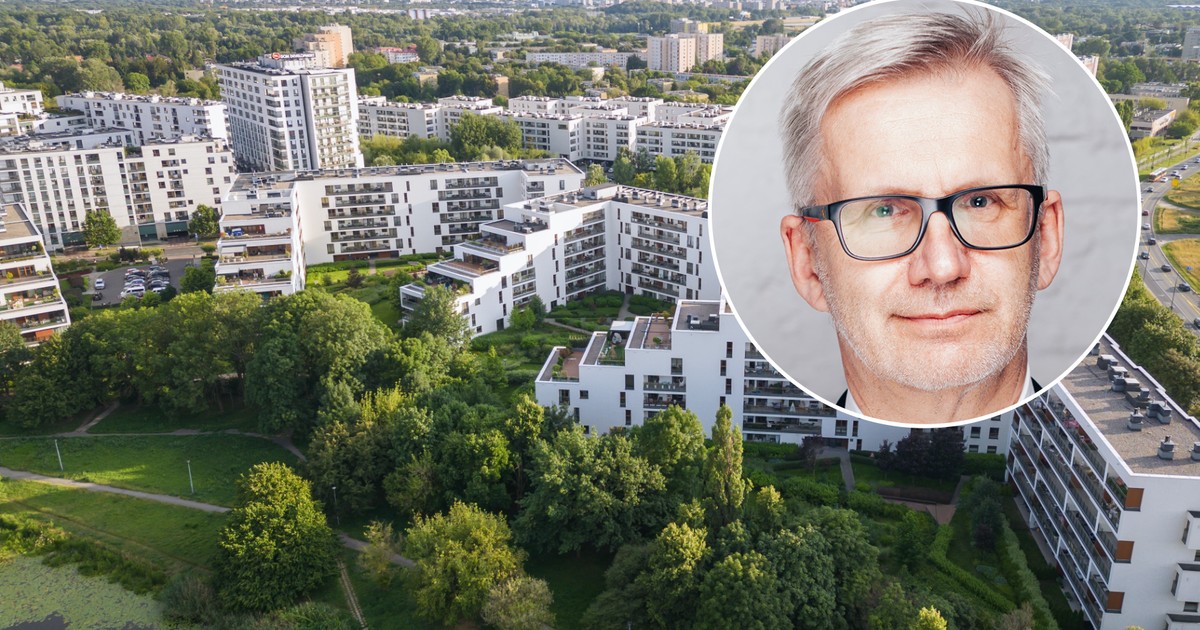
Narrow carriage-like premises, apartments without privacy, concrete courtyards, parking platforms and gated communities regularly appear on social media as examples of the so-called pathodevelopers. In discussions about the housing market, the question arises more and more often whether contemporary housing estates and apartments are not becoming a symbol of the urban crisis. Architect Szymon Wojciechowski from the APA Wojciechowski studio argues that the problem is more complicated than simply identifying the culprits..
In his opinion, contemporary residential architecture is a field of constant conflict between economics, spatial policy, customer expectations and responsibility for the cities of the future. At the same time, there is no doubt that some of the solutions used today in the housing market may prove disastrous in the long run.
Read also in BUSINESS INSIDER
Szymon Wojciechowski – president of the management board, co-owner, architect-partner at APA Wojciechowski Architekci
|
APA Wojciechowski
– This is a very interesting and difficult issue, because nothing here is completely obvious – says Szymon Wojciechowski, when asked about online examples of “architectural bubbles”: extremely narrow apartments, pathological layouts of premises or parking platforms. – Of course some of these examples really cry out to heaven for vengeance. However, we often do not know whether these are isolated cases specifically to cause outrage or a mass phenomenon.
However, the architect emphasizes that the problem does not come down solely to aesthetics or the designers' bad will.
— We would all like to live in apartments that are perfectly sunny, spacious, surrounded by greenery, and with ideal layouts. The problem is that it costs money. “Intermediate” apartments, designed on a very deep route, narrow, with compromises in quality, are simply cheaper. And I'm not saying that this is how you should design. I'm just saying that the alternative is not an ideal world, but often apartments that are several percent more expensive – he explains.
As he notes, the market brutally verifies idealistic assumptions.
— Developers have their own minds. If such apartments did not sell, they simply would not be built. But the problem is something else: we should not design only for the needs of the “here and now” market. Today, there is a group of people who can simply only afford such apartments. But what will happen in 20-30 years? We will be left with a huge amount of very low quality concrete substance that it may turn into a slum or require expensive demolition. This is a huge social and ecological cost, he emphasizes.
This is the argument that resonates most strongly in the conversation: today's design compromises could become a problem for entire cities in a few decades. Wojciechowski warns that short-term market logic may lead to long-term degradation of urban space.
Read also: Home staging changed her life. From a corporation to your own company
Architects under market pressure. “Too often we take the path of least resistance”
Wojciechowski However, it does not remove responsibility from its own environment. On the contrary, he believes that architects accept mediocrity too easily.
— An architect is both a service provider and a profession of public trust. On the one hand, we work for a developer and that's what we make a living from. On the other hand, we are building space for decades. The building that is built outside the window stays practically forever. You can turn off the music, put the book away or take the picture off the wall, but you can't just remove a bad building, he says.
In his opinion, the biggest problem today lies not only in economic constraints, but also in the convenience of design.
– I have a feeling that We, architects, too often follow the path of least resistance. The client sets a goal: a specific number of square meters, a specific profitability of the investment. And you can do it quickly, without much effort. But you can also spend more time on the project and try to achieve a similar result in a better way. And this is where I would have the greatest grudge against our environment, he says.
That's strong a diagnosis of an industry that has been operating under enormous pressure from the housing market for years. In practice, this often means maximizing the PUM, i.e. the usable area of apartments, while limiting investment costs. The result is apartment layouts that are later criticized by Internet users as symbols of pathetic development.
However, the architect argues that simple recipes and political slogans are equally dangerous.
— It's easy to say: let's ban such apartments, let's raise standards, let's forbid compromises. But it means more expensive apartments. And then less is built, prices rise even more, and people are pushed out of the cities. It's not black and white. I do not believe in the narrative of some developers that “if people buy, everything is fine”, nor in the utopia that it is possible to create only perfect apartments without any compromises..
In his opinion Today, the housing market is hostage not only to high land prices and construction costs, but also to regulatory chaos.
— Developers operate in a high-risk environment: uncertain local plans, social protests, long administrative procedures. All this must be included in the margin. I'm not saying you should regret them, but you need to understand the mechanism. Today, the housing market is very much choked by limited supply, he explains.
See also: These regions can benefit [MAPA]
Apartments, parking lots and concrete. “In 30 years we may be left with completely unnecessary infrastructure”
One of the most controversial topics of conversation is parking platforms and a huge number of parking spaces created in new investments.
-We all know that individual car transport is a dead end. The car stands most of the time and takes up space: one at home, the other at work. It's ridiculously inefficient. But this does not mean that today we can simply stop building parking lots. Especially where there is no good public transport. The problem is that In 20-30 years we may be left with millions of square meters of concrete that will be completely unnecessary – says.
Wojciechowski points out that similar dilemmas apply to urban densification policy. In the public debate, there are often demands to tighten the standards regarding the amount of sunlight in apartments or the minimum width of premises. However, the architect warns that the effects of such decisions may be opposite to those intended.
— Tightening the standards for sunlight and the width of apartments sounds good, but it may mean that we will stop building in city centers because plots there are difficult, narrow and complicated. As a result, the development will begin to spread even more to the outskirts. People will commute by car, traffic jams will be greater and cities will be less ecological. Every solution has consequences, he emphasizes.
The conversation also brings up the topic of gated communities – a solution that has been a standard on the Polish housing market for years.
The architect leaves no doubt here.
– This is simple for me: fencing settlements makes no sense. This is either a need for false security or a marketing trick. Good design can create a semi-private space without fences: with an appropriate arrangement of paths, greenery, steps and passages. You can limit traffic through the estate without building walls, he explains.
He adds that physical fences very rarely translate into real safety for residents.
— If someone wants to break the fence, they will do it without any major problem. Of course, I understand the argument of parents of small children, but then you can separate specific zones, e.g. playgrounds, and not immediately close entire housing estates.
Green cities versus new investments. “There are no perfect solutions”
Wojciechowski he is also skeptical about simple narratives about greenery and the fight against new housing investments.
— Warsaw, contrary to appearances, is a green city. But we often deal with a situation in which someone lives in a block of flats on a former green area, with an underground parking lot under the entire estate, and then protests against the development next door because there are three bushes and a piece of lawn for dogs. I understand the emotions of the residents, but we need to look more broadly. If we do not build in the city, the development spreads even further beyond its borders.
The architect argues that modern cities are a constant art of compromise and there are no perfect solutions.
— There are no perfect solutions. I rather believe in “protopia” — things that are good enough, incrementally improved, not perfect. The city will always be an art of compromise, he says.
At the same time, he emphasizes that The architectural community should show greater determination in the fight for the quality of space.
— I will not appeal to architects to completely refuse to design difficult or compromise investments, because it is unrealistic. But I would appeal to ourselves to do so they used all their competences and power of persuasion. To convince investors to use slightly better solutions. To spend more time looking for better apartment layouts, better spaces, better quality. Even if the project economics remain similar. Because that's what we're here for.