publication
2026-04-12 10:00
They no longer have children, but as much as 27 percent remains in their hands. large houses. This is the so-called empty nests of the post-war baby boomer generation. Meanwhile, millennials with children own only 15%. larger apartments. That's “real estate mismatch” in American English.
Who has living space and who actually needs it? This problem was examined by Redfin analysts monitoring the US real estate market. Experts took into account data from 2024 from the population census. The conclusions point to the gap between generations and factors that may cause the mismatch to persist for longer.
The largest generation in the US are millennials, who are currently in the 29-44 age category. They also predominate in the group of households raising children. Millennial families own 15.7%. large housesdefined as properties with at least three bedrooms.
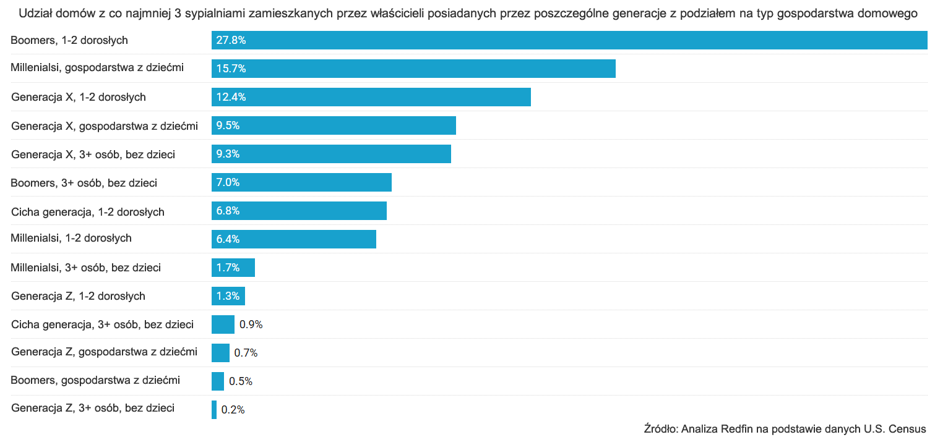
The largest part of larger properties remains in the hands of “empty nesters” boomers (61-79 years old). These are households of 1-2 adults, no children. The slogan “empty nest” usually refers to families whose children have become independent and create separate households. 27.8 percent houses with more than three bedrooms remain in the possessions of people who fall into this specific group.
Families classified as Generation Z (the youngest generation of adults, up to 28 years old) are almost invisible in these statistics. Childless “zetek” households have 1.3 percent. large properties, and families with children – 0.7 percent
A generation gap blocked by the market
The real estate mismatch is likely to last longer, Redfin analysts point out. Almost 58 percent owners from the boomer generation have already fully paid off their mortgages. The rest often take advantage of the low interest rates on old mortgages. Staying in a big house is cheaper for them than moving.
Those who want to limit their living space (so-called downsizing) encounter the barrier of the lack of small, modern and single-story houses or apartments. Social reasons also determine the lack of mobility. Many older people want to stay in their neighborhoods because of habit and proximity to family and friends.
Although the share of millennials in the large home market has increased significantly over the last decade (from approximately 5 percent in 2014 to nearly 16 percent today), they still face significant barriers. The first is high interest rates and a relatively expensive mortgage loan. Research by Ipsos for Redfin shows that approximately 28 percent Millennials refrain from purchasing for this very reason. The second reason given is the lack of savings for own contribution (20%).
Redfin's analysis shows that mismatches exist in every major metropolitan area in the US. The highest share of empty nesters in large homes was recorded in cities such as Memphis (31.2%), Cleveland and Pittsburgh. The lowest share of seniors in such homes (though still above 20%) is in Salt Lake City and Austin. Millennials with children have it relatively easiest in Austin and Columbus, where they own about 19%. large houses.