An American has been biting more than 200 times by venomous snakes, and now, after 25 years, scientists have taken it seriously. How can his extreme gesture help

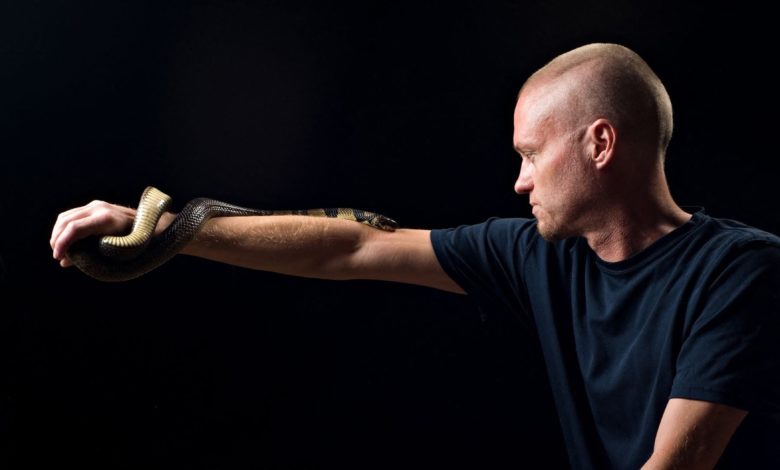
Tim Freide began this experiment in 2001, when he actually had other intentions. He realized, then, that he could help develop a more efficient antivenin. His blood is now studied, but scientists warn that his gesture should not be tried.
Tim Friede was depressed on the day after the attacks of September 11, 2001: this was determined to descend into the basement of his house, where he was bitten by two of the world's most lethal snakes. She came out of the coma caused by the reptile venom only after four days, writes France Presse.
“I know how to die because of the bite of a snake,” said the 57 -year -old American for AFP by video conference at his residence in TWO Rivers, a town in Wisconsin.
This could have made him avoid snakes for the rest of his life, but he simply promised to be more cautious in the future.
Between 2000 and 2018, he was bitten by venomous snakes over 200 times and injected their venom over 650 times.
It has undergone these extremely painful experiences to achieve total immunity against their bites, in the hope of contributing to the development of a more efficient antithene.
What is mitriduity
This practice, which consists in acquiring immunity to toxic substances by ingestion of increasing doses, is called Mitrididism, in reference to Mitridate the Great (113-63 BC).
According to legend, this Greek king, fearing not to be poisoned by his enemies, ingested increasing amounts of arsenic to get used to it.
Now, the former truck mechanic, without higher education, has struggled for a long time to be taken seriously by scientists. After 25 years, research based on his experiments was finally published, in May, in the scientific journal Cell.
Hundreds of thousands of victims of snake bites each year
They show that antibodies in its blood provide protection against many snake bites, and the authors now hope that hyperimality acquired by Tim Friede will allow the development of a universal antivenin.
Current antivenins work only for one or a few of the 600 species of known venomous snakes.
According to the World Health Organization (WHO), snake bites kill about 138,000 people a year and lead to amputations or other disabilities for another 400,000 people. These figures are underestimated, the victims generally living in poor and isolated regions.
“It hurts every time”
His first bite, at the age of five, from a harmless snake, remained a living memory. “I was scared, I cried, I ran,” he says. But then he began to bring reptiles home, hidden in jars of pickles, to the great dismay of his mother.
This is how a fascination was born: he learned, thanks to a course, to extract their venom.
The method of making antivenin has not changed too much in 125 years: small doses of venom extracted from snakes are injected to horses or sheep, which then produce antibodies that can be used as an antivenin.
But this will be effective only for a particular species, and some of the antibodies can cause serious side effects, such as anaphylactic shock.
Then Tim Friede decided to become his own guinea pig. It was immediately offered to be bitten by the most venomous species: cobra, taipan, black mamba, snake with bells. “It hurts every time,” he admitted.
Scientists didn't take it seriously for a long time
Long ignored by scientists, he was finally contacted in 2017 by immunologist Jacob Glanville. Who was looking for, for the work
In search of, for his works, of a “unstoppable researcher in the field of snakes, who would have been accidentally bitten several times,” Mr. Glanville tells AFP that he has encountered a video with the risky endings of Mr. Friede.
“It will seem strange to you, but I would like to put your hand in a little blood,” the immunologist told them during their first conversation.
The antivenin that is the subject of Glanville's research, published in Cell magazine, contains two antibodies from Mr. Friede's blood, as well as a drug called Varespladib, which inhibits toxins.
It offered mice a total protection against 13 of the 19 species of tests tested and partial protection against six others.
Centivax works at a universal antivenin
Although praising the study, Timothy Jackson, from Australian Venom Research, wonders if it is necessary to get involved, given that there are synthetic antibodies.
Centivax company, created in 2019 by Glanville, develops in particular a universal antivenin that could be sold at one point as a pre-filled self-indoor syringe.
Today an employee of Centivax, Friede declares himself “proud” that he has contributed to the progress of medicine, but regrets that he can no longer inject venom-a possible accident would be attributable to the company. “I lack,” he says.