
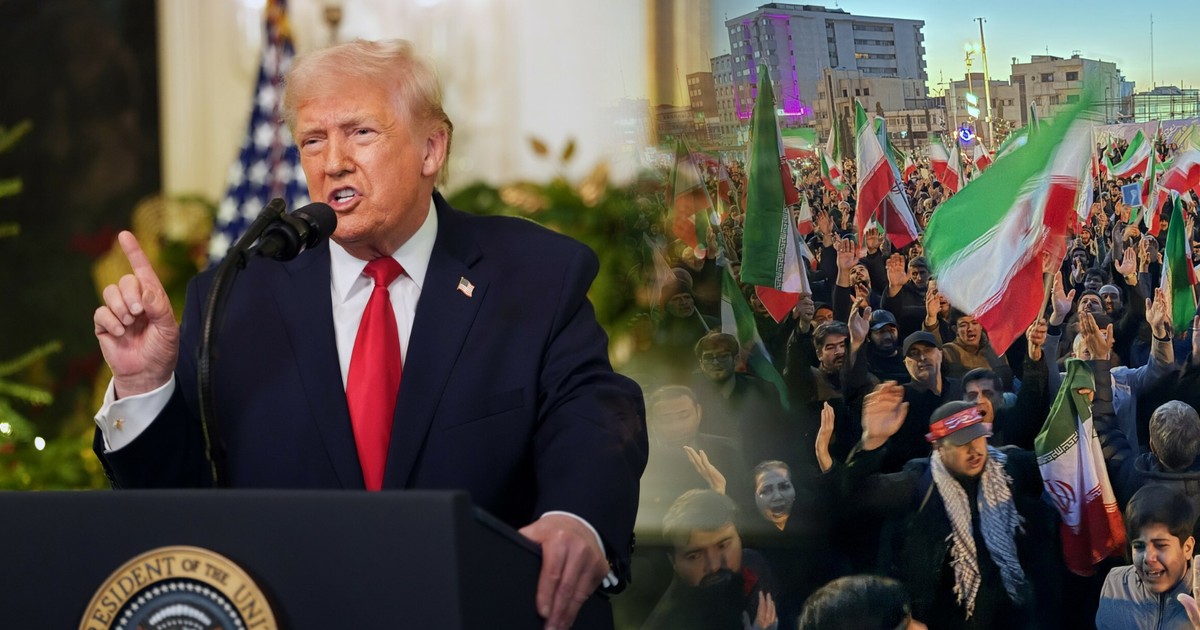
The decisive action of the United States is intended to overthrow the ayatollah regime, and at the same time proves Donald Trump's determination in the confrontation with China.
The US has started to liquidate another Chinese “gas station”. After Venezuela, which cooperated closely with the Russian mining sector and was a valuable bridgehead for Beijing, the time has come to cut off the Middle Kingdom from another important ally. This is a noticeable blow – China is today the largest importer of energy raw materials in the world and the main recipient of oil from Iran. This is where approximately 80 percent went. Iranian oil exports estimated at 1.3-1.5 million barrels per day.
Continued below the video:
If there was a regime change in Tehran and the subsequent easing of sanctions, Beijing would be forced to pay more in its best-case scenario, and worse still, become more dependent on suppliers already linked to the USA.
At the same time, surrounded by economic sanctions, Iran was dependent on Beijing's favor as a recipient of key components. The new regime — even if by no means pro-American — may be less susceptible to these influences.
Regardless of what power ultimately emerges after Khamenei's death, the whether remains an open question The increasingly bold elimination of China's allies by the US brings us closer to a direct clash between Washington and Beijing.
For now, the Middle Kingdom is responding with restraint. Chinese Foreign Minister Wang Yi called the killing of the supreme leader “unacceptable”, and in a conversation with Russian Foreign Minister Sergei Lavrov, he condemned the US and Israeli attacks on Iran and called for an immediate truce.
What's next? Donald Trump's visit to Beijing, planned for the turn of March and April, will be crucial. The statements of the leaders of both powers may bring us closer to obtaining an answer.
2. When the Middle East bleeds, Europe has a problem. How will the EU cope?
The overthrow of the criminal regime in Tehran and the emergence of an at least slightly less radical alternative is long-awaited news not only for the United States, but also for Europe. This Iran was one of the global sponsors of world terrorism, and its weapons supported Russia in its attack on Ukraine.
However, there is a risk that in the short term, Shiite Iran will resemble Syria much more than, for example, the United Arab Emirates, which is relatively open to the West. And this may mean huge migration pressure on Europe.
If such a great shock and migration crisis was caused by the Arab Spring and the war in Syria, the humanitarian catastrophe in Iran, which has a population of 93 million and is in economic crisis, may be at least as great a shock.
And although it is a fact that the shock in Tehran is a blow to an important ally of Russia, Kiev may also fear an escalation of the war in the Middle East. Greater U.S. involvement in the Middle East may mean that the Ukraine issue will be removed from the agenda, and at the same time it will mean an even longer list of arms orders – which may make it more difficult to supply Ukraine. And this is another huge challenge for the European Union, which supports it.
3. Expecting a shock on the oil market. Will supply chains hold up?
Tehran announced the closure of the Strait of Hormuz. This is something that analysts recently considered a shock to the global oil market and Tehran's “nuclear option”. For now we can talk about the calm before the storm – for example, the prices of the Saudi Arabian company Saudi Aramco (an increase of three percent on Sunday) may prove thisthat the market had already calculated the risk arising from turbulence in the strait.
Read more: Orlen under pressure after the attack on Iran? Experts on the possible effects of war
Approximately 19-20 million barrels of oil and petroleum products flow through the strait daily, which constitutes approximately 27%. global oil trade. In addition, the LNG flowing there, mainly from Qatar, meets about 12 percent. European needs.
The blockage is the most important test for the global oil market since Russia's attack on Ukraine. It also shows the desperation of the ayatollah regime, which is fighting for survival – closing the strait means giving up any further possibility of blackmail or making money on the flow of tankers. These elements led analysts to believe that ultimately such a radical move was unlikely.
Closing the strait means two huge tests – first, how long Iran will be able to block transport (or possibly deter insurers from passing through the route), and second, how strong the reaction of global oil markets will be.
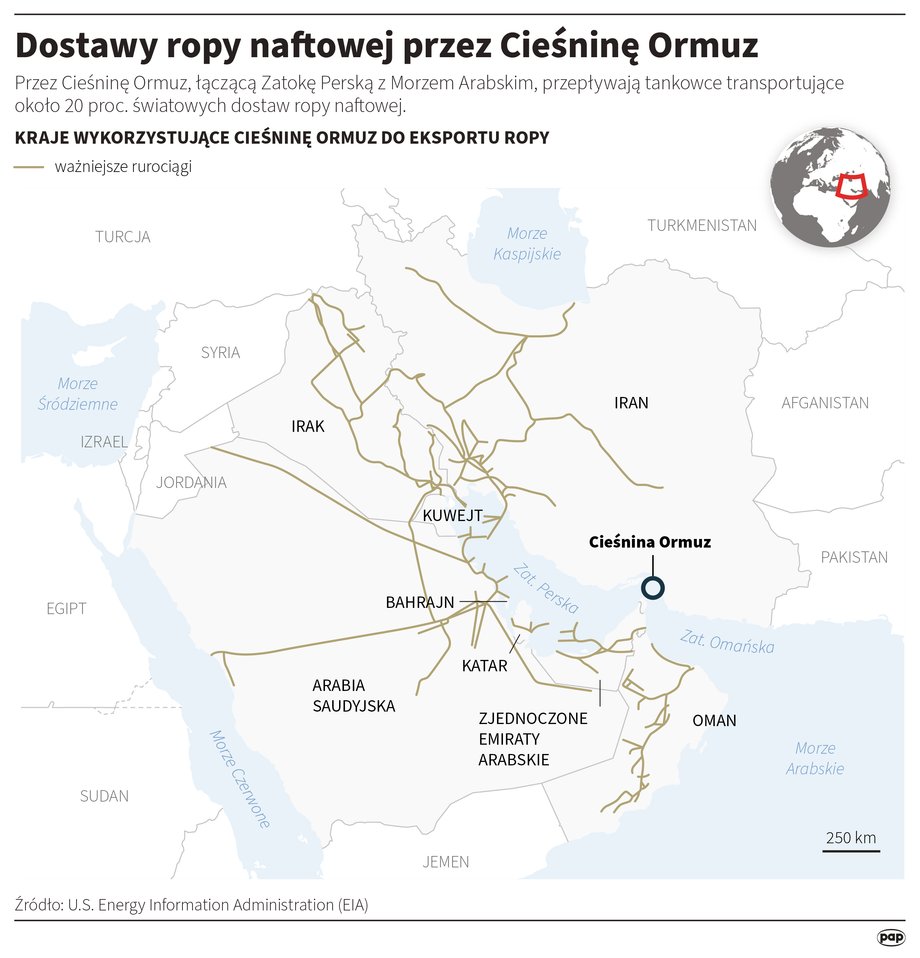
Strait of Hormuz
|
Adam Ziemienowicz / PAP / photos
In response to the shock in Iran, OPEC+ declared an increase in production. However, analysts agree – long-term supplementation of supplies from the Middle East with raw materials from other sources will not be possible without huge cost consequences that may fuel inflation. In an extreme scenario, the smooth operation of logistics and industrial plants may also be at risk.
The suspension of traffic through the Strait of Hormuz is also a major shock to the global LNG market – the blockage means suspension of deliveries by tankers from Qatar. The good news for Europe from this perspective is that the weather is improving. The harsh winter severely drained European gas storage facilities. The arrival of spring significantly reduces this pressure, but does not eliminate it. The rising price of gas is, in turn, a nightmare for the entire chemical industry, for which it is the basic energy raw material.
Grzegorz Kowalczyk, journalist of Business Insider Polska


