How Trump made China even stronger than it would have been without him


However, Xi Jinping can still appear confident because China has a very good position in the international arena. AND it's all thanks to the man who allegedly wants to hinder the development of the People's Republic of China: US President Donald Trump.
He has an ironic nickname on Chinese social media Chuan Jianguowhich literally means: “Trump is building the country.” However, this is not about the United States, but about China. This allusion is the opposite of Trump's “Make America Great Again” slogan – “Trump Makes China Great.”
The US president also disbanded the US development cooperation agency USAID, depriving African countries of urgently needed resources to fight diseases such as AIDS and tuberculosis.
China, on the other hand, has abolished tariffs on goods from Africa and is currently the most important trading partner for 52 of the 54 countries on this continent.. Two decades ago, for two-thirds of African countries, the partner was still the United States.
While Trump has significantly reduced funding for state-funded foreign radio stations Voice of America, Radio Free Asia and Radio Free Europe, Chinese overseas stations are broadcast globally on cable television and are ubiquitous on platforms such as YouTube.
China's “harmony” and “stability”
But isn't Xi Jinping actually suffering from the disruptions in the global economy caused by Trump, and doesn't he want above all harmony and stability, as he claims? “China remains a haven of stability in a troubled world” – this was the title of a comment published a few days ago by the official Xinhua news agency.
“Harmony” and “stability” are popular propaganda slogans of the Chinese Communist Party. They suggest the continuity of a thousand-year-old tradition that dates back to the philosopher Confucius. A party with strong Leninist-Maoist traditions once broke with these traditions and fought Confucian teachings as a feudal heritage. However, under Xi Jinping, the party has returned to some themes, such as a “harmonious society”, to legitimize its power.
This pursuit is not limited to China. As Xi put it during his meeting with Russian President Vladimir Putin in Moscow in March 2023: “There are changes happening now that we haven't seen in 100 years. And we are the ones driving these changes together.”
However, if the Chinese authorities wanted harmony and peace, they could end the war in Ukraine within 24 hours (as Trump once promised). Russia is completely economically dependent on Beijing.
Another common illusion is the belief that Beijing supports a “multipolar world” in which Germany and Europe should skillfully find each other, balancing between China and the United States. Indeed, in the world – just like during the Cold War – countries of freedom and democracy and totalitarian states face each other.
However, there are some important differences from that time: While back then the Soviet Union and China were at odds, today China and Russia are tied together like never before. While the socialist bloc was economically weak back then, today China is the market leader in many industries.
Tempting offers and a lurking trap
Other things that seem new today are not so fresh at all: Totalitarian leaders try to divide democratic forces with tempting offers. The “peace initiatives” of the leader of the Soviet Union, Leonid Brezhnev, were legendary, which led to the division of the social democrats Willy Brandt and Helmut Schmidt into two camps in the conflict over NATO armaments.
Today, the disruptions in transatlantic relations represent an excellent opportunity for the other side. “China and the EU are partners, not systemic rivals or adversaries,” argued Chinese Foreign Minister Wang Yi at the Munich Security Conference, praising his country as a “reliable, progressive partner.”
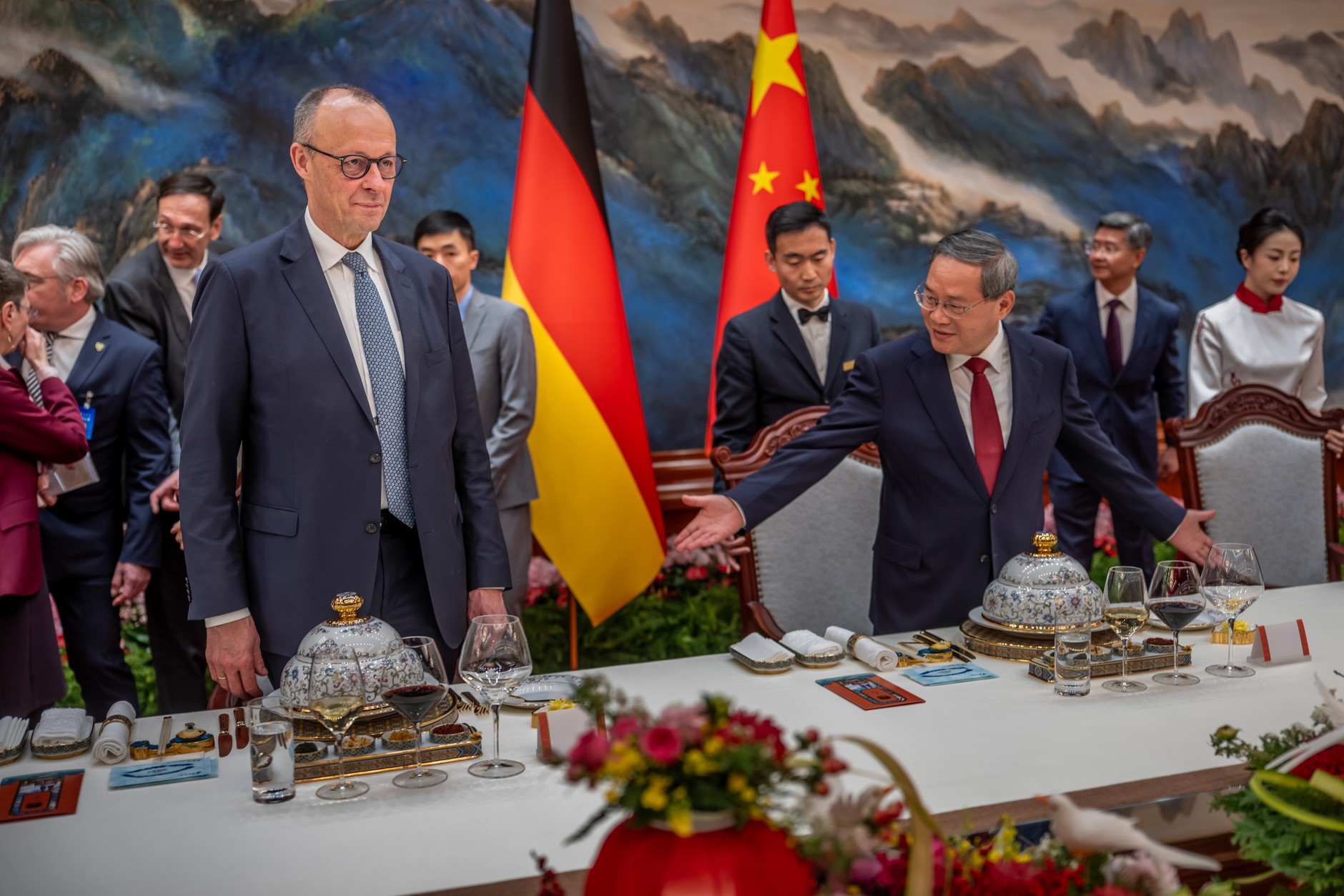
German Chancellor Friedrich Merz (L) and Chinese Prime Minister Li Qiang (R) during lunch at the Great Hall of the People in Beijing, China, February 25, 2026.PAP/EPA/MICHAEL KAPPELER / POOL / PAP
Surplus production, for example in steel, electric cars and solar modules, does not benefit the Chinese economy but is deliberately used to destroy other countries' industries and make them dependent on China.
Another term that communist propaganda effectively blinds other countries to is the “global south.” Geographically, this term is not accurate as it would primarily include Australia and New Zealand. However, it commonly includes countries such as China, India and Egypt, which are located in the northern hemisphere.
This deliberately vague term suggests the common interest of former colonial nations against the former colonial rulers whose interests Beijing purports to represent. However, China is itself a colonial power, for example in Uyghur and Tibetan territories.
Still, this strategy works. It led to the creation of organizations such as BRICS and the Shanghai Cooperation Organization (SOZ), which serve as platforms for countries wishing to deepen economic cooperation and security policy outside Western structures.
This is nothing new either. During the Cold War, it was the Non-Aligned Movement that pretended to represent the Third Way – with protagonists such as revolutionary leader Fidel Castro of Cuba, former Prime Minister Jawaharlal Nehru of India, and former President Gamal Abdel Nasser of Egypt. In fact, they rather supported the socialist camp.
In this way, the arc to the present can be closed: Donald Trump makes it even easier for the enemies of freedom to pose as supposed defenders of a just and reasonable world order.
Trump has made China even stronger than it would be without him.