AI adoption is particularly high among young and more productive enterprises. This result is particularly significant considering the dynamic development of the artificial intelligence market and the pressure organizations feel to implement new tools “here and now”.
Artificial intelligence is today treated as a technology necessary to maintain competitiveness, but in reality the real effects are unmeasurable or even zero.
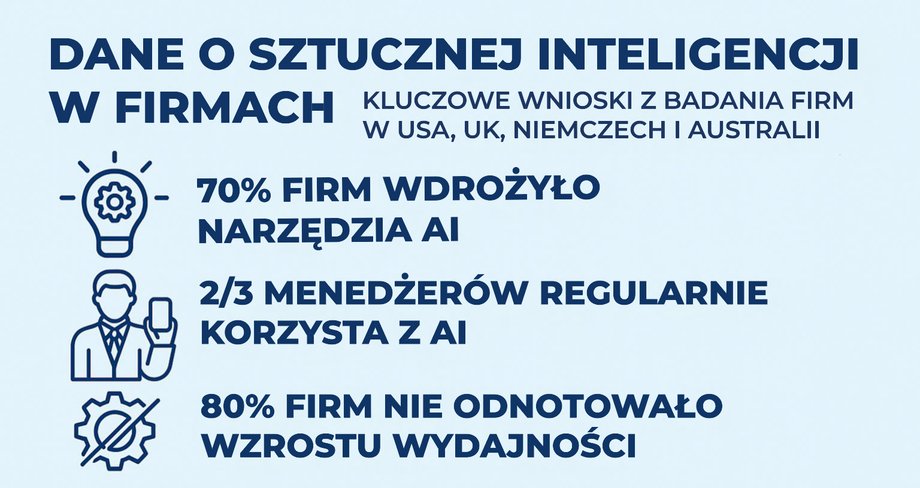
AI in companies
|
Business Insider
The gap between experts' expectations and the actual impact of AI
Study, published by National Bureau of Economic Researchshows clearly that enthusiasm for AI is not matched by practical results. However, managers still assume that within three years AI will bring specific results:
- productivity will increase by approximately 1.4 percent. ,
- employment will fall by 0.7%. ,
- total production will increase by approximately 0.8 percent.
This means that despite disappointing current data, entrepreneurs still treat AI as a long-term investment.
How do leaders actually use AI? The data is surprising
One of the most striking elements of the study is the analysis of how often leaders themselves use AI tools. Data shows:
- over 2/3 of managers use AI in their daily work,
- however, their actual use is only about 1.5 hours a week,
- whereas 25 percent managers do not use AI at all.
These numbers suggest that, thanks to widespread implementation, the vast majority of leaders use AI (although only about 1.5 hours a week), but this does not translate into an increase in performance at all. It may also suggest that the use of AI by managers does not necessarily make the work of lower-level employees easier, which is why it does not translate into higher productivity.
Read also: Artificial intelligence was supposed to help employees. Instead, it brought burnout
A historical analogy: Solow's product paradox
This may resemble a phenomenon known as Solow's productivity paradox. Economist Robert Solow observed that despite the rapid increase in the introduction of computers into businesses in the 1970s and 1980s, productivity not only did it not grow, but it actually fell: :
- in years 1948–1973 the average annual productivity growth was 2.9 percent ,
- after the introduction of microcomputers it dropped to 1.1 percent ,
- it was only in the late 1990s and early 2000s that a rebound was observed.
This points to a classic problem: Implementing new technologies often involves a period of disorganization, learning and adaptation before tangible benefits appear. However, you must remember that unlike computers, many other technologies turned out to be completely useless and fell into oblivion. Other examples also show that v Unlike the use of computers, in the long run the use of AI may significantly reduce the quality and value of work.
AI may increase burnout
It is also worth mentioning a study according to which the use of AI tools may… increase the level of employee burnout.

using AI tools may… accelerate employee burnout
|
Shutterstock
This study shows that the cognitive load of supervising, verifying and correcting AI errors or forced adaptation to use new tools can lead to stress and reduced mental well-being of employees — which is a factor that definitely negatively affects productivity.
At the same time the use of AI by managers does not necessarily mean that work will be easier for regular employees. Therefore, the mere implementation of AI into the management process does not translate into higher company efficiency.
Unrelenting investment boom
Regardless of the lack of results, artificial intelligence is still treated as a breakthrough technology that management introduces with blind enthusiasm and considers crucial to the future of business.
The article cites data on venture capital investments:
- in 2025 61 percent global venture capital went to companies dealing with AI,
- the value of investment in AI amounted to as much as 258.7 billion dollars, when a total of PLN 213.4 billion was invested in all other industries. hole. (total $427.1 billion)
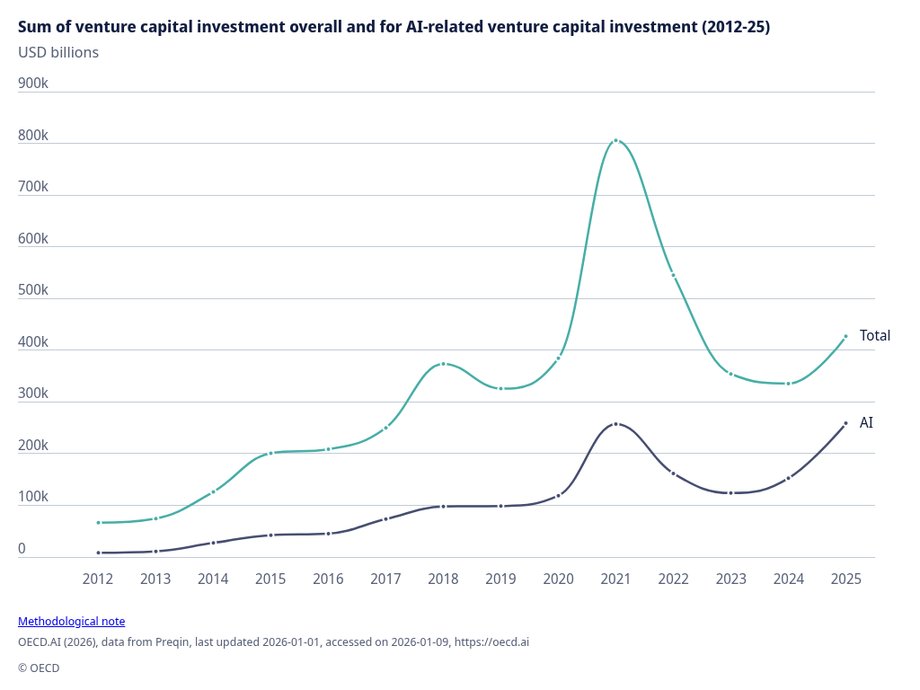
In 2025, venture capital investments in artificial intelligence companies accounted for as much as 61% of all venture capital investments
|
OECD
Surprising results of an employee survey
Researchers also conducted a survey among lower-level employees who expect an increase in employment by 0.5%. in the next 3 years as a result of the introduction of AI. This contrast indicates significant discrepancy in expectationsbecause senior executives anticipate job cuts due to artificial intelligencewhen employees anticipate an increase in the number of new jobs.
Companies like Microsoft continue to bet everything on artificial intelligence, and the boss Microsoft's artificial intelligence team believes that Artificial intelligence could replace all white-collar jobs within 18 months.
AI as a disruptive technology – but still immature and posing a threat
Despite the lack of real effects, AI is still recognized epoch-making technologywhich sooner or later may bring fundamental changes in the way we work. This is fueled by huge investments and the keen enthusiasm of leaders, despite the risk to the quality of content and the health of employees.

using AI tools may… accelerate employee burnout
|
Azat Valeev/Getty Images
The current lack of productivity growth can be seen as a failure of AI – a signal that organizations, processes, structures and work cultures must adapt to realize the full potential of the technology.
This study and other publications on the subject paint a picture of a technology that:
- is widely implemented and used
- raises great hopes,
- and does not bring measurable operational effects (yet?),
- used by managers does not have to mean facilities for regular employees,
- carries risk of decreased content quality,
- Maybe negatively affect the health of employees.