The beginning of 2026 saw continued solid sales of retail Treasury bonds. Poles lent the government almost PLN 5 billion net, despite increasingly lower interest rates offered by Polish treasury securities.
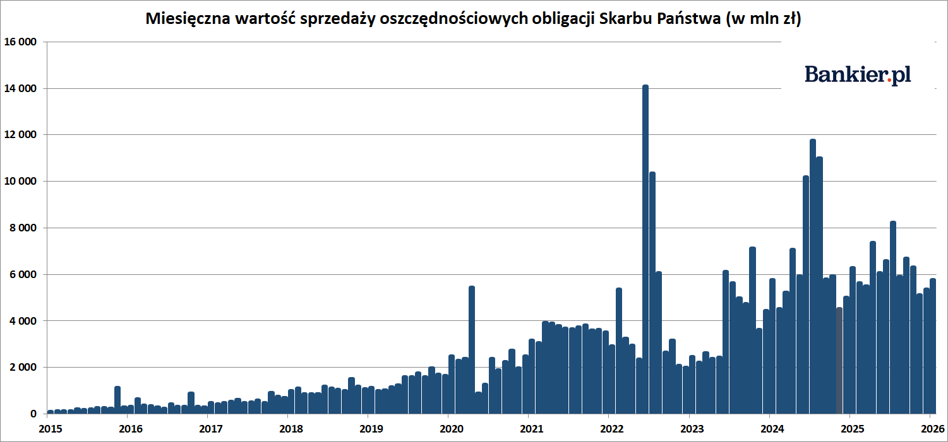
In January 2026, the Ministry of Finance sold retail treasury bonds for PLN 5.76 billion. This result is 8.1% lower than a year ago, but at the same time 7.6% higher than in December, when purchases were prompted by the prospect of forfeiting the annual limit on payments to IKE/IKZE accounts. Of this amount, PLN 990.6 million was the conversion of maturing bonds into new issue securities, so the Ministry of Finance actually obtained PLN 4.77 billion.
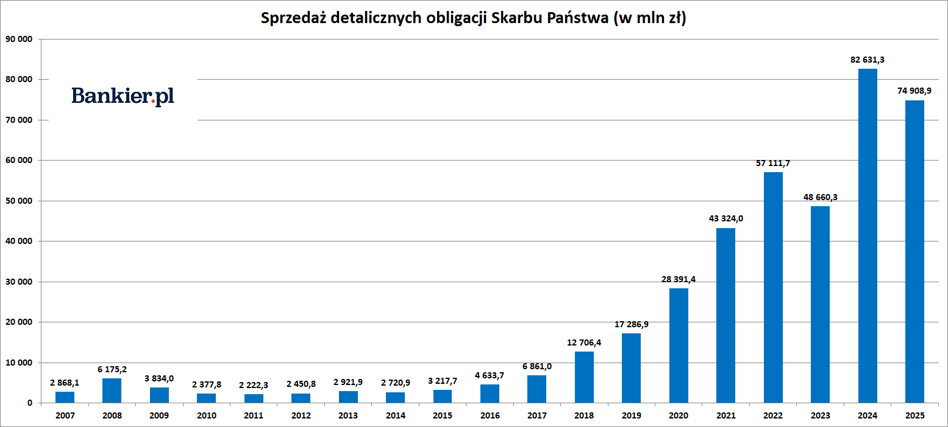
Throughout the previous year, the Ministry of Finance sold retail treasury bonds for almost PLN 75 billion, of which PLN 13 billion was the exchange of maturing bonds for new issue securities. This was still a result proving the great popularity of the Ministry of Finance's offer, but slightly lower than the record PLN 82.6 billion obtained in 2024.
At the same time, since last spring, the interest rates on retail Treasury bonds have been gradually decreasing due to interest rate cuts at the National Bank of Poland. From May to December, NBP rates were reduced by a total of 175 basis points, which translated into a similar reduction in the rates offered by the Ministry of Finance.
But since the Monetary Policy Council did not lower rates in January and February (but will probably do so in March), the interest rates on retail treasury bonds remained unchanged. In the February offer, rates start from 2.5% in the case of three-month OTS through 4.25% in the case of one-year bonds and 5.6% offered in the first year of saving by 10-year EDO securities. These are no longer particularly bargain percentages, but they clearly exceed the current CPI inflation as well as the inflation forecast by the National Bank of Poland for the next 12 months.
– In the first month of the year, Poles invested nearly PLN 5.76 billion in retail treasury instruments. Most often, they chose 1-year bonds with variable interest rates based on the reference rate of the National Bank of Poland, which accounted for 34% of total January sales. Three-year fixed-rate TOS bonds were also very popular, with their share in sales amounting to 29%, comments Jurand Drop, Undersecretary of State at the Ministry of Finance.
How Poles fell in love with bonds
On the same day as the announcement of the Ministry of Finance, data on the sales results of investment fund units were released to the market. Bonds also dominated there. A total of PLN 5.7 billion flowed into TFI debt funds. Together with retail bonds, this amounts to almost PLN 10.5 billion “loaded” into Polish bonds in just one month.
Such a strong inflow of cash into Polish bonds in the conditions of not very high interest rates and the prospects of ending the cycle of their reductions may not end well for investors. However, they clearly prefer assets that are considered safe, which distinguishes Poland from Europe and the world, where, in addition to bonds, investors' portfolios also have a lot of space for shares.
All the more so because the Polish economy is in a phase of the business cycle that clearly favors shares over bonds. And this was clearly visible in 2025, when the Polish stock exchange (assessed through the prism of WIG) earned as much as 47.3%, while treasury bonds with a fixed coupon yielded 9.5% (TBSP index).
The most frequently chosen treasury bonds
Similarly to the previous months, in January the most popular purchases were short-term bonds (ROR) and three-year fixed-interest bonds (TOS). The share of the latter amounted to 28.7% of the total January sales of retail Treasury bonds. In turn, annual current accounts accounted for 34.3% of sales. Therefore, both types of bonds accounted for 63% of the total pool. That is, less than in the summer, when they accounted for over three-quarters of total sales.
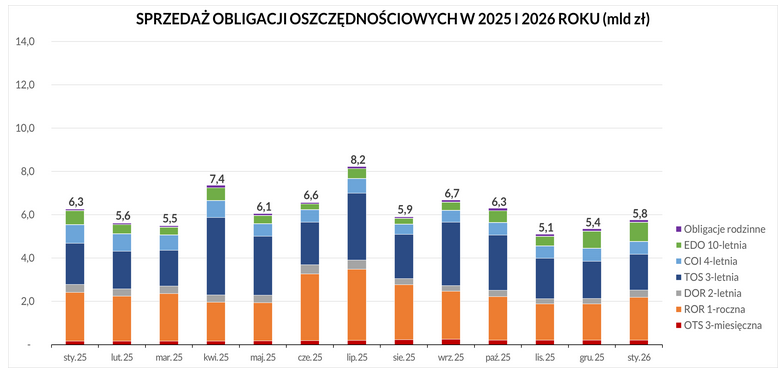
However, the demand for “anti-inflation” securities has not yet recovered. In January, 4-year bonds (COI), 10-year bonds (EDO) and family bonds (i.e. intended only for beneficiaries of the Family 800+ program) accounted for 27.5% of the offer sold. This is a level that we have been observing in the Ministry of Finance data for a long time. Specifically, from the moment when the fixed interest rate on 3-year bonds (as well as the variable interest rate on one-year and two-year securities) began to clearly exceed CPI inflation.
By comparison, in 2022-23, inflation-linked bonds accounted for more than half of retail bond purchases. This is a signal that investors in retail Treasury securities are less and less afraid of inflation. In October, CPI inflation was 2.8% and it was one of the lowest readings in the last 5 years.
– We are also pleased with the interest of Poles in saving for their future retirement under the IKE-Obligacje Account and the IKZE-Obligacje Account. Year by year, we see an increase in the value of purchases of our bonds among people thinking about their future retirement. It is worth noting the purchases in January under the IKE-Obligacje Account, amounting to over PLN 500 million. This is a record monthly value since the introduction of this type of account in 2004, noted Minister Drop.