The “Colosseum” in the Carpathians, awarded by specialists. The new face of the amphitheater in Ulpia Traiana Sarmizegetusa


Reopened in 2025, after almost three years in a conservation and restoration site, the ancient Amphitheater of Ulpia Traiana Sarmizegetusa got a new look, which was not without controversy.
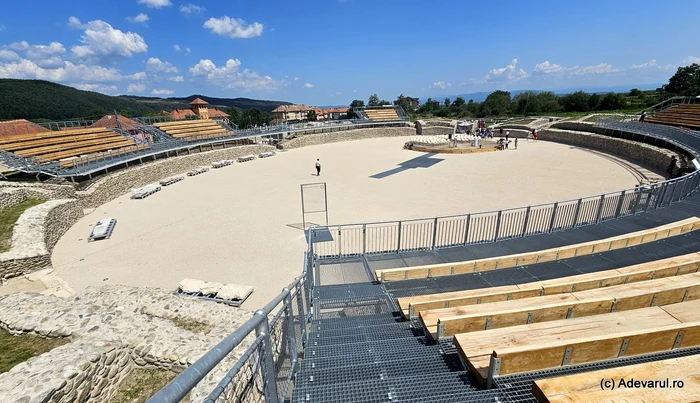
The amphitheater in Ulpia Traiana Sarmizegetusa. Photo: Daniel Guță. TRUTH
The Roman amphitheater in Ulpia Traiana Sarmizegetusa (Hunedoara county) returned to the public's attention in 2025, when the restoration and conservation works carried out in the last three years were completed.
The stone arena was reopened to the public, and tourists found here a new metal structure, used as a grandstand, partially covering the remains of the ancient monument. Some of those who knew the construction needed time to familiarize themselves with its new appearance. Metal and wooden stands partially cover the arena, without the new structure resting on ancient monuments, but giving it a modern look.
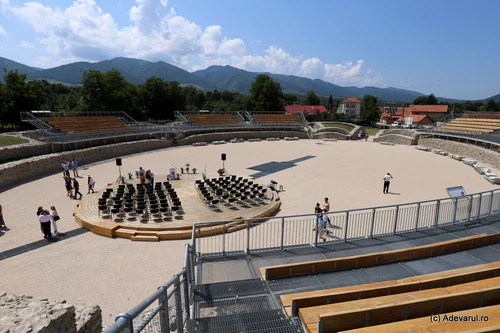
Image 1/23:
Ulpia Traiana Sarmizegetusa Photo Daniel Guță THE TRUTH (35) JPG
Some have compared the more than 1,900-year-old amphitheater to a stadium, and other visitors have complained that its authenticity has been affected. And some specialists, in turn, had objections to the result of the restoration work. The architects and archaeologists involved in the project argued that the solution of the removable metal tribunes was chosen to protect the monument and increase its utility.
Restoration of the amphitheater, awarded
However, the National Union of Restorers of Historical Monuments from Romania (UNRMI) appreciated the project and awarded it within the framework of the National Restoration Triennial – 2025.
“The award highlights the entire effort to restore and enhance the exemplary archaeological heritage of Ulpie Traiana, based on research and appropriate scientific methods, resulting in the return to use of a major archaeological structure, without the new intervention altering the restored heritage asset”, sent UNRMI.
The Roman amphitheater, built at the beginning of the second century in the former ancient city founded by the emperor Trajan, was rediscovered in the 19th century, completely unveiled at the beginning of the 20th century and went through several stages of restoration over time. The most important of these started in 2022 and represented an investment of almost five million euros, financed by European programs (POR 2014–2020 and Western Regional Program 2021–2027), funds attracted by Hunedoara County Council.
“Our intention was to preserve the ruin and allow visitors from now on to perceive it, to visit it, to experience this space as it was for 100 years. But we did not limit ourselves to conservation, we added another layer, that of interpretation. In general, ruins are not self-explanatory, they do not tell their full story without help. It is what we see above the ruin, this metal structure, whose role is, first of all, to restore to the monument its character of an introverted space, facing the arena. The role of these structures is to allow the public to attend the performances, so to restore the original function to the monument.” explained the architect Ștefan Bâlici, president of the Romanian Order of Architects.
The project meant the research and conservation of the amphitheater, but also the restoration of its vestiges, the reconstitution of some architectural elements, the consolidation of the walls, the arrangement of tribunes on demountable metal structures, the construction of a stage, the installation of an architectural lighting system, as well as exterior arrangements that facilitate access and visiting the monument.
Ulpia Traiana Sarmizegetusa, the city of the Romans
Ulpia Traiana Sarmizegetusa, the former capital of the province of Dacia at the time of Emperor Trajan, is located 15 kilometers from Hațeg, and in ancient times the colony covered an area of at least 30 hectares.
In Antiquity, the settlement was called Colonia Ulpia Traiana Augusta Sarmizegetusa and was the place where many veterans from the troops who fought for the conquest of Dacia settled. The ancient city originally had a few thousand inhabitants, who enjoyed the privileges of tax exemption and property rights over the surrounding fertile land, historians claim.
The city with a quadrilateral plan was expanded over a vast area, which also included the current territory of the villages around Sarmizegetusa, and the population gradually increased to 20,000–25,000 inhabitants.
The most famous monument in the complex of ancient buildings is the Roman amphitheater, a stone and marble building, well preserved, despite the destruction suffered over time. The amphitheater was unveiled at the end of the 19th century, and since then it has gone through several periods of restoration.