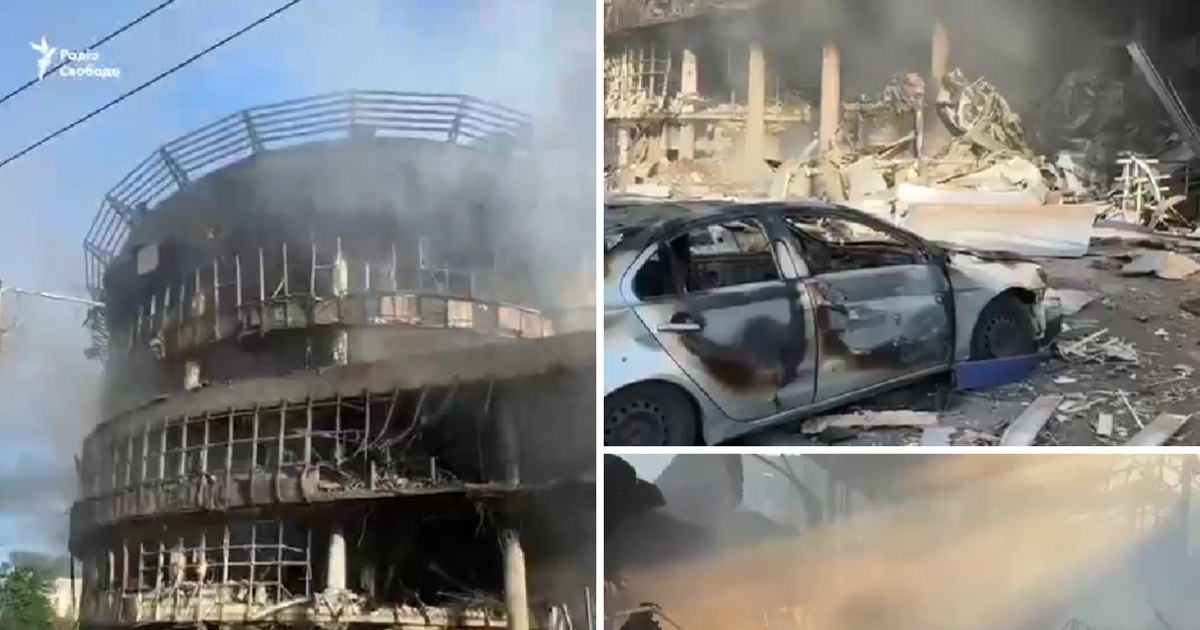
Residents of a Kiev neighborhood say they are living through their hardest months since the start of the war, after Russian attacks intensified. Residential buildings, a shopping center and a subway station were hit repeatedly.
PHOTO: X @VerdadeseNadaMa
The Guardian writes that residents of Kiev believe that the situation has worsened in recent months, and the Lukianivska district, one of the most affected by Russian bombing, has come to resemble an area near the front line.
The final blow collapsed part of the subway ceiling and filled the platforms with a cloud of dust.
The McDonald's restaurant in the area, the first opened in Ukraine, was damaged three times this year alone. On maps showing the frequency of air strikes in Kyiv, the area around Lukyanivska Square and the wider Shevcenkivski district stand out as the concentration of attacks over the past four years.
However, recent massive attacks have also hit civilian structures. A glass tower that once dominated the street was left without many of its windows.
Two charred cars sit on the curb. The entrance hall of the subway, hit five times, is covered with billboards in many areas, and passersby stop to look up at a burned and devastated building.
Despite the destruction, life continues in the neighborhood especially around a few stalls in the local market.
Among the residents is Anastasiia Prymak, a 23-year-old who lives nearby and describes the psychological effects of repeated bombings on her daily life.
“I moved to Kiev from Nikopol two years ago because of the constant shelling there. Now we've got massive shelling here too in the last few months.”
The first was a drone strike on the roof of a nearby apartment building on April 28.
“I thought I heard planes. Then I told myself it couldn't be planes because of the war. Then I looked out the window and saw the explosion on the roof. I've been diagnosed with severe anxiety disorder. I'm anxious all the time, even for no reason, and I have panic attacks.”Prymak also tells.
Ukraine wants its children back: Italian courts block the return of minors evacuated at the beginning of the war
The young woman shows images of fires and destroyed buildings seen from her apartment window and says the recent bombings have prompted her to ask her boyfriend to move to Lviv together after attacks repeatedly hit the area where she lives.
“I tell my friends it looks like Chernobyl. It's getting more and more dangerous here. I sleep curled up like an embryo because I'm afraid a drone or a missile will hit. I want to be killed in one shot. I don't want to lose a limb.”
Sitting at her flower stall, Faina Polishchuk says that while most of the traders have returned, the customers have disappeared.
“Is it dangerous”she says. “After the last massive attack in May, most of my colleagues here were crying, upset and didn't want to come back for a few days. But this is what I do for a living.”
She saw the last attack from her apartment window. At first, Faina says she will stay no matter what and expresses her optimism.
“I'm not afraid,” she states, but immediately adds a nuance. “If things get worse, then I will go to Vinita, my hometown.”
Zelensky announces the intensification of attacks on Moscow
Meanwhile, Ukrainian President Volodymyr Zelensky has announced a radical paradigm shift: Kiev is accelerating its campaign of long-range strikes to bring the brutal reality of war to the eyes of Russian citizens.
“Russia will understand what this war means. They will feel it at home”warned the Ukrainian leader.
While the Russian military continues to use huge volumes of munitions on a daily basis—an average of 650 drones and between 35 and 100 missiles—Ukraine is lining up its own asymmetric response.