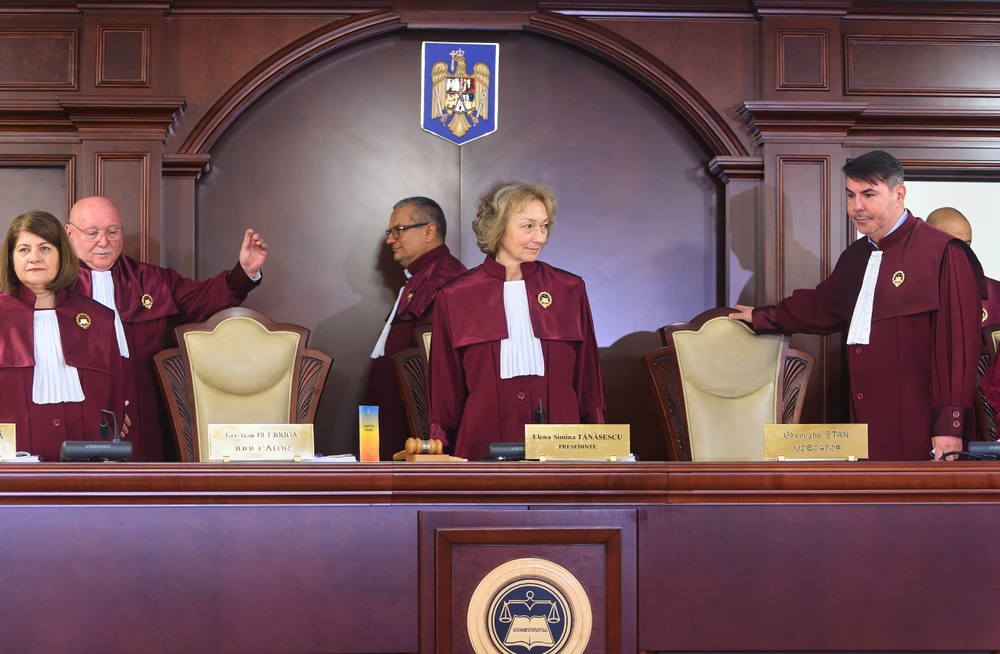
The judiciary risks becoming not only delegitimized for Romanians, but simply irrelevant, believes Horațius Dumbravă, former judge and former president of the Superior Council of the Magistracy. What happened at the Constitutional Court – where some of the judges deliberately chose not to judge a case with which the Court was legally referred – shows the real size of the institutional disaster at the top of the judiciary, writes the former magistrate in an opinion piece for HotNews readers.
The recent developments at the top of the judiciary (CSM – judges' section, the High Court of Cassation and Justice and the Constitutional Court) are symptomatic of the serious institutional deterioration, with direct effects on the functioning of democracy and the rule of law. Under these conditions, the capacity of justice – at its peak, I repeat – to protect fundamental rights and freedoms, to ensure the balance of power in the state, becomes questionable. It is, I have no doubt here, an institutional failure of the Romanian state that hits directly at the pillars that define Romania's membership in the European Union (art. 2 of the European Union Treaty).
“It is unthinkable for a judge of a common court to refuse to hear a case”
What happened these days at the Constitutional Court shows the real dimension of the institutional disaster at the top of the judiciary. It is unthinkable for a judge of a common court to refuse to judge a case, resorting to tricks specific to the political powers established in the state (Parliament), and not to a jurisdictional authority, with a serious disregard for the fundamental principles, universally valid, according to which justice works.
And one of these principles is that of “denial of justice”, which denotes, if you will, the refusal/failure, including by inaction, such as not securing a quorum to resolve a case, to ensure the effective resolution of a case within a reasonable time.
Moreover, in the practice of common courts, there have been extremely few cases in which judges have refused to deliberate with their colleagues from the panel or to pronounce a decision. And if this happened (I repeat, very few times), the judges in question were disciplined with the most serious sanction: exclusion from the judiciary. And yet the common courts number about 5,000 judges. The Constitutional Court, on the other hand, is composed of only 9 members.
At the same time, an elementary fact must be emphasized: the higher one is in the jurisdictional hierarchy – the Constitutional Court and the High Court in the present case -, the more drastic and demanding are the responsibilities and obligations of the judges. Precisely the strict observance of these obligations sends a signal of institutional stability and professionalism to the other courts and, at the same time, ensures the functional coherence of the entire judicial system, an essential ingredient for citizens' confidence in a stable justice system.
The basic obligation of the Court
The Constitutional Court of Romania is undoubtedly part of the national judicial system, and, through its judicial function, it has the obligation, the duty to ensure the application and effectiveness not only of the Romanian Constitution, but also of European Union law. The Court of Justice of the European Union explicitly clarified this European dimension of the CCR jurisdiction in several decisions, the famous case being relevant Euro Box Promotion and others (C-357/19 and related cases).
In other words, the CCR cannot invoke its nature of special jurisdiction to evade the obligations arising from its status as an independent and impartial court within the meaning of European Union law (art. 230-237 of the Decision Euro Box Promotion), including the elementary obligation not to refuse to judge a case.
It is not clear to me if the four constitutional judges who boycotted the CCR meeting twice – thus choosing, without any hesitation, to abandon their obligations according to the Constitution and Law no. 47/1992 on the organization and operation of the CCR – acts as part of a political cartel.
The suspicion is not without context: in the fall of 2024, the same Court shamefully suspended the electoral procedure for the election of the President of Romania, in a gesture that fueled the perception of a political involvement incompatible with its constitutional status.
“Justice reform solutions can no longer be cosmetic”
Such behavior, which is added to other slippages already known at the top of justice, can no longer be ignored. There is a lot of talk these days about justice reform: governmental working groups are being set up, opinion polls are being commissioned at the presidential level. The problem is that the solutions for the institutional reform of justice can no longer be cosmetic. They will most likely have to be radical.
A deep rethinking of the functioning of the Superior Council of the Magistracy, especially the section of judges, and the High Court of Cassation and Justice – institutions that have accumulated excessive administrative power – is necessary, as well as the mechanism for appointing judges of the Constitutional Court. Romania cannot afford, now, in an extremely difficult European and global context, to remain captive to a group of people who end up deciding (our) future.
There is a need for real society control over the functioning of these institutions from the top of justice to regain citizens' trust in justice and to demonstrate that the Romanian state is capable of guaranteeing democracy and the rule of law, as it undertook in its capacity as a full member of the European Union.
Because all of this comes from a massive lack of confidence in the judiciary today. According to a Curs survey (December 2025), only 24% of respondents still give credit to “ordinary” justice (common courts), and the Constitutional Court stops somewhere at 26%. It is one of the worst survey results that the judiciary (the common courts and the Constitutional Court) has known since Romania entered the European Union.
And the problem is not just one of public perception.