Dual use means that the company not only creates for commercial purposes, for the civilian market, but also begins to create products and components and provide services that can be used for defense and security applications. For many companies, dual use is an opportunity for development and an additional sales market. This is also the main reason for entering the dual use area for 87%. – according to the report “Dual-use. Business in the security ecosystem”, prepared by the Ayming consulting company.
The authors of the report indicate that the growing demand – resulting from both the geopolitical situation and market growth forecasts – translates into specific decisions: the construction of new business lines, the development of research and development (R&D) and the preparation of operational facilities.
Entry into dual-use and defense supply chains however, it requires investment. Many companies invest their own funds, but there are more possibilities. As Piotr Frankowski, managing director of Ayming Polska, explains, the availability of support instruments is increasing – subsidies, co-financing programs and tax and capital mechanisms, thanks to which the company's operations can be scaled with less burden on the balance sheet.
Read more: How do companies finance innovation? The R&D relief still has great potential
Why companies are or plan to enter the field of defense and security
The report is based on the results of a survey conducted by Ayming in March 2026 among 150 representatives of medium and large technology and industrial companies that already have experience or specific plans to enter the field of defense, security or dual-use.
The report shows that most companies enter into dual-use because they see demand in the area of defense and security. The companies also believe that the market will grow by 2030.
Reasons for companies' interest in dual use
— The dominance of the demand signal – both resulting from the geopolitical situation and market development forecasts – shows that companies make decisions about entering dual-use based on real revenue and growth prospects and calculations resulting from the reaction to current events. In practice, this means that in the coming years we can expect further acceleration of companies' activity in this area and systematic building of market presence – says Piotr Frankowski.
Where do the funds for investments come from and what about R&D activities?
Entering dual use means the need to make investments and develop research and development activities.
The report shows that it's close 60 percent surveyed companies are already conducting or planning to launch R&D work related to dual-use within the next two years, and another 38 percent companies are considering such actions.
Companies plan high investments. Among companies active or planning research and development as much as 60 percent declares that it will incur expenditure of at least 3%. their revenues.
As Piotr Frankowski says, the armed forces plan to allocate only 0.5 percent to R&D activities. defense budget. According to the expert, this means that the focus on building technological capabilities is shifting towards the private sector, which – as the research results show – is increasingly ready to take on this burden.
— This changes the direction of innovation: increasingly, solutions developed on the civilian market become the basis for adaptation in defense, and not the other way around. This model is strengthened by initiatives such as NATO Innovation Continuum 2026, which encourage companies and research centers to submit technologies in areas including: AI, autonomous systems or cybersecurity, and then testing and implementing them in the defense environment – explains Piotr Frankowski.
The expert adds that private investments in dual-use may turn out to be not only a complement to public expenditure, but also one of the key drivers of increasing innovation in the entire economy.
The report also shows that financing R&D in the dual-use area is based primarily on own funds (51 percent)supplemented by tax breaks (33%) and the capital of a venture capital fund (VC/PE – 31 percent).
Only 18 percent companies are supported by credits or loans, and 15 percent take advantage of subsidy programs.
Read also: The tax office changes the approach to invoices in KSeF. These are the red flags now
How to use tax reliefs, including R&D
— In the case of dual-use R&D projects, the optimal approach is to build financing in the formula of combining support instruments, in which each of them plays a separate function in the project life cycle. Grants and grants should focus on financing key development stages: demonstrators, pilots and technology transitions to higher levels of readiness, while Tax reliefs can be a stable mechanism for systematically reducing R&D costs, supporting the continuity of investments. This approach corresponds to the specificity of dual-use, where the advantage is built through iterative product development, not one-off projects – points out Agnieszka Hrynkiewicz-Sudnik, consulting director at Ayming Polska.
We explained how to take advantage of the R&D relief in this article.
The report also shows that in plans for 2026-2030, the importance of subsidy programs is growing. Companies indicate that their own funds will still be the basis for financing R&D (52%), but 25% would like to use subsidy programs. subjects.
What barriers do companies indicate to the development of dual use?
The authors of the report also point to barriers that slow down companies' investment decisions (in research and development and CAPEX). The constraints are not limited to capital alone, but to a large extent result from the formal environment: entry procedures, testing and approval paths, and regulatory requirements.
Most often, companies indicated the long and unclear testing, approval and certification process as barriers (40%), followed by formal risks related to, among others, with export, dual-use and compliance requirements (33%). Strictly financial barriers are also a problem: lack of funds or high investment costs (23%) and lack of predictable purchase plans and long-term demand signal (20%). Uncertain return on investment and difficulty in obtaining external financing were indicated by 16 percent each. companies.
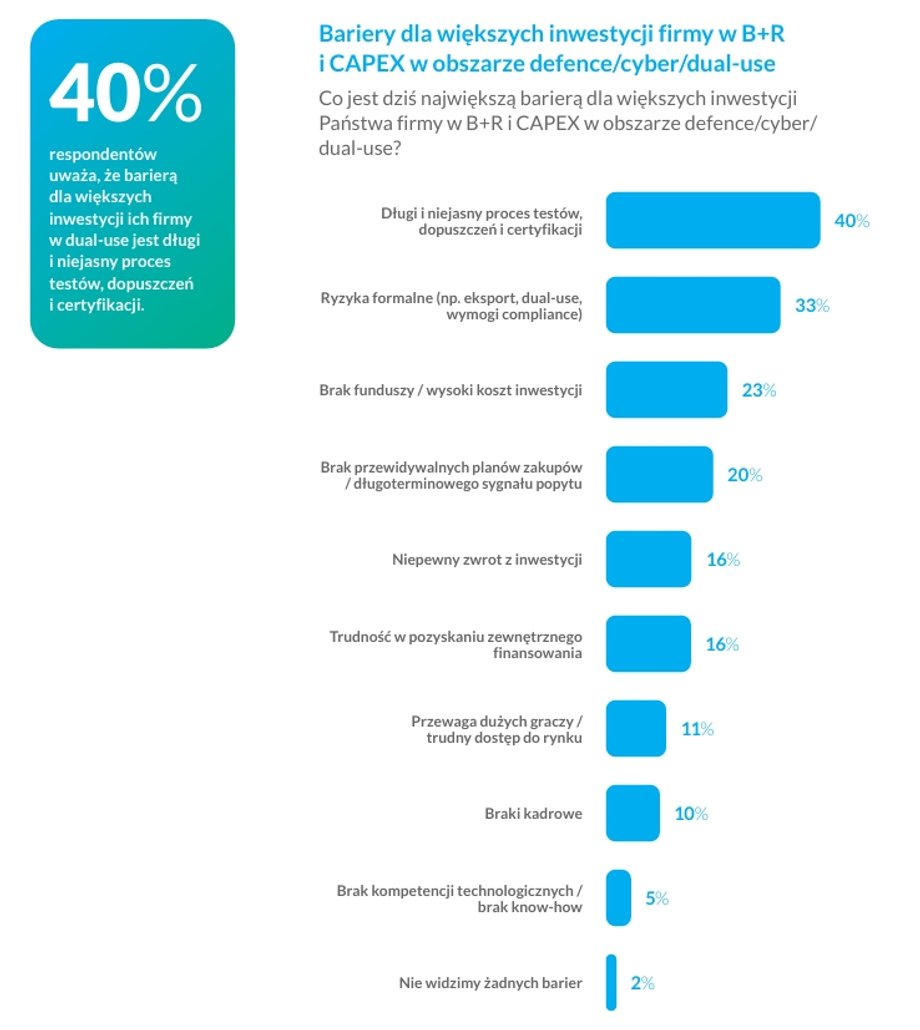
Barriers indicated by companies
— The report provides us with hard data that has been missing in the public debate so far. The fact that 60 percent surveyed companies consider the current moment to be the optimal one to enter the dual-use market, which is a powerful signal of the maturity and ambitions of Polish business. At the same time, the barriers diagnosed in the report – indicated by 40 percent respondents' difficulties in certification and approval procedures – are a clear call to action for us – says Piotr Frankowski.
Author: Łukasz Zalewski, journalist of Business Insider Polska