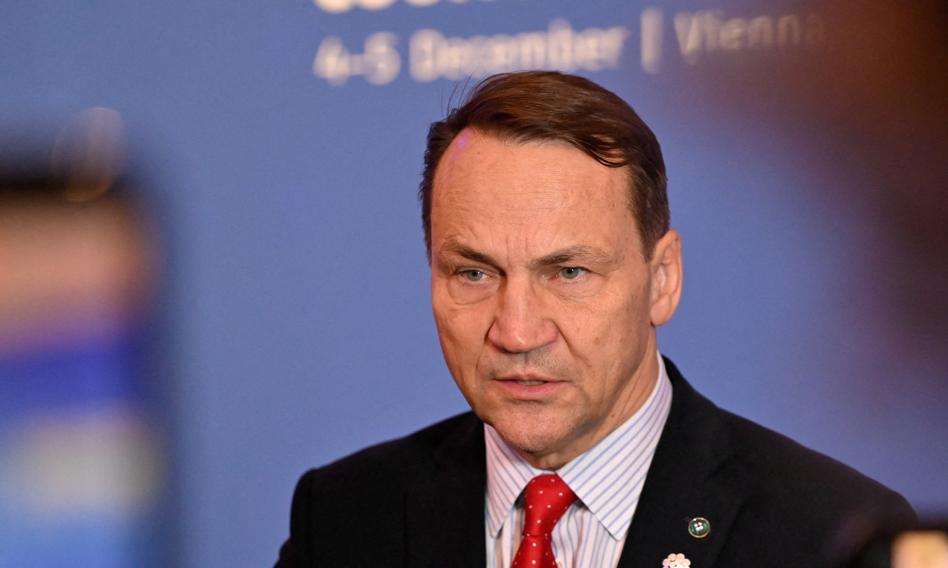
Deputy Prime Minister and Minister of Foreign Affairs Radosław Sikorski, in an interview published on Sunday for the Respekt weekly website, stated that he did not believe that the US would withdraw from Europe. He also said that for Americans, a strong EU is a more difficult partner for negotiations than its individual countries.
When asked about the new US security strategy, Sikorski said that there were many things in this document that he agreed with. “Those concerning geography, raw materials and security. In many respects it is a realistic analysis. There are also some ideological issues that are, let's say, controversial,” said the deputy prime minister.
He also stated that the content of this document is not surprising. “The United States has more things on its plate, and Europe needs to take more care of itself and its own security. Financially. Many of us have been talking about this for a long time, and some of us still have long delays in this matter. We, Poles, have been spending 2 percent (of GDP) on defense for 20 years, and this year we are approaching 5 percent.” – said Sikorski.
He emphasized that compared to Donald Trump's first term, European defense spending had doubled. “This is not a small achievement. In any case, I do not believe that the United States will withdraw from Europe,” said the head of the Ministry of Foreign Affairs.
He also said that the Americans would not close 100 military bases around the world and withdraw all soldiers back to the United States. “Right now, as we speak, American forces are blockading Venezuela and confiscating tankers subject to sanctions. Americans simply believe that Europe is rich enough to defend itself, only with distant support from America,” said the head of Polish diplomacy.
Answering a question about another part of the American document, regarding the EU and the fact that there are too many immigrants in it, Sikorski described this last comment as “strange coming from a country that was built by immigrants.” Focusing on the Americans' attitude towards the EU, he said: “Of course, the European Union bothers the Americans. It is strong, it is a more difficult partner to negotiate with. They would prefer to negotiate with individual countries over which they would have a clear advantage.”
Journalists of the weekly Repekt learned from Sikorski that he would not comment on remarks allegedly contained in the classified part of the document that the US “wants to convince Italy, Austria, Hungary and Poland to leave the EU.” “These are speculations that I cannot engage in,” he said. He emphasized that Poland's goal is to be a good ally of the USA and an influential member of the EU. “Leaving the EU would be a disaster for Poland,” he said. He emphasized that the Union will never defend itself; it must be done by its individual members and citizens.
When asked whether there is a political consensus on European unity in Poland, Sikorski replied negatively and addressed – as his interlocutors put it – political rivals: “They play on the same fears and demagogy that I saw in the early 1990s in Great Britain, when the EU treaties were approved.” He admitted that he made it his personal mission to prevent the same situation from happening again. “By the way, Brexit has shown that the EU does not take away countries' sovereignty. When Hungarians wanted to leave the Warsaw Pact or Czechoslovaks wanted socialism with a human face, Soviet tanks arrived. This is what limited sovereignty looks like. The British left. There was no EU invasion of Britain,” he said.
Part of the conversation was devoted to Ukraine and Central Europe. “I do not believe that (Putin) will risk war with NATO. After the end of the war with Ukraine, he will need several years to arm himself again. And we also have this time,” he said. When asked about the strength of his conviction, he admitted that he could not rule out that Putin would make another cardinal and criminal mistake. “According to some analyses, thanks to the Ukrainian resistance, his army has lost a million soldiers. There are not enough manpower. But, admittedly, I can never be sure of that. That is why we are arming ourselves more than ever before and we will arm ourselves even more. We are currently approaching 5 percent of GDP. More than half of these funds are spent on the purchase of combat equipment,” Sikorski said.
Sikorski also expressed surprise at the attitude of Hungary and Slovakia, questioning their arguments about the need to buy cheap raw materials from Russia. He was particularly critical of Viktor Orban's attitude. “My alma mater, the University of Oxford, where Viktor Orban studied for a year on a George Soros scholarship, is not proud of his political path. In fact, I know it is not,” he said. Sikorski emphasized that he had attended many meetings of European foreign ministers, where they were assured that Hungary and Slovakia could receive sufficient amounts of gas and oil from southern Europe. “And if the contracts were long-term, the prices would be comparable to Russian ones,” he said, adding that he believed his colleagues from the European Commission and Croatia.
“Will the war in Ukraine end next year?” – Czech journalists asked at the end of the conversation. The Polish politician replied that he hoped for a just peace that would allow Ukraine to rebuild and integrate deeper with us, the European Union countries, at least economically. However, he did not rule out that the war would continue. “Then we, Europeans, will have to support the victims of this fight so that evil does not win,” said the head of the Polish Ministry of Foreign Affairs.
From Prague Piotr Górecki (PAP)
ptg/mal/js/