The latest forecasts of the Central Statistical Office show that in 2060, Poland's population will drop to 28.4 million. That's as much as 24.3 percent. less than in 2024 The question that is being asked more and more often in the public debate is: what does this mean for the real estate market? Will we see a wave of vacancies, a collapse in prices and mass “ghost cities”? Or maybe – contrary to logic – apartments will continue to become more expensive?
Read also: Varso Tower in Warsaw without crowds. The fair turned into an installation
— Demography is a bit like that emperor from the fairy tale who walked around naked and everyone pretended not to see the problem. This has already happened – says Maciej Gołębiewski, an expert in real estate investing and creator of the website dobronajmu.pl. — Demographic processes are so long that… we have missed the moment when something more could have been done to stop population decline.
The next part below the video:
The decline in the number of inhabitants is a fact, but its effects are not evenly distributed. And this is where the story of two-speed Poland begins.
Demography down, housing market up?
At first glance everything is wrong. If the number of people decreases, why is the demand for apartments in large cities still high? The answer lies in the structure of households.
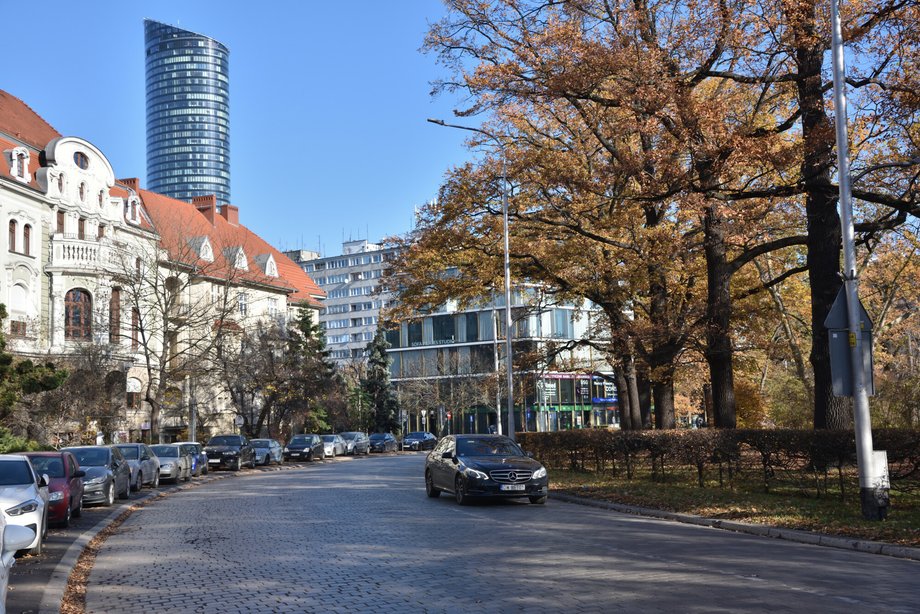
The least at risk are Warsaw, Kraków, Wrocław, Gdańsk and Poznań, in the photo: Rondo, Plac Powstańców Śląskich, in Wrocław's Krzyki
|
Bartlomiej Magierowski / East News
See also: A drifting government with some successes. Pros and cons of 2 years of Tusk's coalition [ANALIZA]
Demography doesn't end with counting heads. The Central Statistical Office forecasts that by 2050, the percentage of single-person households will increase from the current 25%. to over 33 percent Fewer and fewer people live together, and more and more people live separately. In the 1960s, an average of 3.5 people lived under one roof, today just over 3, and in the following decades it may be only 2.5.
— The increase in the number of households despite the decline in population is not a paradox the effect of changes that have been happening quietly for years – explains Maciej Gołębiewski. — Divorces, separations, living “on your own terms” and the disappearance of the multigenerational model mean that one family is increasingly turning into two apartments. There was a time when a house was built with a future floor for children in mind. Today everyone wants to have their own.
This is why the need for housing is growing faster than demographics alone would suggest. The problem is that it doesn't grow everywhere.
The “empty nest” stage and the paradox of empty apartments
Ph.D. Piotr Szukalski from the Faculty of Economics and Sociology of the University of Łódź draws attention to one more factor: the prolonged stage of the so-called empty nest.
— Spouses are living alone longer and longer because the children have become independent. This reduces the average number of people in a household and automatically increases the number of households, explains the demographer.
Simultaneously about 80 percent communes in Poland are losing inhabitants, and the largest cities and their surrounding communes are gaining. Effect? According to the last census, we have approx 1.8 million empty apartments, mainly located in peripheral areas.
— Theoretically, the situation is balanced: there are empty premises and people looking for apartments. In practice, they cannot be “paired” together. – Szukalski emphasizes. — The premises alone are not enough. Young people want work, services and social life. This is not what the depopulating towns offer them.
Houses for PLN 1 and Polish Detroit
Europe has already experienced this scenario. In eastern Germany, entire housing estates were demolished because there was no one to live in them. In Italy, houses were sold for one euro as long as someone saved them from ruin. In Poland, similar phenomena are just beginning, but the direction is clear.
— As time goes on, there will be places where There will be more than enough people willing to rent apartments – says Maciej Gołębiewski. — Prices will start to fall there not because the market will collapse, but because there will be no one to take over these properties.
The most endangered is the so-called County Poland, especially those poorly connected with large centers. One large factory is not enough to guarantee stability.
– Wałbrzych and Detroit show how quickly the collapse of one industry can take down the entire city – says the expert.
According to Piotr Szukalski We already have 18 poviats that have lost at least 20 percent in 25 years. population. Krasnystaw and Hrubieszów counties are at the forefront, where up to 40 percent have disappeared. young. A similar situation applies to the south of Podlasie or parts of the province. Świętokrzyskie.
Safe islands – who will benefit from depopulation?
The long-term forecasts of the Central Statistical Office show that: the real population increase will only concern the Warsaw agglomeration and Krakow and the surrounding area. Against this background, the situation in Łódź looks dramatic, as it has lost over 25 percent since 1989. inhabitants and may be heading towards a decline of around 40%.
Marek Wielgo, an expert of the RynekPierwotny.pl portal, cools down the catastrophic mood.
— The worst-case demographic scenario does not have to fully come true – he notes. — The decline in birth rates is partially compensated immigration — mainly from Ukraine and Belarus, but also from India, the Philippines and Colombia. Some of these people will stay in Poland permanently.
The least at risk are Warsaw, Kraków, Wrocław, Gdańsk and Poznań — cities that attract people and capital, and at the same time spread over larger and larger areas.
Growing bagels and escaping from the center
Suburbanization is one of the strongest phenomena on the real estate market today. Metropolie.pl data shows that between 2019 and 2024, the number of inhabitants in Warsaw increased by 4%, but in suburban communes – by as much as 10%.
— Over 70 percent Poles dream of a single-family house – reminds Maciej Gołębiewski. — Cheaper land and more space are pushing people to the outskirts of cities. It is also a reaction to overcrowding of apartments – in Poland as much as 34 percent premises are overcrowded, and the average area per person is 31 sq m.much less than in the West.
Effect? Metropolises are bursting at the seams, and their “bagels” are growing faster than their centers.
Ghost towns or weekend towns?
Depopulation does not always mean complete abandonment. This is an increasingly common phenomenon two-home and even multi-home.
— Residents of large cities buy cheap real estate in recreational towns – as weekend homes or investments – says Dr. Hab. Szukalski. — The scale is not huge yet, but it will grow.
However, this will not save all towns. Houses left by people who are 70 or 80 years old, often of low standard, will be increasingly difficult to manage..
Metropolises as a magnet – and a barrier
Prof. Joanna Tyrowicz, an economist from the University of Warsaw and member of the Monetary Policy Council, emphasizes that apartment is not equal.
– Singles are concentrated in large cities, which additionally increases the pressure on the local housing market – he points out. — In smaller towns this mechanism will not work. People will migrate to the metropolis anyway.
According to the economist Poland is a poorly urbanized countryand remote work will not become a mass solution for us. This means that cities will remain the main centers of life and work – as long as they can manage their own development.
Two Poland, one market
The long term awaits us growing “scissors opening” between real estate prices in metropolises and tourist-attractive towns and the peripheries without an economic base.
— In three decades Poland will be a country of two parallel realities – summarizes Maciej Gołębiewski. — Metropolises that still attract people, and counties where the lights will go out one by one.
Depopulation will not stop the housing market. It will change him — and deeply. The question is no longer “if”, but where and for whom housing will remain a desirable good.