Google Chrome integrated with Gemini. The AI agent will replace you on the network


A breakthrough in this matter will actually take place in 2025, but only in the coming months will it reach the broadly understood mainstream.
Until now, the new way of browsing the web was reserved only for the greatest tech-enthusiasts, willing to give up their current preferences, habits and convenient patterns.
In a moment it will become everyone's everyday life. This is all due to Google's decision to transform the most popular browser in the world, Google Chrome (chosen by nearly 80 percent of all people using the Internet), into the so-called agent browser.
Read also in BUSINESS INSIDER
This is a solution that has been presented in recent months by, among others, OpenAI by providing the Atlas browser integrated with ChatGPT and Perplexity, giving birth to Comet AI. In the case of Chrome, Google decided to fully integrate with an agent using their proprietary model, Gemini.
How is this supposed to work? To put it simply – completely different than what we are used to. Although the matter is much more complex and will require skills that a large part of society still does not have.
The foundation of the entire idea behind agent browsers is user role reversal. Until now, he was responsible for where he goes, what he does, in what order and at what time. Each activity required manually entering or clicking a given command. Through the browser, we accessed a number of data and information that were important to us, and then processed them in our own way – by reading, listening, watching or downloading them. The scheme seems relatively simple, but it had one drawback – it could be very time-consuming.
Agent browsers are supposed to solve this problem, taking over most of the activities from users that make up web browsing. The AI agent will read all the articles you are interested in and only send you their summary.
It will watch the video for you and summarize the most important points and moments. He will find the most suitable recipe and make the necessary purchases. He or she will find the best-rated doctor for the condition you're suffering from and make a reservation based on your calendar. He will review and respond to all emails from work, and then send you suggestions of places you can visit this weekend for an evening dinner with your family.
Of course, he won't do it completely without your participation, he will first need some direction. The instructions given to AI agents in browsers are entered exactly as we do for chatbots. The new Google Chrome, after activating the agent mode, simply opens a conversation window in which we can enter or dictate subsequent commands. Once we give instructions within a given card, we can actually exit it. An agent working in the background will start carrying out tasks that we can preview at any time. Tabs and tabs with an active agent, similarly to other agent browsers, look slightly different in the new Google Chrome – they usually have blue borderindicating that activities that “spontaneously” happen on our screen are the result of artificial intelligence.
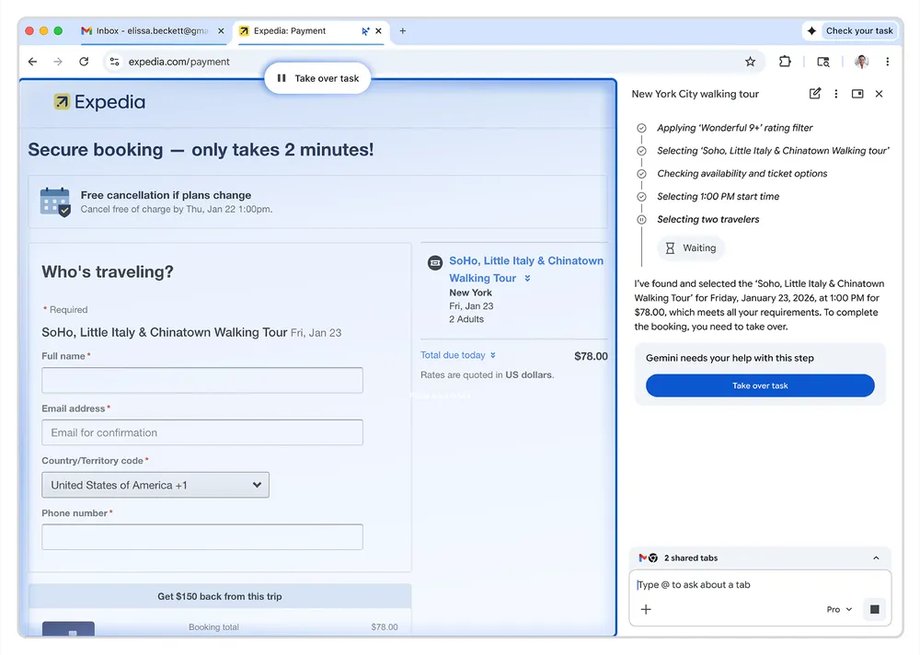
An AI agent in Google Chrome makes a reservation
The key here is that what the agent does – automatically clicking and scrolling, filling out fields, opening links – also takes time. Of course, slightly shorter than in the case of human interaction, but each of these activities requires some processing. At this time the user actually has two paths to choose from — the less sensible one, which will initially seem more natural, and the one consistent with the intentions of the creators of agent browsers. In the first option – we simply look at the command automatically executed by AI, in the meantime looking at something on the phone or drinking coffee. We don't do anything else, we observe the work of artificial intelligence and how it performs individual activities slightly faster than us.
This second option, which is to become the target way of using the Internet is based on the idea of multitasking, something that many people – also offline – have a huge problem with. And it requires a complete change in thinking about interacting with the network.
Instead of waiting for one task to be completed, we open the second, third, fourth and subsequent tabs, there we also issue new commands to the AI agent and let it run in the background. According to this idea, when using an agent browser, we do several or even a dozen things at the same time — or rather, the agent does them at our request. And what would normally take us, for example, an hour, because it would require queuing certain tasks and activities, we can accomplish in 10 minutes. Because everything is happening at the same time.
This is a promising vision of the future, in theory freeing up a lot of time during the day. But and carrying certain riskswhich we have not had to deal with on such a scale before when using the Internet.
First of all, from the very beginning of the appearance of AI agents, they have been under constant fire from cybercriminals. These solutions are still very imperfect in terms of cybersecurity, very susceptible to any attacks and external interference for a very simple reason – artificial intelligence cannot distinguish the origin of the prompt given to it. I.e. doesn't see the difference between what we type and a hidden instruction from someone from outside. She only understands that she has received an order and is trying to follow it. The so-called prompt injection, i.e. injecting prompts, e.g. via e-mail, is a constantly growing problem that all big tech companies are trying to fight – so far unsuccessfully.
Secondly, but somewhat resulting from the first one – in order for an AI agent, especially the one in the browser, to actually perform the tasks entrusted to it, we must give him a lot of permissions and access. Only when we allow him to log in to individual websites on our behalf, reveal a bunch of keys and passwords to our accounts, give him full insight into the calendar, e-mail, and transaction data, will he actually be able to complete tasks at a pace unattainable for humans. Otherwise, he will stop every time and ask for permission and temporarily take control of the process.
In its entry explaining the operation of the new Chrome, Google calls it security procedures and assures that it will prevent unwanted access to, for example, our social media or making unwanted purchases. In theory, this sounds sensible, of course, but when using the agent browser in the intended way – i.e. performing multiple tasks at the same time – the whole mechanism becomes problematic. Because requires constant “supervision” of individual cards and making sure that the agent hasn't hit any step that requires human interaction. When we overlook this, all work stops and instead of saving time, we simply waste it.
See also: Vibe coding and the vibe of the apocalypse. A disaster on the scale of Chernobyl is hanging over us
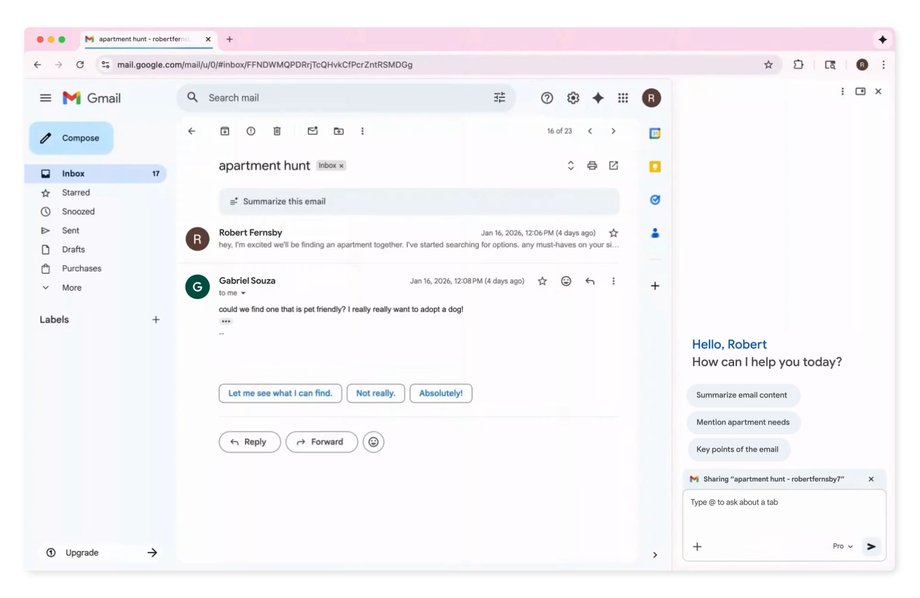
Gemini in Google Chrome while the AI agent works with Gmail
The mentioned benefits appear in this model only when the agent is given large powers. And this, for obvious reasons, will cause resistance among some people and concerns about the security of their data. Not only because of potential cyberattacks, but also because the agent acting on our behalf, records and monitors every operationand information about it is sent to external servers. Also when we do not use the agent, the very fact that it is embedded in the browser may mean something that can be called simply tracking our activity. Officially, of course, so that the agent can later better perform the tasks assigned to him and better respond to our needs.
In theory, of course, you can adopt a passive attitude and assume that big tech collects so much information about us that it won't change much. In practice, however, this means another step, taken quietly and inconspicuously, towards the end of any anonymity. The fact that we willingly put so much information into the hands of AI chatbots poses a huge privacy risk that we collectively ignore for convenience's sake. And the proliferation of agent browsers will make this problem worse. By letting artificial intelligence into our lives not only when we open the appropriate application, but also during every second of our online activity, we expose ourselves to algorithms. For Google, OpenAI, Microsoft or Meta – this is an ideal scenariowhich fits perfectly into the proposed model of the future, in which algorithms know us better than we know ourselves. In business terms, it's a goldmine, especially since most users will have no qualms about using this tool.
It is to be naturally optional and, at least at the initial stage, it will require active clicking and launching the agent mode in Google Chrome. But looking at the giant's past practices, e.g. those related to the AI mode in the search engine, it won't be long before the agent window will become the default optionwhich greets us every time we want to access the Internet.
Google Chrome integrated with Gemini debuts first in the United States and requires paying for one of the Google AI Pro subscriptions (PLN 98 per month) or Google AI Ultra (PLN 1,230 per month). The pilot stage will probably last several months, after which expansion to other markets and access to additional users is planned.