The story of the most mysterious political prisoner in Europe. His identity is not known exactly even after centuries


One of the most mysterious political prisoners in history was undoubtedly the famous “man in the iron mask”. Even to this day, it is not known exactly who was that man who actually died hidden in prison and what was his fault. Specialists issued a series of hypotheses.
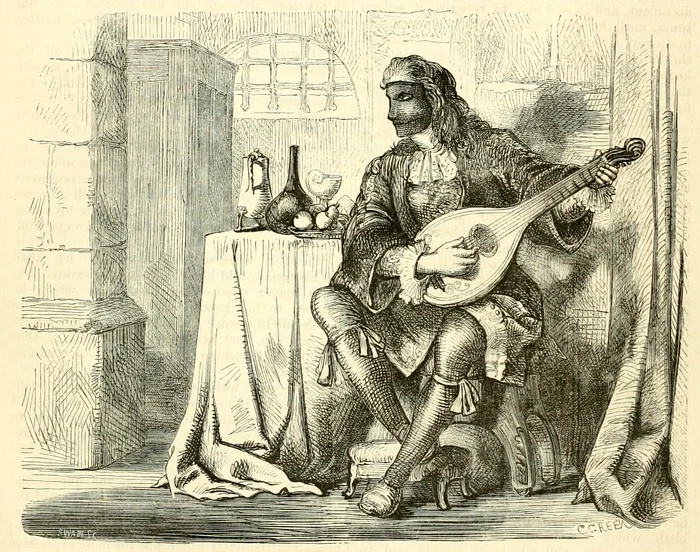
A representation of the man with the iron mask from the year 1860 PHOTO wikipedia
In 1850, in France, the novel “Vicomte de Bragelonne” was published, the last part of the trilogy dedicated to D'Artagnan, written by the famous Alexandre Dumas, which also included “The Three Musketeers” and “After twenty years”. This novel also features the story of “The Man in the Iron Mask”, a mysterious character who was imprisoned by order of King Louis XIV and forced to wear, as the name suggests, an iron mask. At the same time, the name of the prisoner was an absolute secret. The story of this political prisoner, perhaps the most mysterious in history, was addressed by several authors in works of fiction, but the most famous was that of Dumas. Incidentally, the French author also revealed the identity of the prisoner claiming that he was the identical twin brother of King Louis XIV. Obviously, it was just an opinion of the author. In reality, no one knows who the “man in the iron mask” really was and why he was made to serve such a terrible punishment. Specialists who have studied the problem have issued, however, several hypotheses.
The mysterious “valley” locked up in secret in the celebrity prison
Although a character in various works of fiction, the “man in the iron mask” was as historically real a character as possible. There is no doubt that he was a political prisoner, as his real name was carefully concealed, probably known to no more than two or three people, including the king. At the same time, his face was not to be seen by the rest of the prisoners and he was only allowed to speak what was strictly necessary, that is, to ask for what he needed and to answer essential questions.
Besides, the prison guards and commanders had to discuss with him only things of strict utility. If he had spoken anything else or dared to show his face he would have been killed. The first time, the “man in the iron mask” was imprisoned in Pignerol, a fortress-prison where only men of rank, dignitaries, princes or ambassadors who were considered a disgrace or a threat to the kingdom of France were held. Pignerol was a political prison. The first document in which the “man in the iron mask” is mentioned is from July 19, 1669, when France's Minister of War, the Marquis de Louvois, a close associate of King Louis XIV, sent a letter to Bénigne Dauvergne de Saint-Mars, the governor of Pignerol prison (now Pinerolo in Piedmont, Italy. It was under French occupation until 1639). In his letter, Louvois informed Saint-Mars that a prisoner named “Eustache Dauger” was due to arrive within the next month. It was stated that he was “just a simple valet”
The story, so later specialists showed, was clearly sewn with white thread. What would a valet be looking for in a political prison and why was he not allowed to show his face? The letter shows that the prisoner's name, “Eustache Dauger”, was added later by Louvois himself. The story of this mysterious prisoner actually begins on July 28, 1669, when he was arrested by Captain Alexandre de Vauroy, commander of the Dunkirk garrison. The character in question was brought from Calais, but in great secrecy. Not even the governor of Dunkirk knew of Captain Vauroy's mission. He believed that his man was looking for Spanish soldiers who had wandered through France, from the Netherlands. As the date difference between the letter sent by Louvois and the capture of “Eustache Dauger” shows, his arrest was planned long before. The prison commander was informed that he would receive a prisoner 10 days before he was caught. At Pignerol, the prisoner was housed in a cell with special doors that prevented anyone from eavesdropping on what was going on inside, let alone seeing the prisoner.
“The Man in the Iron Mask” was actually the “Man in the Velvet Mask”
In the fortress of Pignerol, only men with a staff were imprisoned. There were few prisoners and they enjoyed special conditions: food according to rank, heating, change of clothes, hygiene and a personal servant at their disposal. Among those imprisoned at Pignerol were, for example, Nicolas Fouquet, Marquis de Belle-Île, former superintendent of finance, arrested on September 5, 1661 by order of Louis XIV, on charges of embezzlement. Fouquet was escorted to Pignol by the famous d'Artagnan, together with a company of 100 musketeers.
Next to Fouquet, at Pignerol was also the Marquis de Lauzun, the one who had engaged, without the king's consent, to the duchess de Montpensier, Louis XIV's cousin. Another prisoner in Saint-Mars' custody was Count Ercole Antonio Mattioli, an Italian diplomat who had tricked Louis XIV into acquiring the town of Casale on the border with Mantua. Mattioli was kidnapped near Turin by a group of elite French troops and brought to Pignerol. In order not to be recognized by the other prisoners, the mysterious “valet” was forced to wear a mask. In works of fiction it is an iron mask, probably for dramatic effect. In reality, the prisoner was wearing a velvet mask. Besides, he didn't keep it on his face all the time. He was bound to put whenever he interacted with someone. If he didn't do this, he was killed.
Probably even the commander of the fortress did not know who was behind the mask. The fact that this prisoner was dangerous to the French royalty is also demonstrated by Minister Louvois' desire to completely isolate him from the rest of the prisoners. For example, when Saint-Mars asked Louvois for permission to use “Eustache Dauger” as a servant to the Marquis de Lauzun he was flatly refused. Saint-Mars had really believed that “Eustache Dauger” was a “mere valet,” as Louvois told him, and was ready to use him as such. Historians believe that Louvois had good reasons for keeping Lauzun de Dauger away. It appears that the two knew each other, or the “Dauger valet” might have been recognized by the Marquis. Furthermore, when it was suspected that Lauzun and Fouquet were trying to find out the identity of the secret prisoner, the “jack” was urgently moved to a tower on the opposite side of the fortress.
He died in prison
It is also mysterious that the fate of the secret prisoner was also linked to that of the prison commander. It is possible that the latter had the prisoner's identity revealed to him and was appointed his personal guardian, precisely to ensure that no one found out the secret. Therefore, where Saint-Mars moved, the “man with the iron mask” was also brought. For example, in 1681, Saint-Mars became governor of the prison of the Fort Exiles (now in Italy). The secret prisoner is moved there with him. This is how the “man in the iron mask” accompanied Saint-Mars to Sainte-Marguerite and the Bastille in Paris. In fact, the Bastille was the convict's last home. He was already described, in correspondence between the warden of the prison and the king's ministers, as “the old prisoner.” “He brought with him in his palanquin an old prisoner whom he had at Pignerol, whom he keeps always disguised, and whose name is not spoken”said Lieutenant Etienne du Junca upon the arrival of the new prison commander.
The mysterious prisoner was lodged in a furnished room in the Bertaudière tower and his food was brought to him by the deputy of the prison, Rosarges, which indicated that he was no mere “valet”. The masked prisoner died in the Bastille on November 19, 1703. “This day, Monday, November 19, 1703, the unknown prisoner with the black velvet mask, brought here by the governor, M. de Saint-Mars, when he came from the island of Sainte-Marguerite, and who had been in his care for a long time, felt a little sick after attending service, and died today, at 10 o'clock in the evening, without suffering any serious illness”wrote Etienne du Junca.
Who was the “Man in the Iron Mask”
The mystery of this prisoner remained unsolved throughout the centuries. Even today it is not really known who the “Man in the Iron Mask” was. However, a series of hypotheses have been issued. French court gossip indicated that the prisoner was actually an English lord somehow involved in the dispute between the Duke of Berwick and King William III. More precisely, Elisabeth Charlotte, sister-in-law of King Louis XIV, had sent a letter to her aunt in which she said that the prisoner was guarded by two musketeers, at all times, who were supposed to kill him if he took off his mask. She also claimed that she had learned from a source that he was “an English milord connected with the business of the Duke of Berwick against King William III”.
Another, more reliable source, i.e. the famous philosopher Voltaire, testified that the prisoner of the Bastille, i.e. “The Man in the Iron Mask”, was the half-brother of Louis XIV, the fruit of an extramarital affair of Anne of Austria and an unknown nobleman. The half-brother was imprisoned in secret so as not to be used by the king's opponents for a palace coup. Later, a 20th century writer with a passion for French history, Marcel Pagnol, supported Dumas' idea that the “Man in the Iron Mask” was the twin brother of King Louis XIV. He argues that the great political and religious figures of the kingdom were present at the birth of Louis XIV. However, Pagnol said that the king, Louis XIV's father, would have created a diversion by quickly moving the witnesses to a Te Deum to the chapel of Saint German Castle, contrary to custom, precisely so that the queen could give birth to the second child, assisted only by a midwife. Also in the 20th century, in the fifth decade, a well-known historian, Hugh Ross Williamson, claimed that the real “Man in the Iron Mask” was actually the natural father of Louis XIV. It was known that Louis XIII had been estranged from his wife of 14 years, Anna of Austria. Under these conditions, the queen would have conceived Louis XIV, with the consent of Richeliu, the prime minister, with an illegitimate nephew of Henry IV. Immediately after conception, this grandson of Henry IV would have been sent to America, to the colonies, to lose track of him. His mistake was that he returned, trying to blackmail King Louis XIV. He was immediately seized at Calais, as soon as he set foot on French soil, and imprisoned. Finally, another plausible hypothesis is that the prisoner was actually Eustache Dauger de Cavoye, the son of a captain of Musketeers of Richelieu and a lady-in-waiting of Queen Anna of Austria. Maurice Duvivier claims that this Eustache Dauger de Cavoye was involved in several scandalous stories, including black magic and custom poisoning. Louis XIV would have wanted the individual to disappear precisely because his mistress, Madame de Montespan, was also involved in the story. In Minister Louvois's letters to the commandant of the prison there are said to have been references to the fact that the masked prisoner was suspected of poisoning Fouquet.