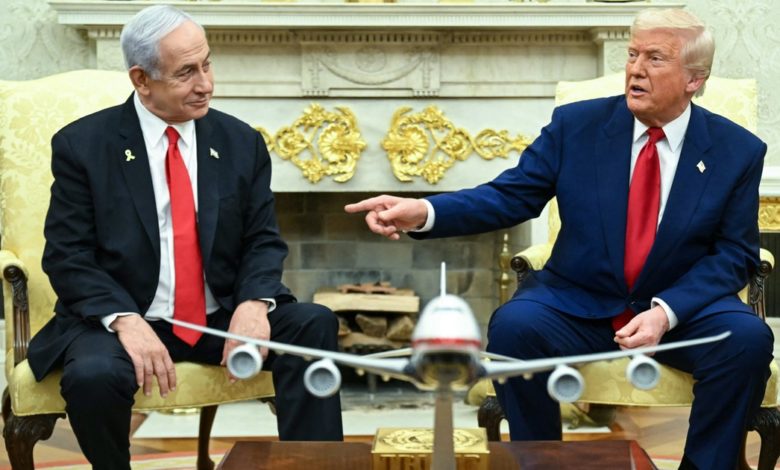
Just before closing the markets on Monday afternoon, Donald Trump invited journalists to the oval office. The US president accepted the premiere of Israel Binjamin Netanyahu and wanted to convey a message. In the morning, stock markets around the world fell sharply because Trump and his advisers only gave the messages about absolute uncompromising. As a result, American markets also opened red.
When the information appeared that Trump was considering 90-day deferring duties for negotiations, share prices shot up. Just half an hour later they fell again after the White House rejected this report as false. However, this explained what message markets needed. Ultimately, Trump said the duties would stay in place. He signaled that he was open to negotiations without conviction.
Netanyahu was the first foreign guest who personally met with Trump after he announced his duties. The Israeli government declared that he wants to endure all customs on American imports at the weekend. It was clear that Netanyahu intends to talk about trade, as well as the war in the Gaza Strip and the conflict with Iran.
However, no agreement was reached during the almost two -hour meeting. “We'll talk about it,” Trump said when he was asked to comment by journalists. This did not mean, however, that Israel would be accepted because the country already receives “billions of dollars a year”.
Trump does not want concessions
In this way Trump dispelled all hopes for the rapid end of customs chaos. Israel – as one of Washington's closest allies – should be relatively easy to reach an agreement. But this was not a message that Trump wanted to send on Monday.
Of course, he was glad that “almost every country wants to negotiate.” This does not mean, however, that the agreement will be reached with everyone. “There will be honest contracts,” said Trump. But not for everyone. “Some will pay significant duties,” he added.
Continuation of the material under the video
The example of Israel clearly showed that far -reaching offers from other countries do not put Trump automatically in a mild mood. On Monday, the EU also offered a complete abolition of all duties to industrial products. “We offered zero duties to industrial goods, as we have already done with many other partners,” said the chairwoman of the European Commission Ursula von der Leyen. Europe is always “ready for a good agreement”.
However, the offer was “insufficient” – said Trump. His goal was to eliminate the EU trade deficit. Then he directly mentioned one of the ways in which it could be done. “You can buy our energy,” added the US president.
He also declared that non -lone trade barriers, such as regulations or currency policy, would be the subject of possible negotiations. By making such demands, the American president makes it clear that he is not prepared for quick concessions.
“It's just the beginning”
Markets reacted on Monday ambivalent. The leading American index Dow Jones closed over 300 points down. The S & P500 ended the day with a slight fall after a crazy ride by a mountain queue, while the NASDAQ technological index ended the day with a slight increase.
Uncertainty was fueled by the fact that Trump's opinions are influenced by advisers who, behind the scenes, are fiercely struggling for power. For example, Treasury Secretary Scott Bessent leads a group of negotiators. Trump instructed him to “open negotiations to realize the vision of a golden age for global trade,” he wrote on X, announcing talks with Japan.
Brendan Częlowski / AFP
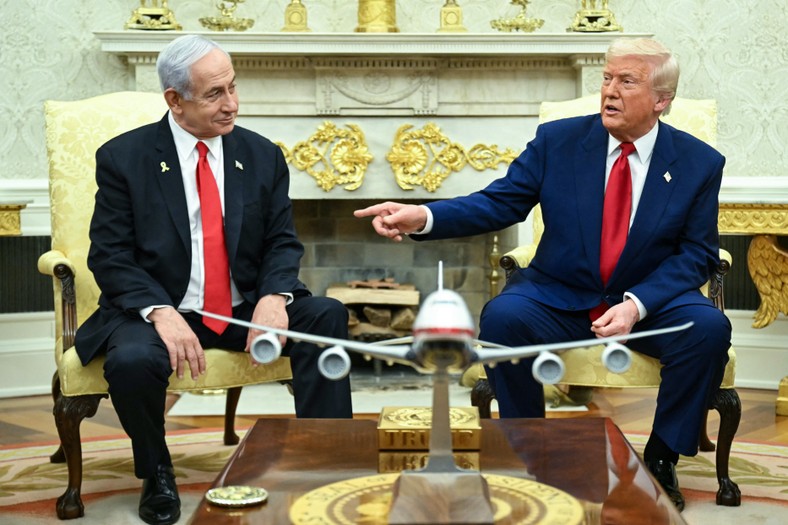
US President Donald Trump and the Prime Minister of Israel Binjamin Netanyahu in the White House, April 7, 2025.
Kevin Hassett also spoke on Foxnews with a great desire to talk in the White House. “Trump will hear our partners if they come to us with a contract that will help American employees,” he said.
At the same time, the hospitable article of the trading consultant Peter Navarro appeared in the Financial Times: “Donald Trump's tariffs will repair a broken system.” This is an extraordinary situation, not negotiations. “World leaders who suddenly offer a reduction in duties after decades should know that this is just the beginning,” wrote Navarro.
Shortly afterwards, Elon Musk attacked Trump's adviser on X. “He built a g *** about” – he wrote. Later, however, Musk removed this post.
Middle Eastern plan Trump
Netanyahu's visit was overshadowed not only by the tariff shock that Trump inflicted to Israel. The Middle East also became the subject of discussion because The situation in the Gaza Strip has become inflamed again. Trump's negotiator, Steve Witkoff, negotiated the suspension of weapons in the Gaza Strip before the US President took office, which was to lead to a peace plan.
This agreement brought Trump a triumph in foreign policy before January 20. However, from mid -March the Israeli army has been bombing the Gaza Strip again. According to Palestinian reports, hundreds of civilians, including many children, were killed and injured. The humanitarian situation is catastrophic. The agreement on the hostages was suspended. Work is currently underway on a new agreement, 'said Netanyahu in the oval office.
Unlike his predecessor Joe Biden, Trump does not try to dissuade Netanyahu from his hard approach to Hamas. Instead, the US president announced during the February visit of Netanyahu that the United States wants to “take over” the Gaza Zone, and Palestinians living there will not be able to come back.
Part of the Middle Eastern policy discussed by Trump and Netanyahu is also joint action against Iran. The US President announced that direct talks between Washington and Tehran will take place on Saturday. He added that it will be a “high -level” meeting. At the same time, Trump threatened with military strikes, and the Pentagon is working on increasing the number of American troops in the region. “If the conversations are not successful, Iran will be in great danger,” Trump threatened.
I’m Ashley Davis as an editor, I’m committed to upholding the highest standards of integrity and accuracy in every piece we publish. My work is driven by curiosity, a passion for truth, and a belief that journalism plays a crucial role in shaping public discourse. I strive to tell stories that not only inform but also inspire action and conversation.