Security experts warn that Finland's bay – a narrow portion of water between Finland, Estonia and Russia – could become the triggering point of a direct conflict between Moscow and NATO.
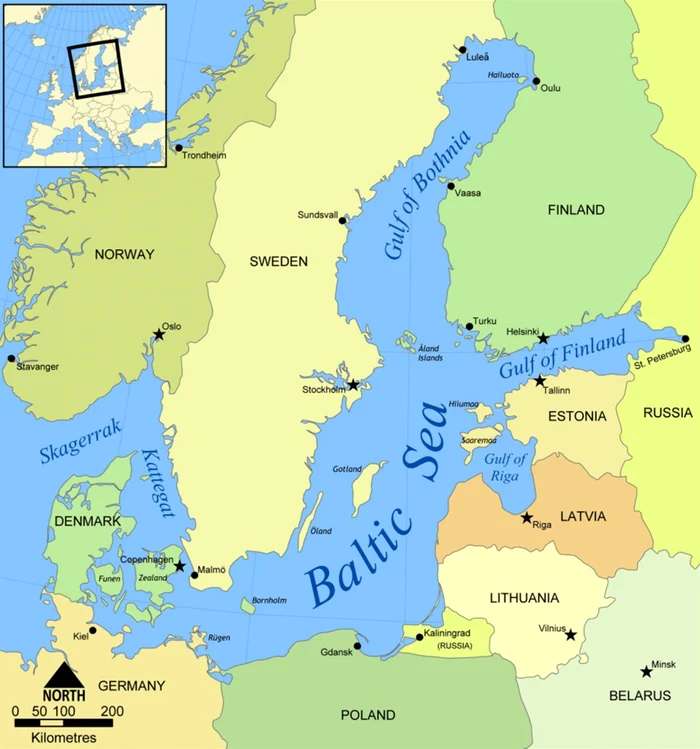
Located between the capitals of Helsinki and Tallinn, with St. Petersburg to the east, this arm of the Baltic Sea is of a disproportionate strategic importance compared to its dimensions. Over the last year, the area has become a witness to air confrontations, suspicious naval activities and underwater sabotage incidents, amplifying tensions between Russia and the North Atlantic Alliance, writes The Sun.
A restricted area but with a global stake
With a width of only 130 kilometers, Finland's bay is one of the most sensitive maritime regions in Europe. According to the International Security Expert Tom Keatinge, “it is a very narrow, but extremely military space. Errors or challenges in such places can have unpredictable consequences.”
Here frequently pass Russian commercial and oil vessels, some of them belonging to the so-called “ghost fleet”-a network of ships with difficult to identify, used, according to Western analysts, to transport oil and other goods despite the international sanctions imposed on Russia.
“Finland's bay has become a vital link for Moscow's war economy,“Explains Natalie Sabanadze, former Georgian diplomat and an expert in Russian foreign policy. “Through these ships, Russia manages to mitigate the effect of sanctions and maintain commercial flows.”
The “ghost fleet” and the danger of sabotage
However, several recent incidents suggest that some of these ships do not only carry oil. In September, the French authorities detained a suspicious vessel, accused of participating in launching drones in the NATO airspace, after passing through the bay of Finland.
A few months before, another ship, Eagle S, had been involved in deteriorating five submarine telecommunications cables – an incident cataloged as “sabotage” by several European capitals.
Sabanadze warns that the lack of rigorous control in the region could encourage the repetition of such actions: “Whether it is recognition, sabotage or illegal transport, these vessels take advantage of a vacuum of supervision and create serious risks for European security.”
Airfalls and Demonstrations of Strength
Finland's bay is not just the scene of a naval shadow game. In recent months, the air space above it has become a direct contact area between NATO forces and Russian aviation.
In a recent incident, two F-35 Italian aircraft escorted three Russian MIG-31 aircraft for 12 minutes, capable of transporting nuclear armament, after they had entered the ally air space.
In another episode, a Russian plane SU-35 was observed aggressively flying a suspicious oil near the Estonian coast-a demonstration of force that aroused firm reactions to Tallinn.
“The Russian Federation is ready to defend its shadow fleet at any price,“Keatinge said. “The situation is really serious.”
A vulnerable chain from the sleeve channel to St. Petersburg
The route of the commercial ships that leaves from the Russian ports to the Atlantic passes through a series of narrow points-from the Danish straits to the sleeve channel-which makes the entire extremely sensitive route.
“The risk of something to go wrong is high,” ” explains Keatinge. “It can be an aerial collision between NATO and Russian aircraft, or an oil leak that would affect the coasts of Poland. In such narrow spaces, small errors can become international crises.”
A challenge for the whole of Europe
Although Finland and Estonia have increased supervision in the region, experts warn that the answer must be coordinated at European level.
“If only Finland's bay is controlled, Russia will move operations elsewhere,” says Sabanadze. “There is a need for a comprehensive approach – from the Baltic to the Black Sea.”
She points out that for Russia, Finland's bay is a safe alternative to the Black Sea, where the Ukraine war makes maritime transport more risky.
“A dangerous game of challenges”
While the war in Ukraine continues, Moscow seems willing to maintain the pressure on NATO in the Baltic region, constantly testing the physical and psychological borders of the Alliance.
“This is the reality we face now,” “ concludes Keatinge. “These ships can carry oil, or may not. But it is certain that he is not there for harmless purposes. ”