For nearly two centuries, Western Europe organized, intermittently, extensive military campaigns against the Islamic states of the Near East, known as the Crusades. Although officially justified by religious motivations, specialists claim that behind these wars were much more complex interests.
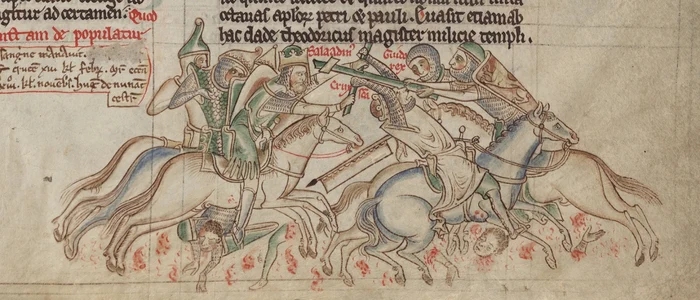
Battle of Hattin during the Crusades PHOTO wikipedia
November 27, 1095. Clermont, 11th century France. Pope Urban II, on a French “tour” gives a speech and issues an appeal that will change the European medieval world and beyond. In short, it calls for Christian warriors to go fight Muslim “pagans” to reclaim Christian holy sites located in the Middle East. It was mainly about Jerusalem, the place where the Holy Sepulcher was located, in the hands of the Seljuk Turks. His sermon aroused general enthusiasm, being greeted with the cry “Deus vult” (God wills) and a military, religious, demographic and social movement unprecedented in European history.
The call of Pope Urban II would lead to an intermittent assault by the Christian West on the Muslim East, spanning two centuries. From 1096 to 1270 there were eight major crusades with profound implications on all levels. For a long time, religious reasons were displayed as the main purpose of the crusades, that is, those invoked by Pope Urban II, but modern specialists nuance the situation. There are many opinions regarding the origin and motivation of these centuries of fighting. Among other things, there was no lack of the desire for adventure, the specter of enrichment and robbery, the interests of the feudal lords, but also of the Church.
Centuries of struggle for power in the name of religion
The Crusades were not the first conflicts between Christians and Muslims between the European West and the East. They were just the peak. Since the early Middle Ages there have been numerous conflicts between Christians and Muslims, either between the Byzantines and the Arabs, or between the various western European kingdoms and the Arabs. Among the most important conflicts between the Christian West and the Muslim East, which preceded the Crusades, was the great Arab conquest that began in the 7th century, with the death of the Prophet Muhammad, with the pretext of the holy war against the “infidels”.
In the 8th century, the forces of Islam managed to conquer a large part of Spain and were stopped from entering France by the Battle of Tours in 732. At the same time, other Christian territories in Europe were occupied by Islamic armies in the 9th century, for example Sicily. We are not talking about Muslim raids in the territories of the Franks and Italians, such as the one in 935 when Genoa was devastated or the one in 950-952, with the looting of Calabria. There were opinions that indicated that the beginning of the Crusades was as a kind of Christian revenge for the Arab conquest. In reality the motivation was much more complex. Furthermore, those in areas not affected by the Arab invasion did not have the same motivation as those in Spain and Italy, for example.
A Byzantine affair that fired the imagination in Rome
Arab raids were no longer necessarily a problem for Western European Christendom. And this in the conditions where there were conflicts of a political and religious nature between the different Islamic factions. The Crusades actually originated in Byzantium. At least as an idea and impetus. The Eastern Roman Empire or the Byzantine Empire had serious problems with the tribes of the Seljuk Turks, steppe tribes, converted to Islam. More precisely, in the last decades of the 11th century, the Byzantine Empire suffered a heavy blow.
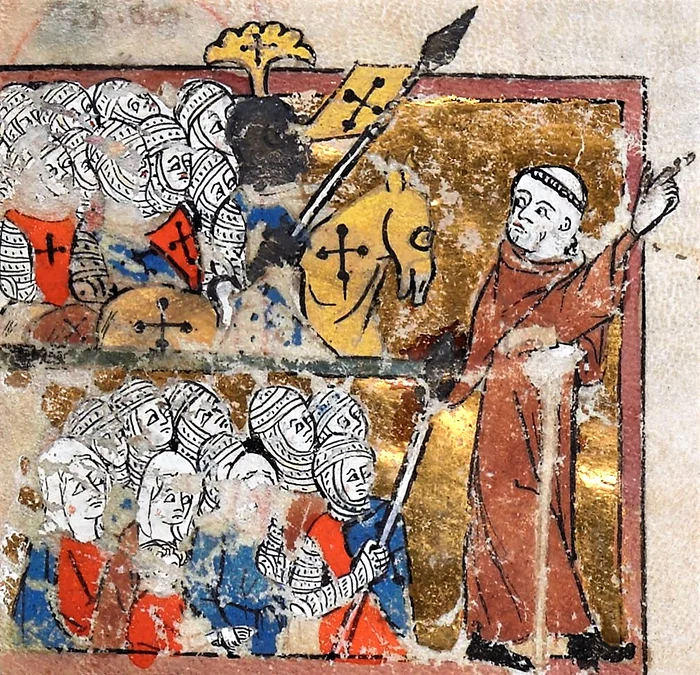
Peter the Hermit PHOTO wikipedia
In 1071, the Roman emperor IV Diogenes lost the battle of Mazinkert to the Seljuks. The consequences were catastrophic for the Byzantines. They lost Anatolia and much of the adjacent areas of Asia Minor. The emperor's defeat and imprisonment led to internal strife in Byzantium, which further weakened the empire's political and military power. Not to mention the financial shock due to the huge sums spent for the redemption of the Roman Emperor, but also the loss of some particularly important cities from an economic point of view. Following the civil war, the Komnen dynasty imposed itself on the imperial throne.
More precisely, the emperor Alexios I Comnenus, the father of the famous Ana Comnena, the author of the “Alexiade”, arrives. Alexios realized that the Byzantines would not be able to recover the lost territories in Asia Minor on their own. And then he decided to turn to the Christian kingdoms of the West. And he also found the perfect bait: Jerusalem. The “Holy City” of Christendom was under Byzantine rule until the end of the 7th century, when it was lost to the Arab dynasties.
Finally, in the 11th century, it came under the control of the Seljuk Turks. So Alexios I acted smartly. He launched an appeal to the Pope from Rome in 1095 asking for help from the Christian brothers for the liberation of Jerusalem. For the Byzantines it was extremely convenient. With the help of Christians from the west, they liberated not only Jerusalem, but also expelled the Turks from Asia Minor. Or at least weakened their forces so that they became vulnerable to the Byzantine armies.
“Seeing Seljuk control of Jerusalem as a means to tempt European leaders into action, Alexios appealed to the West in the spring of 1095 AD to help drive the Seljuks not only from the Holy Land but from all those parts of the Byzantine Empire they had conquered. The sword of Christendom would prove a very useful weapon in preservation of the crown of Byzantium”stated the historian Mark Cartwright in the work “The Crusades. Causes and Objectives” published for the “World History Encyclopedia”.
At the same time, Alexios I Comnenus took care to emphasize the fact that the Seljuk Turks imposed taxes and duties on Christians who wanted to visit the holy places, something that the pilgrims learned first hand. Last but not least, he encouraged rumors about the mistreatment of Christians in the area. Initially ignored, the appeal of Alexios I Comnenus suddenly piqued the interest of the Pope. And we will see why.
The Pope's dreams of aggrandizement and the chance to get rid of the “thugs” of Europe
Pope Urban II (1088-1099) immediately noticed the advantages of the “Byzantine question”. That is, to an urgent aid given to the Eastern Christians against the Seljuk Turks. And it wasn't even the first aid of this kind. In 1091, the pope sent troops to help the Byzantines against the Pechenegs, steppe horsemen, also of Turkic origin, who had invaded important areas of the Empire. And that's because the pope dreamed of aggrandizement. More specifically, to be able to reunite the Christian Church under his scepter. A victorious campaign of Western European forces under the sign of the papacy would have meant an important ascendancy for Urban II. He would have been a savior of Christians.
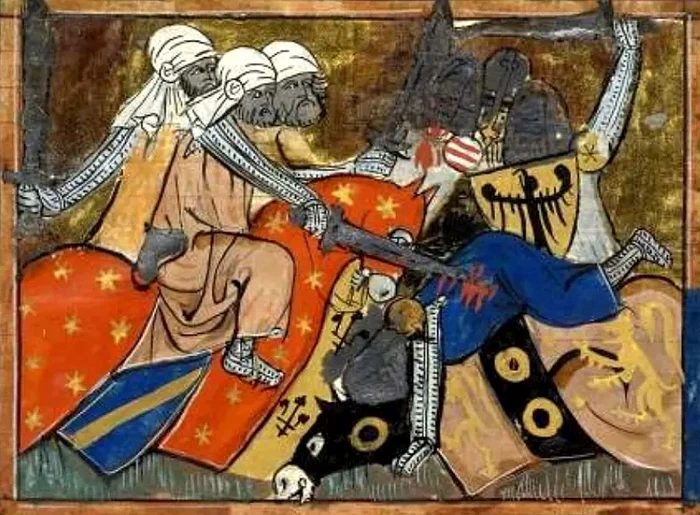
Battle of Ager Saguinus PHOTO wikipedia
“Urban II also hoped to reunite the Western (Catholic) and Eastern (Orthodox) Christian churches, with himself at the head, above the Patriarch of Constantinople. The two churches had been divided since 1054 AD due to disagreements over liturgical doctrines and practices”, stated Mark Cartwright in the same paper.
The second obvious advantage of the papacy was the consolidation of the political position in Italy, after facing serious threats from the Romano-Germanic emperors in the previous century. The Crusade would have shifted the attention of turbulent and warlike emperors, kings and dukes to another target: the Muslim East. Not to mention the fact that the pope was happy that he could rid Europe of all kinds of “thugs” focused only on conflict and robbery. It was mainly about those younger children of the seniors who didn't get to inherit anything and turned into brigand knights, robbing fortresses, cities and even monasteries.
“The others had to find a purpose. They often became warriors involved in all sorts of conflicts across Europe, those people the Church wanted to get rid of, or simply armed robbers on the high road. The Crusades gave them the opportunity to fight to gain a domain of their own, to conquer. The desire for honor, adventure, gain and lands also appeared in crusaders”wrote Jonathan Phillips in his work “Holly Warriors: A modern History of the Crusades”.
In addition, the Catholic Church wanted to extend its influence to other territories, being able to obtain believers, income and prestige.
A boon to the poor and disinherited
As Jonathan Phillips also stated in the work mentioned above, the Clermont pope's appeal and the idea that they would be able to go to the East to kill “infidels” and plunder without being accused of sins or condemned, even with all sins forgiven (as the pope had promised them), was a godsend for the large number of headless knights, nobody's warriors or the poverty of cities and villages. In large noble families, the eldest son usually inherited most of the father's domains. The youngest sons stayed by.
The East, which was said to be full of riches, represented an “El Dorado” of these disinherited. They armed themselves, rallied with each other and were ready to go to battle with the Muslims for the liberation of the Holy Sepulcher. Everyone enunciated the mystical, deeply religious idea, but many had their eyes on fortunes, fiefdoms, booty. The poverty of villages and towns left first in the Crusade. They hoped to get rid of taxes, tithes, and in addition to get their hands on some wealth. Some hoped to become “nobles” somewhere in the East. A huge mass of 10,000 men without any business of arms, including women and children, set out like a mob on the roads of Europe. When they arrived in Byzantium, to get rid of them, the emperor Alexios Comnenus threw them directly into the lion pit.
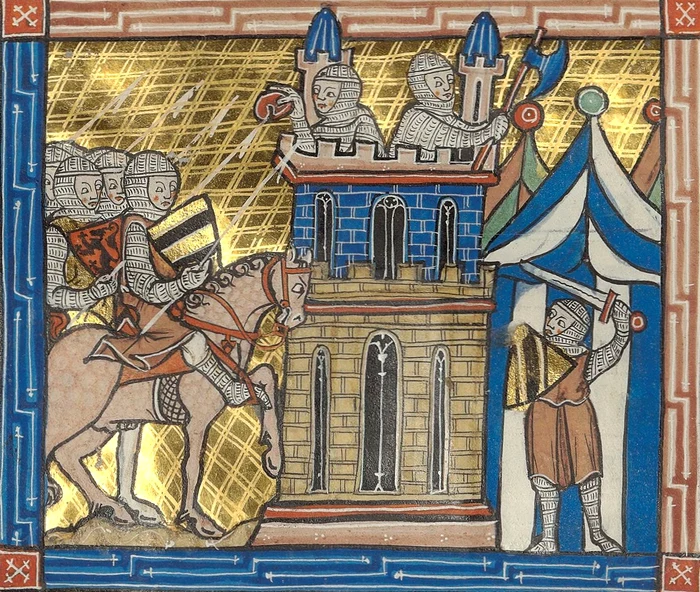
Crusades PHOTO wikipedia
That is, he sent them in the way of the Seljuks in Asia Minor. They were quickly massacred. There is no point in specifying that only a part of the 10,000 managed to reach Asia Minor. After the crusade of the chalices and the headless adventurers, the idea of the holy war in the Eastern lands caught on wonderfully with the great seniors.
Obviously they were knights animated by deep religious feelings, but most of the great seniors had clear economic interests. They hoped to gain new fiefs, new sources of income and greater prestige. “The Crusades were therefore able to offer these fighters without occupation, even some peasants, the opportunity to improve their condition. To agonize a fortune by dividing the booty and by robbery; and to those who stayed at home, by a more fair distribution of goods”wrote Robert Delon in “The Crusades”.
Merchants rubbed their hands at the thought of silver
The Crusades were supported by all social classes. Effectively, the Byzantine bait gave the expected results. What Christian would have refused the idea of freeing the Holy Sepulcher and fighting for Christ? Especially since everyone had an advantage. The poor were trying to escape poverty, the knights wanted to settle down and found a city, and the great seniors and the pope had even grander dreams. Merchants, a dynamic force in medieval society, strongly supported the Crusades. Obviously, they also had their advantages. Maybe as big as the seniors. New markets, new trade routes, meant wealth and more wealth.
“Merchants, although not as involved in the First Crusade, certainly became more involved from AD 1200 onwards as they wanted to open trade routes with the East, even controlling prosperous trade centers such as Antioch and Jerusalem. In addition, merchants could make a considerable profit by transporting Crusaders across the Mediterranean. Indeed, as early as the Second Crusade (1147-1149 AD), lucrative contracts were made in advance to transport armies to the Middle East. The Italian merchant states of Venice, Pisa, and Genoa, as well as Marseilles in France, were rivals, each eager to gain a monopoly on east-west trade. It must be remembered, however, that these cities also provided a host of religious zealots eager to fighting for the Christian cause and not just making money out of it”said Mark Cartwright.