Was he aware of this? There is no certainty. It is impossible to say whether the worker chosen to install the pyrotechnic ignition devices knew or at least imagined that with his work he would begin the most ambitious pilgrimage of all: the journey into space.
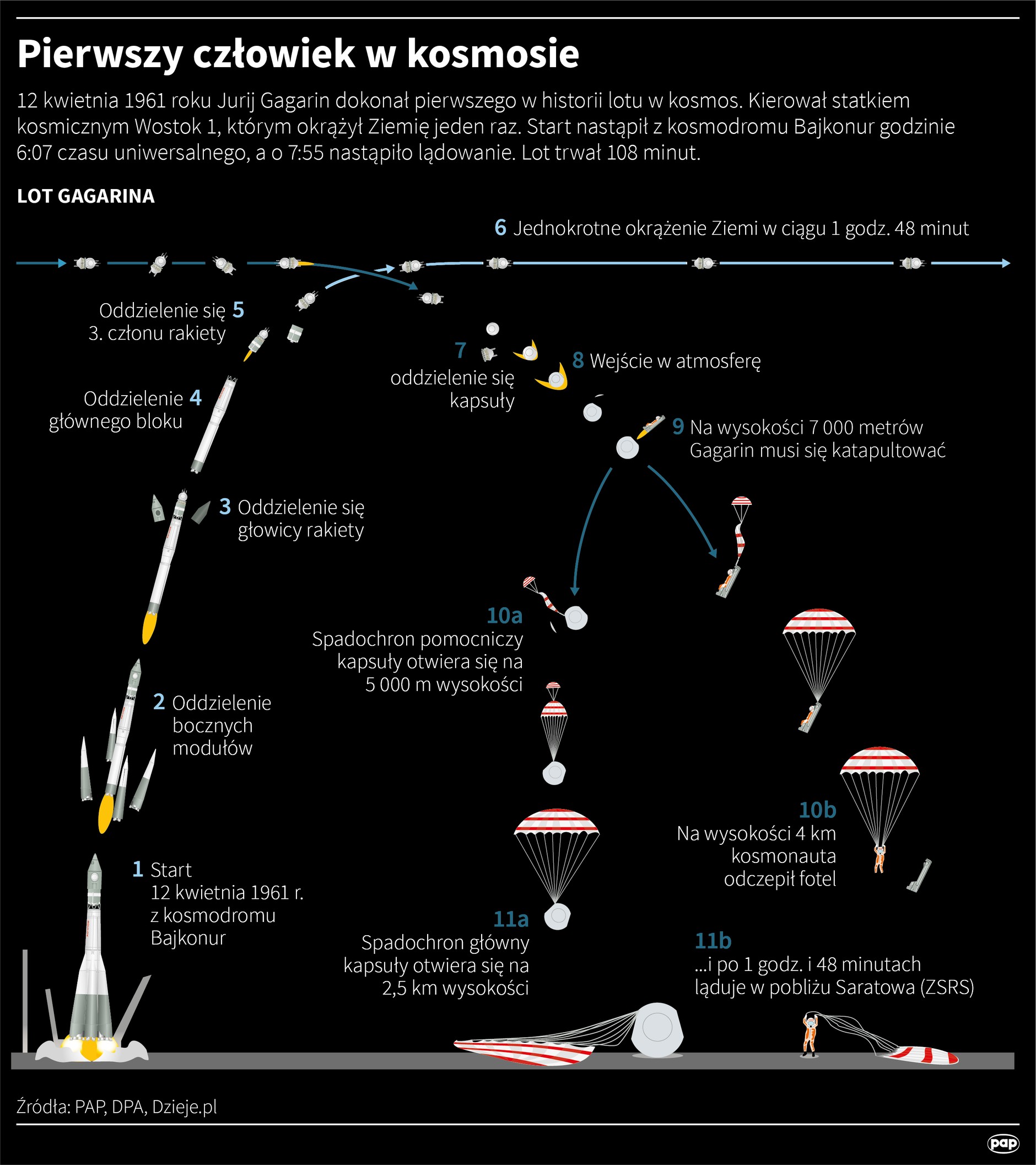
One spark in the devices placed inside the combustion chambers of the R-7 rocket and on Wednesday, April 12, 1961, when it was 9/07, Yuri Alekseevich Gagarin was shot into the sky. And even further.
Codenamed “Kedr” (cedar), Soviet Air Force Lieutenant Pilot Gagarin was twenty-seven years old and the son of Alexei Ivanovich Gagarin, a carpenter, and Anna Timofeevna, a farm worker.
The spaceship he was sitting in was called Vostok, Russian for “east,” and it didn't look particularly impressive. It was a metal ball not much larger than Gagarin himself (so small that you could say he had it on his back). himself) and containing just enough to keep him alive for about twelve days. It was powered by the same type of R-7 rocket that had put Sputnik 1 into orbit four years earlier.
The article continues below the video
Vostok it could not be piloted. Gagarin was only a passenger. Everything was calculated and determined by ground systems: man could control position relative to the Earth and little else. But for an 88-minute flight, it was more than enough.
Ship it didn't even have a rescue system. In the first 100 seconds after take-off, Gagarin could have ejected in a seat resembling the system used in jet planes and hoped that fate would be kind to him. If something went wrong in the next few minutes before entering orbit, he would have no chance. When returning, at an altitude of 7 km, it will have to eject from Vostok. Otherwise, he would have collided with the Earth and said goodbye to life.
Maciej Zieliński, Adam Ziemienowicz / PAP
During the early stages of this flight, Gagarin experienced acceleration nearly six times his weight, and although he was well trained, he lost consciousness for a few seconds. But audentes fortuna iuvat: regained consciousness and entered orbit.
In 88 minutes (108 from takeoff to landing), it orbited the Earth once. Having left our planet as a senior lieutenant, he returned to it as a hero, parachuting down in front of two terrified peasant women, a mother and daughter, in a field near Saratov, where he had learned to fly at the flying club.
Young Eagle, as Sergei Korolev called him [rosyjski specjalista w dziedzinie techniki rakietowej i astronautyki]spread its wings to fly into history, as majestic as the entire nation. He will forever remain the first cosmonaut, the first man to go beyond the Earth's atmosphere and circle our globe.
In less than 1.5 hours the perspective changed forever. For everyone.
A star is born
When Gagarin himself looked out the porthole on April 12, he could not contain his emotion. Although his journey, like all the missions launched in the last four years (five Sputniks and three Lunas, the first to leave Earth's orbit), confirmed Soviet dominance in space, the Earth seen through the porthole seemed to him “blue, beautiful and borderless.”
Immediately after landing, Gagarin became a symbolic figure, welcomed like a brother in every corner of the globe. During an official visit to Buckingham Palace three months after the start, he even managed to bend the very strict protocol of the English court. Eating a lemon after tea in front of shocked court servants, he made the amused Elizabeth II, ready to imitate him, exclaim: “Today we eat in the style of Gagarin!”
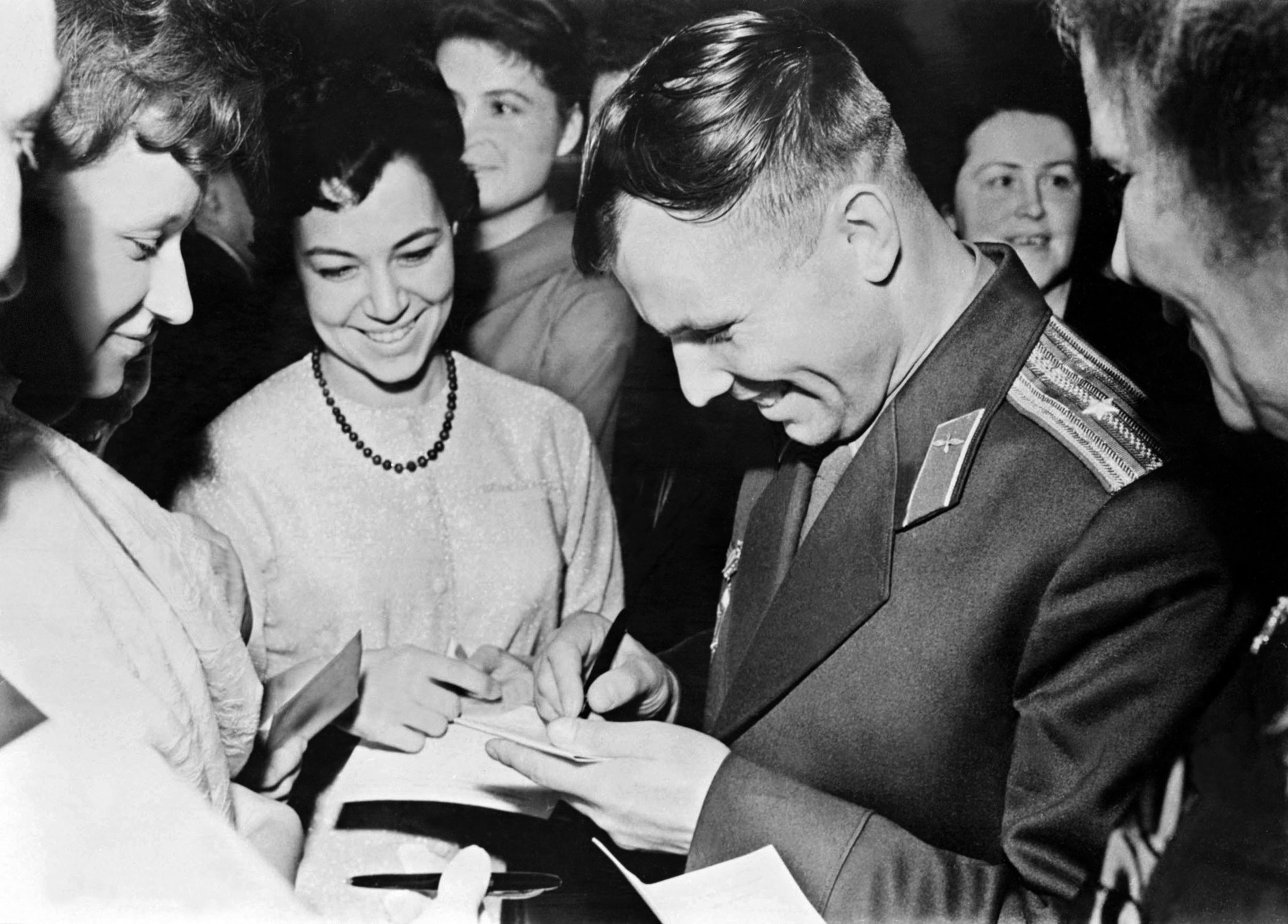
Yuri Gagarin signing autographs (1961)Collection Roger-Viollet / AFP
According to the chronicles and mythology of the time, Gagarin was characterized by simplicity, an open smile of the “golden boy” and an authentic manner. More specifically, the cosmic Young Eagle was all this and more. He was shaped by years of dedication, commitment and commitment, which led him from the fate of a country boy brought up amid the horrors of war to the work of a foundry-moulder who dreamed of flying, which he pursued with such perseverance that he placed pillows in the pilot's seat so that, despite his short height (157 centimeters), he could see the landing strip from the cabin, pass the exam and obtain a pilot's license.
He was noticed by the general and hero of the Soviet Union, Nikolai Petrovich Kamanin, who was looking for candidates for the boldest challenge that Khrushchev and the USSR had ever presented to the world: to be the first to send a man into space.
Recruited in the first group of daredevils, he fought for the title of first cosmonaut with two companions much more extraordinary than himself: twenty-four-year-old Gererman Stepanovich Titov, an intellectual with an athletic body able to recite Pushkin by heart, and Grigory Grigorievich Nelyubov, a pilot with exceptional psychophysical abilities, but hot tempered. Gagarin himself mentioned several times that they did not know who would fly until the very end. However, the official document signed by Kamanin reveals that the choice was made on March 10, a month before the start. It was only given to candidates on the evening of April 8, four days before departure.
Gagarin was also chosen for his communication skills and ability to cope with the spotlight, perhaps even a certain tendency to colorism useful to satisfy the sensation-hungry media. Kamanin knew that the first cosmonaut, despite the relative “simplicity” of his mission, would become famous all over the world.
Moreover, Gagarin had one feature that determined his choice: he was the son of the people. In line with communist ideology and propaganda, he had the perfect passport to the stars. During the Nazi occupation in 1943–1945, he lived in a 3 m by 3 m barracks, sharing it with others, and witnessed the deportation of two of his three brothers to a forced labor camp.
After moving to Gzhatsk after the war, he studied at a vocational school at a local foundry, from which he went to a technical school in Saratov, distinguishing himself with his competences and skills. In Saratov, during Sundays devoted to voluntary recruitment of cadets, he boarded a Yak-18 plane for the first time.
Since then, his path has been forever linked with aviation. After graduating from high school in 1955, he attended a pilot school in Orenburg. In 1957, he took off for the first time on his own, piloting a MiG-15 aircraft. On November 5 of the same year, he became a lieutenant in the USSR Air Force, and in 1959, he was promoted to senior lieutenant. A few months later, Korolev and Kamanin, who had been appointed chief of training, placed him along with 19 others among the first candidates to fly into space. After an extremely demanding selection in January 1961, Gagarin was among six candidates for the inaugural mission.
Symbol of the nation, hero of the people
He was such a valuable person for Soviet propaganda that he was subject to constant protection. Fearing that some accident could ruin the reputation of the living symbol of his nation, Gagarin was forbidden to fly and was assigned only representative duties. It wasn't easy for an eagle with its wings spread.
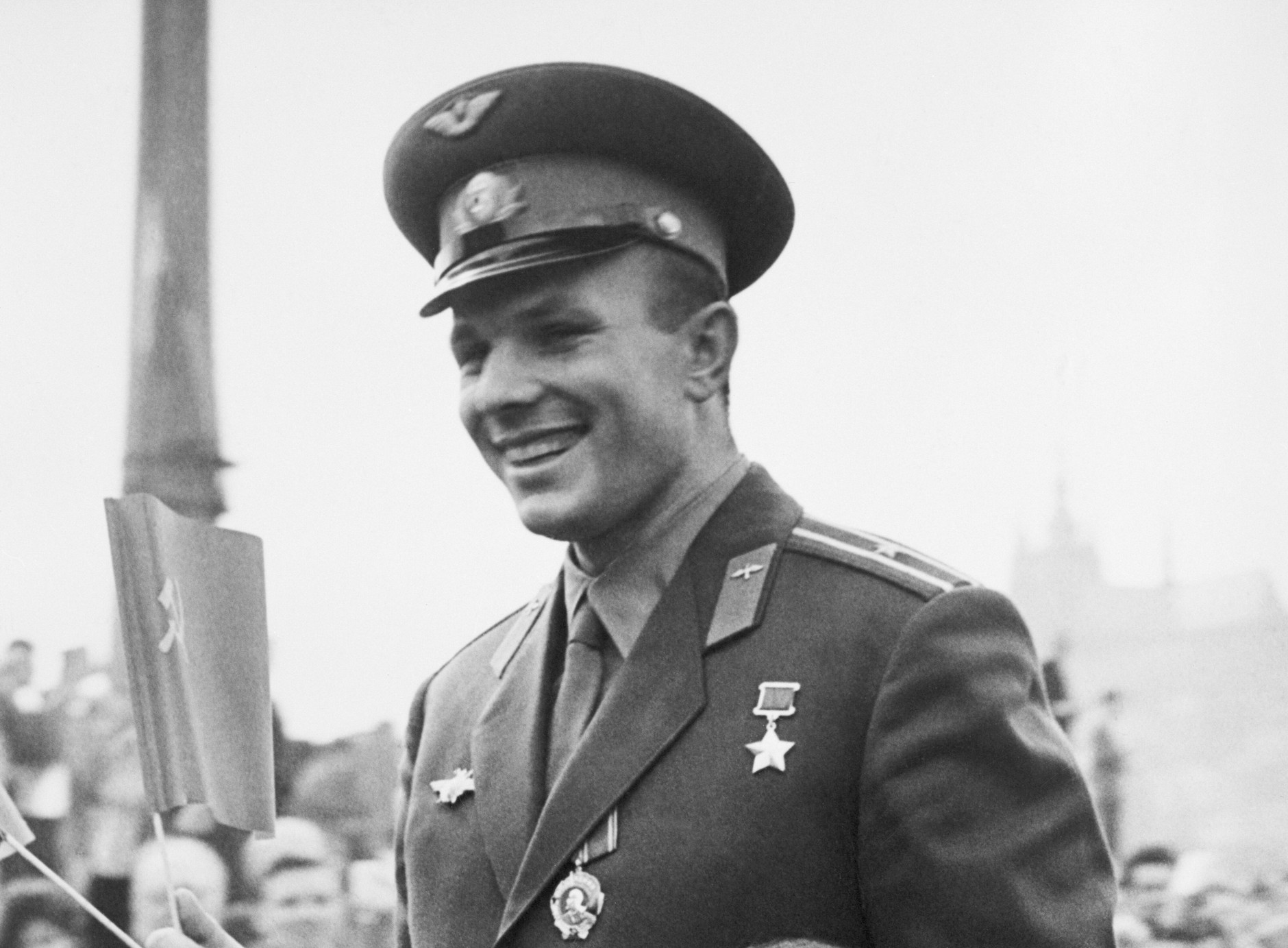
Yuri Gagarin in Czechoslovakia (1961)CTK / PAP
Of course, there was also family: Valentina Goryacheva, whom he met as a cadet and always considered the love of his life. Legend has it that Gagarin was so devoted to her that once he became an iconic figure, he rejected the advances of Gina Lollobrigida, one of the most desirable women of that time, who was hopelessly infatuated with the hero. Life gave him Valentina, and every evening when he returned from work, he gave her a bouquet of daisies. Among the many monuments erected to the first cosmonaut after his death, there is one special one, in front of his house. Stone Yuri stands looking straight ahead. Behind his back he hides a bouquet of daisies for his Valentine.
He also had daughters Galina and Yelena. As an Orthodox believer, he decided to baptize them before the historic launch, which is in contradiction with the sentence attributed to him, uttered in orbit, taken from Mayakovsky: “There is no God up here.”
After returning from the mission, he stubbornly fought to be reinstated as a cosmonaut and regain the right to fly. He succeeded. In 1964, a few months after he was appointed deputy director of the cosmonautical training center, he was reinstated as a fighter pilot.
This time, however, his success turned out to be disastrous for him.
On March 27, 1968, perhaps due to an error in the control tower at the Chkalovsk base, the MiG-15 UTI number 625 on which he was training flew dangerously close to another aircraft. It is not certain whether it was the identical MiG-15 or the supersonic Sukhoi Su-11, but it does not matter much. The plane with Gagarin and instructor pilot Colonel Vladimir Seryogin went into a spin. Due to the low flight altitude, the pilots were unable to regain control of the machine. Decades later, an analysis of the accident published by Roskosmos, the Russian Space Agency, showed that, given the choice of ejecting or crashing the machine in the village of Novoselyovo, Gagarin and Seryogin decided to do everything to save the inhabitants.
The hero of heroes was buried in the necropolis under the Kremlin walls. Today, there is no crew of astronauts or cosmonauts who, when departing on a Russian spacecraft, would not first come to his grave to lay flowers at him. There is no place in space where a cosmonaut would be without a photo of Yuri Alekseevich Gagarin.
Pablo Picasso dedicated a screen print to him, the world of music paid tribute to him: Jean Michelle Jarre (Metamorphoses), PJ Harvey (Rid of Me), Claudio Baglioni (Solo). There are monuments, awards and stadiums dedicated to his memory.
Above all, he is the first cosmonaut named after the asteroid 1772-Gagarin and the vast crater on the dark side of the Moon. They are there, in space. This new horizon that allowed him to be the first, even when Kennedy and Khrushchev suggested something completely different, to look beyond all limits. And shout to the world “They're gone!” Let's go.
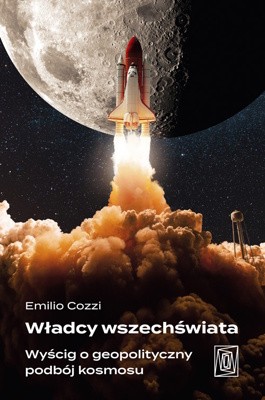
Fragments come from the book “The Lords of the Universe. The Race for the Geopolitical Conquest of Space”, which was published by Wydawnictwo Szczeliny. The author is Emilio Cozzi.
Szczeliny Publishing House