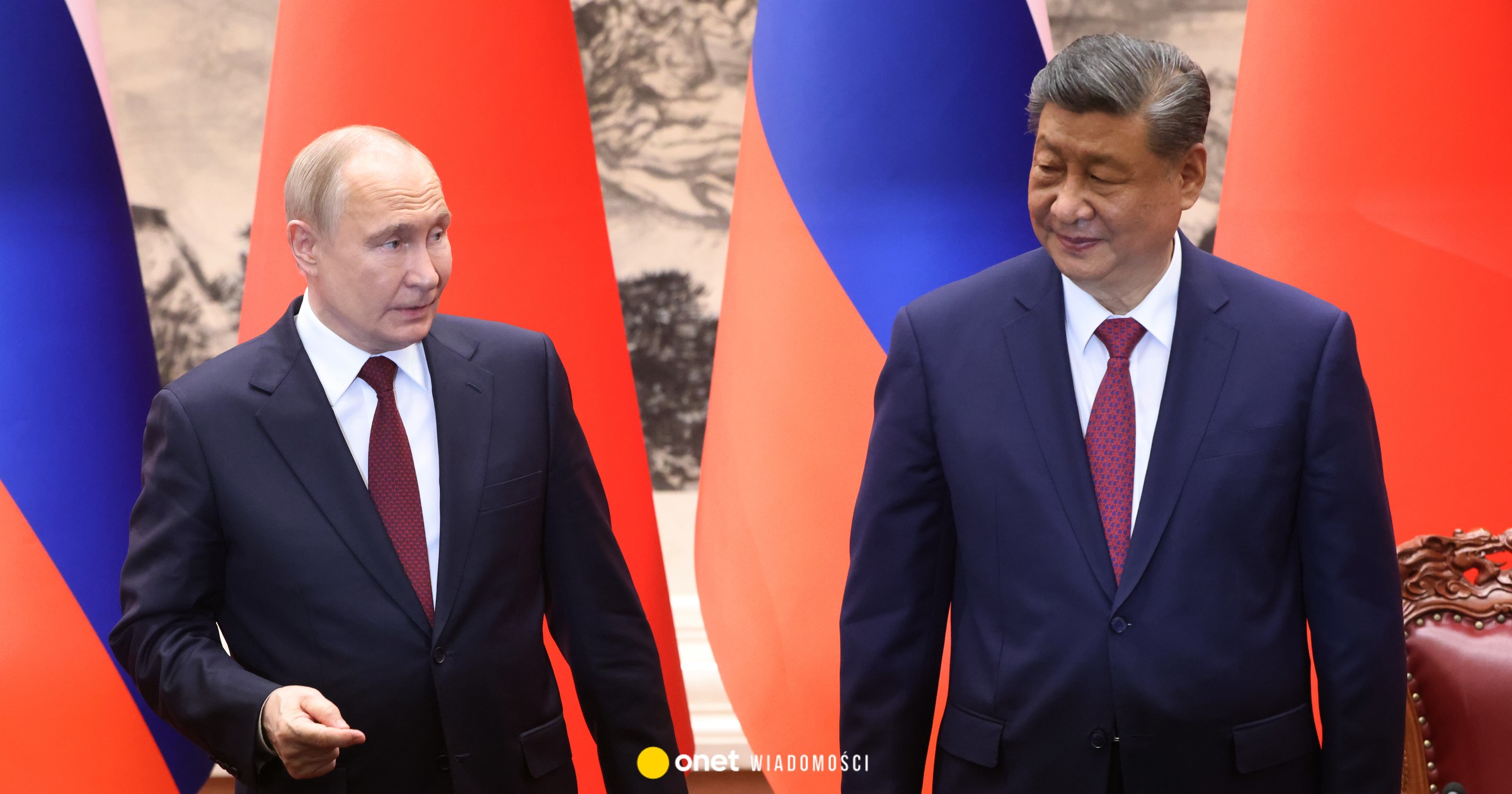
Xi Jinping likely gave Putin a stern reprimand [OPINIA]

Timothy Ash is an emerging markets sovereign bond analyst at Bluebay Asset Management Company, based in London
Perhaps Putin finds himself in a slightly more awkward position because, before launching a full-scale invasion of Ukraine, Moscow liked to view Sino-Russian relations as a partnership of brothers and equals.
The reality, however, is that as a result of Putin's failed war in Ukraine Russia has been weakened and is now becoming an increasingly dependent partner in the Russian-Chinese axis.
And if we think that Xi Jinping does not intend to use this ruthlessly, we are wrong.
Indeed, as Western sanctions have impacted Russia, the Kremlin has become more dependent on China as a market for its energy and raw materials and as a conduit for access to scarce imported goods.
This does not mean, however, that it was an act of charity for China; on the contrary, China took advantage of Russia's weakness by accepting Russian energy and raw materials at discounted prices, while simultaneously demanding the highest prices in dollars or renminbi from Russia for key imported goods.
So it's worth noting that Putin's calling card in Beijing this week was a new attempt to breathe life into the project Power of Siberia 2 gas pipeline. This is a Russian idea that has been circulating for years, consisting in building another gas pipeline that would transport gas (over 50 billion cubic meters) extracted in western Russia, previously intended for European markets, now to Asia.
China was playing for time here, wanting to secure the best long-term gas contracts at low prices and linking them to construction financing, which was again in Beijing's interest. The Middle Kingdom is also afraid of excessive dependence on energy supplies from Russia – a country that can be considered a strategic rival in the East.
As for the Power of Siberia 2 project, it doesn't look like Putin has achieved a breakthrough. Putin returned empty-handed — which is truly remarkable considering that despite all the uncertainty surrounding the situation in the Persian Gulf, China still prefers Iran as a supplier over Russia.
Given China's continued dependence on raw material imports and developments in the Persian Gulf, the country would certainly like to see a return to some normality in Russia. The end of sanctions and the prospect of Western investment returning to Russia to revive Russia's oil and energy production would currently be preferred solutions for China.
As it stands, Russia's ability to increase oil and energy production — even to meet existing OPEC production limits — is limited by Western sanctions on technology exports to Russia. Secondly, by continuous and intensifying Ukrainian “deep strike” attacks on Russian energy and production infrastructure. In the face of disruptions in the supply of energy and raw materials from the Persian Gulf and the US takeover of supplies from Venezuela through “decapitation”, China must be concerned.
I think China may be additionally concerned about the direction of the war in Ukraine, as there are many indications that we may be at some sort of turning point.
Ukraine appears to have gained an important advantage in drone technology, which has helped it overcome labor shortages, stabilize its front lines, and even led to net Ukrainian gains. Russian casualties are now approaching 30,000. per month, exceeding recruitment.
However, China may agree with my prediction that as the Iran war drags on, or at least as the straits close, it will ultimately lead to a global decline in oil demand, which, combined with the coming OPEC price war – signaled by the United Arab Emirates' exit from the organization – could result in oil prices lower than before the Iran war in a year's time.
This would be disastrous for Russia – it would mean impending economic collapse and perhaps even the long-awaited collapse of Putin's regime.
So I think the wise advice Xi gave Putin this week was to end the war — and perhaps a tough stance on Power of Siberia 2 was part of that message. Xi probably said: “Solve your problems with Europe before it's too late, and don't expect any more bailouts from us.”
China plays the game of chess its own way
Just a short note about Russian-Chinese relations. First of all, it is not a partnership without limits, as both sides sometimes try to make us believe. There are tensions and rivalries between them. Russia, for its part, has always been concerned about Chinese intentions in Siberia and is aware of the scarcity of population in this region compared to China.and the situation is made worse by the number of deaths from the war in Ukraine.
However, as I mentioned above, Russia has become increasingly dependent on China as its relations with the West deteriorate and as a result of sanctions. However, this came at the cost of China taking advantage of Russia. In the case of China, it is important to remember that its most important foreign policy relationship is with the United States, which has influenced the way it has treated Russia in recent years.
China has given Russia some support in the Ukraine war — buying raw materials and facilitating key imports — but has restricted supplies of military equipment to avoid secondary U.S. sanctions. They also used their relationship with Russia and the support they could provide it in the war in Ukraine to gain customs relief from the USA — at least that was the case during Joe Biden's administration, when the US cared about Ukraine.
One could argue here that just as the United States gave Kiev enough support to keep it in the war but prevented it from winning, China did the same to Russia. China benefited from Russia being stuck in the war in Ukraine, increasing Moscow's dependence on China.
Perhaps China sees an advantage in having both of its rivals, the West and Russia, stuck in a resource-draining war in Ukraine, but at the same time China is not interested in Moscow failing. The latter prospect seems more likely at this stage, which perhaps explains why China can at least encourage Putin to reach a deal while he still has influence over the terms before the Kremlin suffers a catastrophic defeat.