The secrets of the first battle in the modern history of Romanians. Started from the incident by the stunts of laughter and ended up in a blood bath

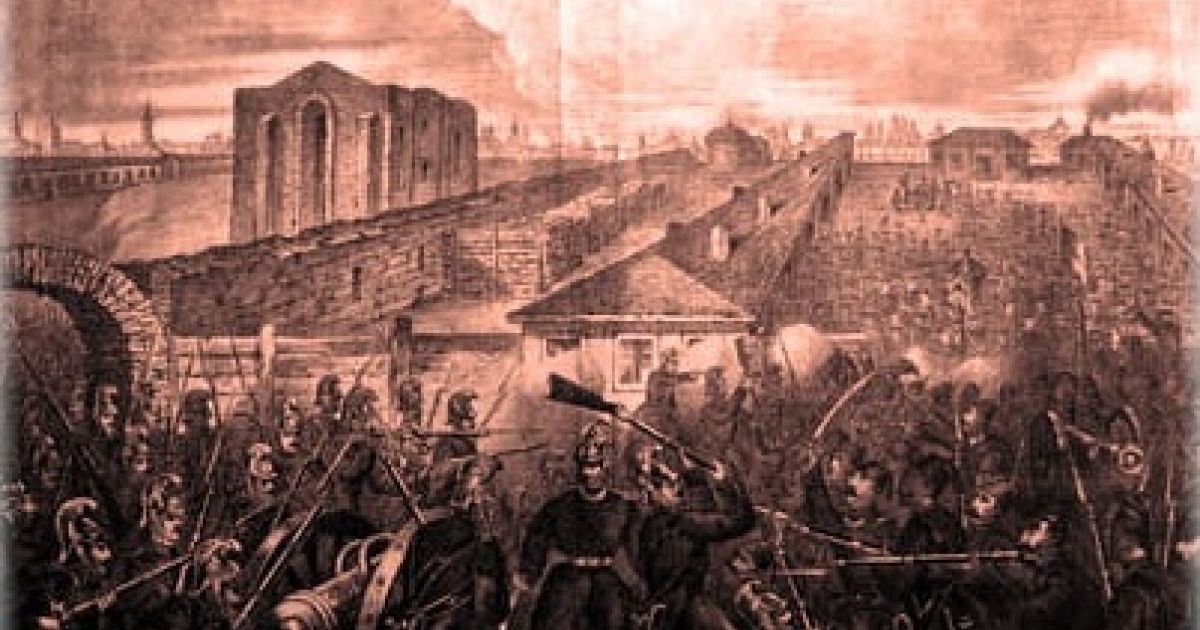
177 years ago, the first battle in the modern history of the Romanian Principalities and the last confrontation between the Turks and the Wallachians on the Romanian territory took place. It is about that Romanian “thermopile” in which 500 Romanian soldiers faced an otoman forces of 5000 people.
Battle of the Hill of Spirit Photo ISU
In 1848, the Romanian Principalities went through a process of modernization, of state conclusion. A new generation of Romanian intellectuals and aristocrats in Western Europe were trying hard to snatch the country of the Middle Ages. They were difficult times, especially since the Romanian countries were still under Ottoman suzerainty, they were coveted by the Russians and there was also a significant development gap to the European West. In this delicate context marked by revolts and internal seizures, the first battle in the modern history of the Romanian Army took place. It was rather a scourge started from an incident of laughter, spiced with many Romanian pride.
A new generation, a revolution and the great feed powers
The year 1848 remained in history as the “spring of peoples”, marked by revolutionary movements that have spread over the entire continent. It was a century of nations, the development of national spirit and identity. After the “century of lights” (no eighteenth century), the idea of nation appeared and the peoples wanted to be in the borders of national states, different from the old borders of the feudal kingdoms. France, a country of revolutionaries by vocation, entered this hour in this hour of national invoice riots, followed by almost all the peoples of Western and Central Europe. Sons of rich boyars or merchants from the Principalities, sent to studies in Paris, Vienna or Berlin have observed the differences in civilization and found that while Europe was in the industrial age, Wallachia and Moldova were still struggling in the Middle Ages. They were the providential generation that changed the destiny of modern Romania. These young intellectuals returned to the country and started with a fight between generations, their own parents, grandparents and generally all the conservative world of the lauds and church of the Principalities. Later, they lit the spark of the revolution from 1848.
Timid in Moldova and with aplomb in the Romanian Country. The revolution of the Wallachians from 1848 was a success, at least initially. The ruler Gheorghe Bibescu was forced to sign the proclamation from Islaz, the programmatic document or the Constitution of the Valahi revolutionaries. Then he abdicated. The revolutionary government of which Ion Heliade Rădulescu, Nicolae Bălcescu, as Rosetti and Christian Tell, took over. The revolutionaries wanted the immediate modernization of the Romanian Country. Namely, the emancipation of the cloves and the Jews, the release of the Gypsy slaves, the appearance of a national army, the separation of powers in the state and many others included in the proclamation of Islaz. In order to avoid the armed intervention of the Ottomans, the revolutionary government recognized the suzerainty of the high gate.
The great race between Russians and Turks for the occupation of Bucharest
Even under these conditions, the great powers, suzerainty and protective, that is, the Ottoman Empire and the Tsarist Empire, were just waiting to intervene. And Bibescu's abdication and the attempt of the provisional reform government were the perfect pretext. So the Russians and the Turks started a crazy race: who gets in Bucharest first. Obviously, who occupies Bucharest, his was Wallachia. The Turks manage to reach the Russians. Instead of Soliman Pasa, who had recognized the proclamation from Islaz, at the command of the Ottoman troops south of the Danube was named Fuad Pasa, a man recognized for his interventions in force.
So Fuad Pasa at the forehead of over 20,000 Ottoman soldiers passes the Danube, on September 13th. The Ottoman army was divided into three columns. The Russians pass Milcov only on September 15, 1848, with an army led by General Aleksandr Nicolaevici Luders. Too late, however, for the Tsar's people. Without an army capable of resisting the troops brought by the Ottomans, the members of the revolutionary government demand the Wallachian military garrison in Bucharest not to resist. On September 12, the War Minister of the Provisional Government of Wallachia, General Cristian Tell, ordered directly to Colonel Radu Golescu, the commander of the 2nd Infantry and Garrison Regiment, to gather on the Hill of Spiri (no where today is the Parliament Palace) and to give the Ottoman troops. In addition, to have unloaded weapons. Fuad Pasa's army entered on September 13 in Bucharest, in three directions. One column from Văcărești, another from Calea Plevnei and the latter from the Hill of Spirii. Cristian Tell, on the other hand, removed some of the Romanian troops and coated them in Râureni, under his command.
A beating like Maidan after a violated order and a snack
Two military units with a special pride were canted on the hill of the Spiri. They were among the first modern units of the Wallachian army and in addition, they had also carried the revolutionary tricolor. It was about the 2nd Infantry Battalion in the 2nd Infantry Line and Company 7 of the 1st Infantry Line. The two units numbered 700 soldiers and were under the command of Colonel Radu Golescu. Near the barracks, the third Ottoman column reached, counting 9000 soldiers, under the command of Kerim Pasa. Although he received an order from the Minister of War to teach the Ottoman barracks, Radu Golescu refuses. Nor does the weapons want to teach them to the Ottomans. He even has a defiant behavior towards the Turkish commander and announces it. “The duty of a soldier is to die with the weapon in his hand and that he is more satisfied than to be disarmed.”transmitted to Colonel Golescu to Kerim Pasa.
“As the avant-garde arrived and, after her, General Kerim Pasa, with the Colonel and Major Arabu, the commanders of the Infantry Regiment, who followed in march, stopped against the barracks, giving the band to stop. Captain Caragea, in Turkish, that he cannot fulfill this desire without the order of his general and, as he sends him order, he will be able to free his barracks. “Details the colonel Dimitrie Papazoglu, participant in the battle on the Hill of Spirii, in his work “History of the city of Bucharest” in the chapter “Something about the Revolution of 1848”.
Dissatisfied Kerim Pasa, does not stretch the rope and prefers to avoid a conflict so that he continues his movement. Then there appears on the table a fire company commanded by Captain Pavel Zăgănescu. They had received the order to go to the barracks on the Hill of the Spirit to give the Honor of the Ottoman troops. Only it has delayed unjustifiably. He missed the meeting between Colonel Golescu and Kerim Pasa and in addition he gave his nose with the Ottoman troops.
Moreover, in a hurry to reach the barracks, firefighters pass through the Ottoman soldiers, with all the attempts of the Turkish commanders to stop them. Throughout the jacket, a second lieutenant from Caracal, Dincă Bălșan hit an Ottoman artiller. The scene happened to cross a bridge, and the Turkish soldier fell directly into the mocry ditch, to the amusement of the military firefighters. A Turkish major, punishes Dincă and hits him with the side of the sword. Dincă removes his guns from the belt and downloads them directly to the Ottoman senior officers. He hit the Major directly and kills Kerim Pasa's horse. A scourge began as in the slum. The Turks and firefighters shared their fists and feet. After which they went to weapons. The 166 firefighters proved agile to the body fight and even managed to get their hands on two Ottoman guns, laughing at the Turks.
“The sub-lieutenant from Dincă released the guns in the Turkish general and the Arabian major, so that the major fell dead, as well as the general's horse; the flanks were beating in fires and bayonets, and Kerim Pasa ordered, shouting, coming. When two cannons arrived, who had to take their position, Killing a few artillerymen, the two cannons in their hands kidnap;Papazoglu said in the same work.
Firefighters fled through the gardens, the barracks soldiers remained with the siege
Although they fought bravely and successfully in the general beat, Zăgănescu's firefighters were overwhelmed, especially when he went to firearms and the Turkish cavalry intervened. So they retired through gardens to save their lives. Seeing that the firefighters are in anguish, Colonel Golescu asks the soldiers to bring ammunition and load the weapons. Golescu gave the soldiers' order to execute fire on the Ottomans to ensure the firefighters withdraw. Part of Zăgănescu's people reached the fort on the Hill of Spiri and housed behind the walls. But Colonel Golescu triggered hell, however. The Ottoman artillery was put in a fighting position and several projectiles were drawn to the barracks. In their turn, the Ottoman soldiers began to shoot the commanders.
“It did not pass the 8th minute and the entire front of the Ottoman troops, which was in the break-up of all the extension of the barracks, having cannons between the distances of the battalions, was drawn in front to the barracks and opened the fastest line on our front, as well The barracks on us, we also began, with the mentioned 6 companies, to draw the most terrible fire on them, so that the soldiers ended 20 patrons of patrontaş, they ran into disorder in the bottom of the barracks, where, near the regiment's warehouse, finding the two-wheel To the enemies scattered through the courtyard of the barracks, spread on the branches, resting the rifle even on the fallen bodies.confessed Papazoglu describing the battle of the Hill of Spiri.
The Romanian soldiers proved their value fully, they would prove it again in 1877, also in front of the Ottomans. Good targets, capable of loading quickly and shooting precisely, Colonel Golescu's people killed 158 Ottomans and injured another 400.
After three hours of fighting, Colonel Golescu is injured and the Romanian troops actually overwhelmed by the number of Ottomans, but also by the superiority of the artillery. Kerim Pasa asks the soldiers to surrender with the promise that they will be allowed to leave.
Party refuses and withdraws leaving the fortress on a secret door. “Slowly, we withdrew through the street from the bottom of the barracks, where in that retirement anger and an Ottoman cavalry patrol, made up of 8 people, wanting to shoot with the carbines, stealing through bayonets, they and their horses, passing over their bodies.”confessed Papazoglu.
The 300 soldiers who surrendered, were disarmed and eventually shot by the Ottomans, although they were promised freedom. After the battle, Bucharest was occupied and the humiliated and disarmed Romanian soldiers. Many soldiers and officers were killed by the Turks when they were caught in the city.