The treasures of a Thracian warrior discovered by archaeologists. Who was the “Lord of Sakar” and what a terrible weapon he was handling during his life

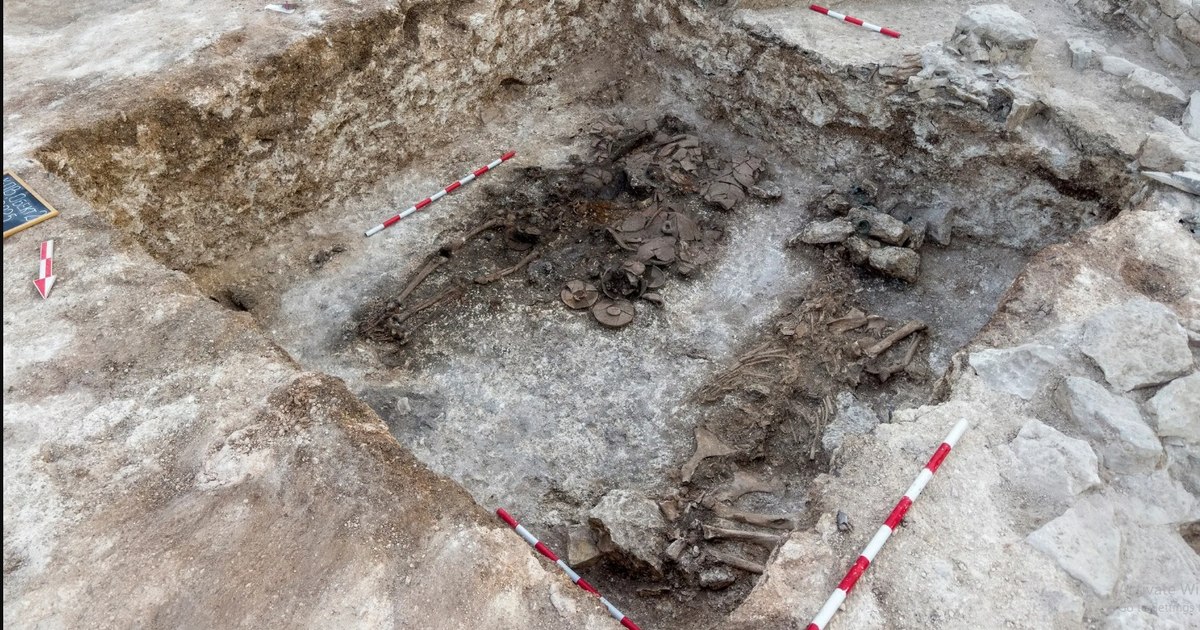
The Thracian warriors were true princes of gold in the ancient world. And the best evidence is the “Lord of Saka” as the rider whose remains were nicknamed this summer by Bulgarian archaeologists. His funeral inventory is impressive.
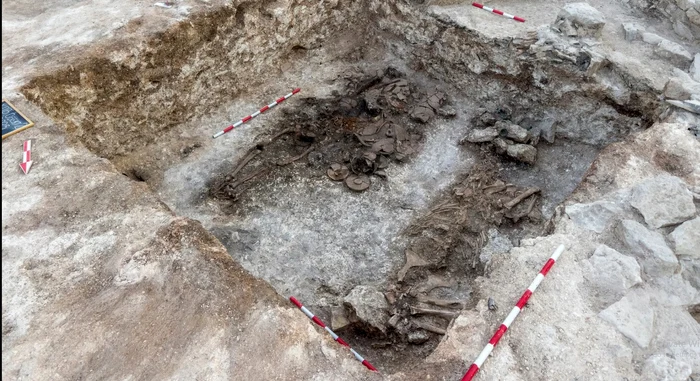
The tomb of “Lord from Saka” in situ photo artnews.com
The Thracians were one of the most important ancient populations that lived in the Balkan area. They were a fearful warriors and modeled the history of these places. Attestate documentary for 4000 years, they appear mentioned in Iliad but also in the writings of ancient authors. “The Thracian nation is the largest in the world, after the one of the Inzilor”Herodotus wrote. The same Greek learned said that “If they had only one leader or if the Thracians would understand each other, their nation would be undefeated and much stronger than all nations”.
The Thracians lived divided into numerous tribes and dominated the entire area military. Were used especially as mercenaries because “In their eyes, the trail passes as the greatest honor. To work the earth is the most shameful thing, and when you live from the war and predictions, they say, you do something as good as possible ”add the same heronodot. They were extremely rich from the war prey and their special martial culture is proven by numerous discoveries. The most recent is that of a Thracian warrior from the second century, buried with his fighting horse. Both the warrior and the horse had numerous gold and silver ornaments, with a fabulous work. The discovery was made by Bulgarian archaeologists and is considered the richest Thracian fighter grave discovered on the territory of Bulgaria.
A photovoltaic park, a rescue dig and the last remnants of a warrior
The discovery took place in an archaeological site near the village of Kapitan Petko Voivoda in Topolovgrad, that is in the south of Bulgaria. Actual, a team from the Bulgarian Academy of Sciences, led by archaeologists Vladimir Staykov and Deyan Dichev, under the scientific supervision of the famous Thracology specialist Daniela Agre performed a series of rescue excavations to arrange a photovoltaic park in the area. During the research, a series of ancient mounds were discovered. In one of these Bulgarian archaeologists made a fascinating discovery. It was about the funeral pit of a Thracian warrior buried with his battlefield.
The complete skeleton of the horse was on the left side of the tomb, a feature of burial in the Thracian world. The skeletons were well preserved and the specialists identified that the deceased was around 35-40 at the time of death. It may have been killed in the fight. The fact that the deceased was a warrior is proven by a series of artifacts discovered in the tomb. This is a tip of iron spear, a umbo (protuberance, metal reinforcement located in the center of a shield and protecting the fighter's arm) but also a gorgeous Greek Makhaira. The latter was a sword, a weapon with a curved and wide blade, with a single cut on the inside. It was used for strong blows of cutting, splitting, beheading and not for pushing. In the hands of a skilled warrior was a nightmare weapon capable of amputating arms, heads and evisceration.
“Lord from Sakar”, an honored warrior
The one discovered in Topolovgrad is one of the many tombs of Thracian warriors found on the territory of Bulgaria, a power center of these powerful tribes of which the ghettos, as the North-Danube branch, were also part. What makes it really special are the treasures discovered next to the deceased warrior. They have both material and especially archaeological and cultural value. It is the richest grave ever discovered in Bulgaria specifies the representatives of the Topolovgrad municipality. The deceased had a magnificent ceremonial crown of gold silver, specially made for funeral. This shows that he was a famous warrior and at the same time a member of the tribal elite in the area. At the same time, the warrior had a lot of jewelry worked with a special skill. It may have been import goods or objects obtained from war prey. It's a bracelet, a ring and a fibula. All of precious metal.
We are not talking about the fact that Makhaira, that curved sword, had the handle inlaid with gold and semiprecious stones. The richness of the ornaments of this weapon is considered unique and highlights the special status of the deceased. In addition, there were other gold and glass and ceramic vessels in the tomb, of the highest quality. The horse, in turn, had a harness but also spectacular ornaments. The horse's harness had gold, silver and bronze medallions, golden and encrusted with embossed representations representing scenes from Greek mythology. It's about Heracle's work. “The golden treasures discovered in our lands confess the high mastery, rich spiritual life and prosperous societies”said Evelina Slavcheva, president of the Bulgarian Academy of Sciences, in a statement, quoted by Live Science. The warrior was told “Lord from Sakar”, after the mountain range of southeast Bulgaria where he was found.
It is known that in the Thracians it was a habit, that the vase warriors would be buried next to the battlefield. The animal was sacrificed and deposited in the master's grave. They were even buried with their life partners. The women were sacrificed and deposited with the man. “When one of them died, he gets among the women of the dead great misunderstandings, and friends give their trouble and show an unspeakable zeal to find out which of the wives loved the deceased. The woman considered to receive the honor is praised by men and women.Herodotus wrote.
At the sunset of the Thracian warriors
The “Lord from Sakar” lived around 150 BC. It was most likely an aristocrat, a tribal leader. The objects of Hellenistic, import or prey inspiration, clearly show the connection from these Thracian kingdoms with the neighbors in the Greek world. The Thracians served as mercenaries for the Greek cities, made trade with them and why not, undertaken prey against them. It is certain that the Thracian civilization was strongly influenced by the Hellenistic one. As Greek mythology was influenced by the Thracian one.
The god Dyonisos, the god of wine and mystical euphoria, is a Thracian Divinity. The most renowned kingdom of the southern Thracians was that of the Odris. The Kingdom of Odris was founded in 470 BC and reached the greatest brilliance and power under the leadership of King Sitalkes. It is said that Odrisii had over 150,000 warriors, most of whom were horsemen. In fact, Odrisii have acquired their Hellenistic culture, being their capital from Seuthopolis. The Odrisii made the law in the Balkans for a long time, Tucidide saying that they were a considerable military force, being outdated only by that of the dreaded Scythians.
The tomb of the “Lord in Sakar” is not singular in the area. In 2024, the teams of Bulgarian archaeologists also found the tomb of a woman, also with a rich inventory.
For the Thracians, the second century, represented a period of the sunset of their glory. It was the moment when the Roman presence was increasingly important in the Balkans.
.