
2026-03-24 21:05
publication
2026-03-24 21:05
Tuesday's session on the New York stock exchanges did not bring about a continuation of Monday's rebound. The gains were hampered by conflicting reports about the conclusion of peace with Iran. This means a continuation of the oil crisis and an increased risk of stagflation.

The Dow Jones industrial average lost 0.18% on Tuesday and reached 46,124.06 points. The S&P500 went down by 0.37% and finished with a score of 6,556.37 points. The Nasdaq Composite dropped by 0.84% and ended the day at 21,761.90 points.
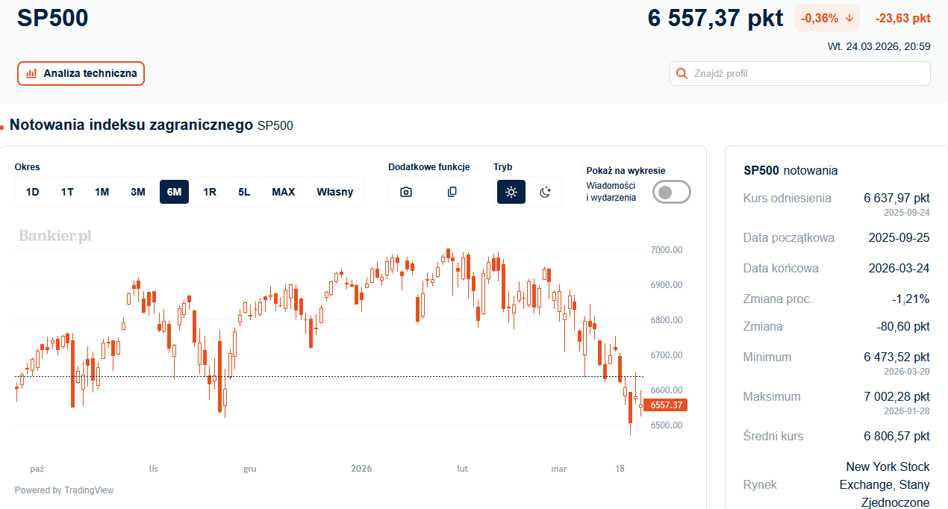
This means no continuation of Monday's rebound and keeping the American indices close to their six-month lows. And in fact, this is hardly surprising, because Monday's euphoria seemed to be greatly exaggerated. Mainly because the Iranian authorities denied President Trump's revelations. On Tuesday, this dissonance of contradictory information continued, so investors did not really know what was going on. Is Iran misleading us all, or is President Trump simply confabulating?
Advertisement
Media reports about the sending of the elite 82nd Airborne Division to the Middle East did not improve the mood. This does not look like a sign of de-escalation and raises the stakes in the negotiations. And this threatens to prolong the war with Iran, which, according to initial market estimates, was supposed to last no longer than two weeks. A bit like Russia's “three-day special operation” in Ukraine, which has been going on for over 4 years.
At the moment the situation does not look good. The war in the Middle East continues, the Strait of Hormuz remains essentially closed, and any week now the world may run out of supplies not only of oil and gas, but also of other key raw materials, such as helium, sulfur and bromine. And with each day of the US and Israel's war with Iran, the situation will worsen. Additionally, Iran has suspended natural gas supplies to Turkey as a result of last week's bombing of the South Pars field.
All this threatens to repeat the inflationary scenario of 2021-22, but this time on a much larger scale. The March PMIs from the euro zone already showed a strong increase in the costs of enterprises, which began to pass on higher costs to consumers. And this is only the beginning of the energy crisis and the first three weeks of broken supply chains. Therefore, the risk of stagflation is growing – i.e. slow (or negative) economic growth and high inflation. This is the biggest nightmare not only of central bankers, but also of investors remembering the “lost decade” of the 1970s.
The rising yields of treasury bonds are also worrying. The yield on 2-year Treasuries remains above 4%, implying… A 25-point increase in interest rates in the Federal Reserve. 10-year securities already offer 4.40% YTM compared to the federal funds rate currently maintained in the range of 3.50-3.75%. The futures market estimates the chances of a Fed rate increase by the end of 2026 at 30%.
Higher discount rates mean a lower present value of future cash flows, which lowers the model value of the stock. Especially in the case of growth companies, whose valuations are most sensitive to changes in the cost of capital. Perhaps it is for this reason that shares such as Google (-3.9%), Microsoft (-2.7%), Oracle (-4.7%) and Salesforce (-6.3%) suffered the most on Tuesday.
– In the short term, we have a double whammy from higher oil prices and higher interest rates – both of which put pressure on share valuations. It's quite a stagflationary environment, which – to say the least – is not the best for the stock market, Kevin Gordon, head of macroeconomic strategies at the Schwab Center for Financial Research, told Reuters.
In addition, there is still a crisis in the private debt market in the United States (private debt, i.e. direct loans from investors/funds to enterprises). Shares of Ares Management fell by up to 5% during the session after information about the limitation of withdrawals from one of the funds investing in private debt.
K.K
The publication contains affiliate links.