publication
2025-09-04 10:49
The official measure of inflation in Switzerland remained in August practically in Zera. Such a result would cause a panic attack in many central bankers, but the Helvers will not have sleepless nights for this reason.
In August CPI inflation in Switzerland was 0.2% year on year And it remained at the same level as in July – the Federal Statistical Office informed. Compared to the previous month, the Swiss index of consumer prices reduced
by 0.1%.
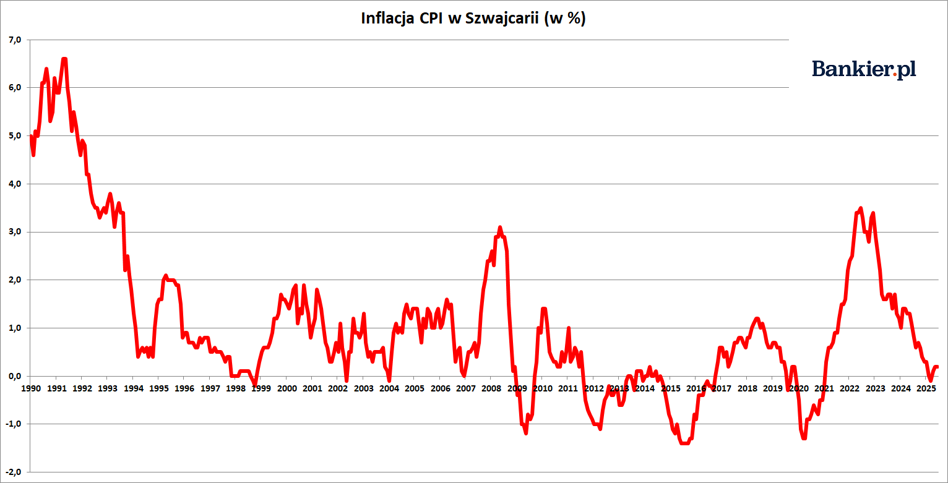
From the beginning of 2025, the annual dynamics of the CPI indicator in Switzerland remained near zero. In January it amounted to 0.4%, and in February and March 0.3% and fell to 0.0% in April. May was marked by the first statistical deflation in the country of Helvet (-0.1% yard), but June brought a return above zero and a reading of 0.1% yard.
All this does not change the fact that In 2025, Switzerland achieved authentic price stability. At least on average and in general, because the prices of individual goods can be (and often are) both higher and lower than a year ago. It is a contrast with the “price stability” defined by central bankers as a state of permanent inflation understood as a systematic price increase. It doesn't matter if the inflationary goal is 2%, 2.5% or 3.5% –
Central banks are always about maintaining relatively low, but permanent, price and monetary inflation.
But the Swiss National Bank for its purpose has chosen inflation “not higher than 2%”, which in a purely mathematical sense means the pursuit of maintaining CPI inflation in the range of 0%to 2%. And it works well in recent years. After a period of covid-war price increase from 2022-23 in June 2023, the annual dynamics of the Swiss CPI fell below 2%.
It is also worth adding that the deflational episodes in this alpine country are not unusual. Switzerland experienced periods of price deflation (understood as a negative annual CPI dynamics) in 2014-16 and 2011-13 and in 2009.
You can recall one more result here. Swiss statistics publish not only the monthly and annual dynamics index of consumer goods prices (CPI), but also its change in relation to the state of December 2020. So, roughly speaking, relative to the start of the starting-war inflationary wave. Since then, the Swiss CPI has only increased (or as much as) by 7.7%. For comparison, in Poland an analogous price measure went up by over 44%.
Due to the elimination of inflation, the Swiss National Bank could afford decisive reduction of interest rates. In June, SNB reduced the monetary policy rate from 0.25% to a round 0.00%. Earlier, in March, the Helvets made the fifth to reduce the monetary policy rate, bringing it to the area of zero. Before that, SNB reduced interest rates at 25 PB. In September and June and in March 2024, when it surprised everyone and as the first in this cycle the central bank of the developed country decided to reduce interest rates.
SNB inflation forecasts for 2025 are 0.2%in 2026, 0.5%, and in 2027 0.7%. At the same time, the unemployment rate remained at a very low level of 2.8%in August.