
Why are the Romanians so dissatisfied with the life they lead? It goes from evil to worse, and the poor functioning of institutions in the country leads us to these figures


Dumitru Sandu, professor at the Faculty of Sociology at the University of Bucharest, analyzed a European survey and says that “maximum dissatisfaction is concentrated in southern EU and in former communist countries.” And Romania is a champion of dissatisfaction, shows the sociologist Dumitru Sandu by collecting the reasons in an opinion text that Hotnews publishes.
- “In all I, the satisfaction with the personal life is the lower the less the belonging has greater difficulties in paying the monthly invoices.”
- But there are other important factors.
Romanians aged 15 and over this age were the most dissatisfied with their own lives (34%), in the European survey of the Eurobarometer in the spring of 2024 (EB 101.4). They were still dissatisfied with two years before, in 2022 (according to Eurobarometer 95.3), but not the most dissatisfied with personal life. Then, in 2022, the maximum dissatisfaction with life was in Bulgarians and Greeks.
Why in 2024 the situation changed from evil to worse, here? The question deserves to be asked because the years 2024-2025 are years of electoral social movements with a powerful pro-Sovereign vote, in Romania. It was said that it was a strong social dissatisfaction, root of this type of vote, but comparative arguments, based on survey data were not formulated. We try to offer them here. The major interest is not for the relationship between vote and dissatisfaction, but for understanding the sources of dissatisfaction in Romanians, in European context.
The hypothesis from which we start claims that The way of public administration has led to a kind of strengthening a culture of dissatisfaction (Almond & Verba, 2015). In this material we will proceed comparatively, considering Romania in the context of the European Union (I), Starting from the belief that, without comparisons and contextualizations, few things can be understood.
Let's start with the descriptive context of dissatisfaction with our own life.
The descriptive context
The start question was, in the survey, of the type “in general, how satisfied you are with the life you lead.” The over 26 thousand interviewed subjects respond on a four -step scale, from very satisfied to fully dissatisfied.
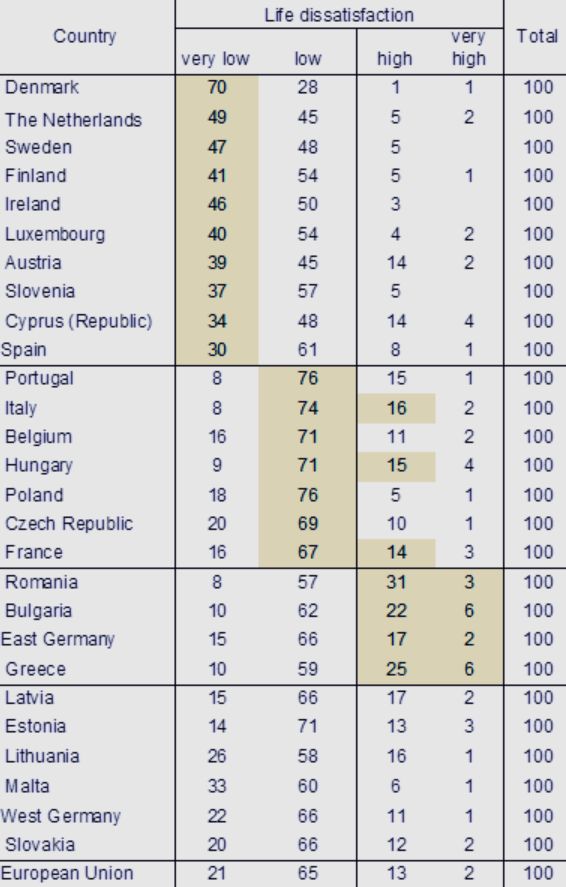
The average of those dissatisfied with their own life, in me, was 13%. At the country level, for Romania, the maximum appropriate percentage of dissatisfied was 31%, in the case of Romanians. In the same group of maximum dissatisfaction are the Bulgarians, Greeks and East Germans. In other words, the maximum dissatisfaction was concentrated in the south and in former communist countries. The satisfaction with life is concentrated in the north, especially in Denmark, Sweden, Finland and Ireland.
For the case of Romanians, of priority interest here, I already mentioned that between 2022 and 2024, the share of those dissatisfied with life has increased. The intermediate group between the very satisfied northwest and the very dissatisfied Eastern and South EU, is formed by a heterogeneous group in Central and Western Europe.
TABLE 1. LIFE DISSATISFACTION BY COUNTRIES OF THE EUROPEAN UNION (%) (Dissatisfaction with life according to European Union countries)
In order to determine the regional specificity of the satisfaction with life in Romania, I resorted to a classification of the countries in I in five major geo-cultural groups that distinguish between North, South, West, Center-East and East EU (Sandu, 2009). Romania, it is demonstrated in the material to which we referred previously, is part of the group of eastern countries (together with Bulgaria and the Baltic countries), relatively poor, located in the eastern extremity of the EU.
In fact, the adopted classification is very close to the United Nations Geo-Schema, which distinguishes, in the group of countries in Europe, between the north, south and west. The classification we have adopted to determine the specificity of satisfaction with life, for Romania, segments the eastern countries in Europe, in Eastern and Central-East (Poland, Slovakia, Slovenia, Hungary, Croatia). If we move the emphasis from the degree of satisfaction-to be resigned to life to significant relationships in explaining the dissatisfaction in relation to the ordinary life, with which of the mentioned regions does Romania resemble?
Predictors of population dissatisfaction
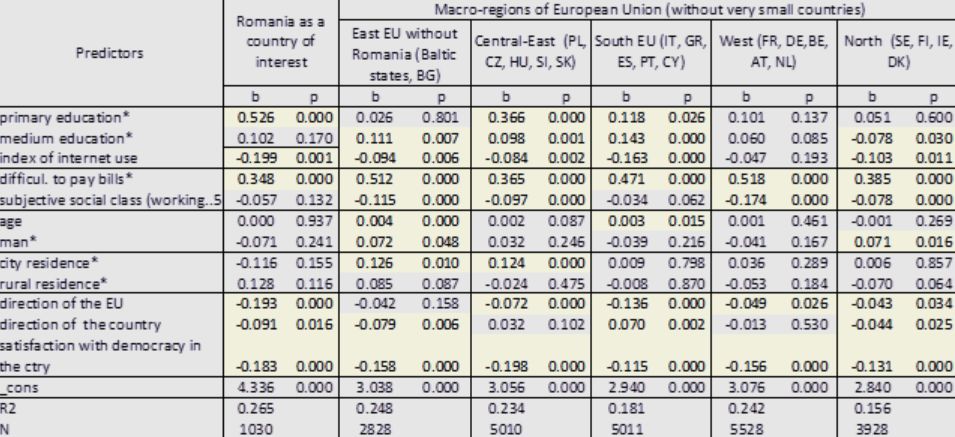
Geographically, Romania is part of the EU Eastern countries, together with Bulgaria and the Baltic countries. Its specific profile for conditioning the dissatisfaction with life for Romanians differs, however. Although the analysis data in Table 2 are incomplete, the analysis model being relatively poorly specified, it turns out that the high -probability hypothesis is the one that claims that The poor functioning of the institutions in the country (Sandu, 2025) is one of the major causes of the dissatisfaction of the Romanians.
The more interviewers in Romania are more dissatisfied with the functioning of the institutions in the country, the greater the probability that their dissatisfaction in relation to their own life will be higher. The tendency is the same at the level of the eastern part of which Romania belongs.
Another major finding of the analysis is that education matters. The dissatisfaction with life in Romanians seems to be the higher the level of education is lower. Only in Central and Eastern Europe and in the southern Europe seems to be such a strong condition.
Otherwise, In all I, the satisfaction with the personal life is less lower as the belonging house has greater difficulties in paying the monthly invoices.
TABLE 2. Predicting Life Disatatisfaction in the Country of Interest and by Macroregations of the European Union (forecasting the dissatisfaction with life in the country of interest and macroregions of the European Union)
A European model of dissatisfaction with life?
Yes, there is such a model. I ran, without presenting here the calculation results, such a model, on the EU ensemble, adding to the predictors in table 2 the first four countries with maximum dissatisfaction of the population with their own life (RO, BG, GR, East Germany) and the countries with maximum satisfaction (DK, NL, SE). Even under these conditions, with many control variables, the dissatisfaction of those in Romania remains maximum, at the country level (beta coefficients).
Otherwise The typical European for the state of dissatisfaction with one's own life is weak or medium educated, with low internet access, with difficulties in paying the monthly invoices, belonging to the social class, from the basis of the social pyramid, relatively elderly, dissatisfied with the democracy in its own country and the direction in which things “go” in I. The finding says, among others, that it should not be exaggerated with the idea of specificity. On certain components, He begins to speak of a cultural model of social dissatisfaction at European level.
Discussion
If someone would like to reduce the dissatisfaction with the daily life in Romanians, the most dissatisfied people in this regard, today, in I, they should improve the functioning of the institutions in the country, to increase the level of social justice, to improve the direction in which the country and the European Union “go”. Obviously, all this cannot be done without specialized studies, competent counselors and officials, elected by transparent public competitions, not by political appointments.
There is a European model of thanks/dissatisfaction with the success in its own life, with certain particularities and Romanian culture. Both should be considered for the foundation and design of public social well -being policies.
This article was initially published on contributors.ro.


