INTERVIEW “Either brilliant or ridiculous.” How an international editorial phenomenon about a highly intelligent octopus was born, now one of the most popular movies on Netflix

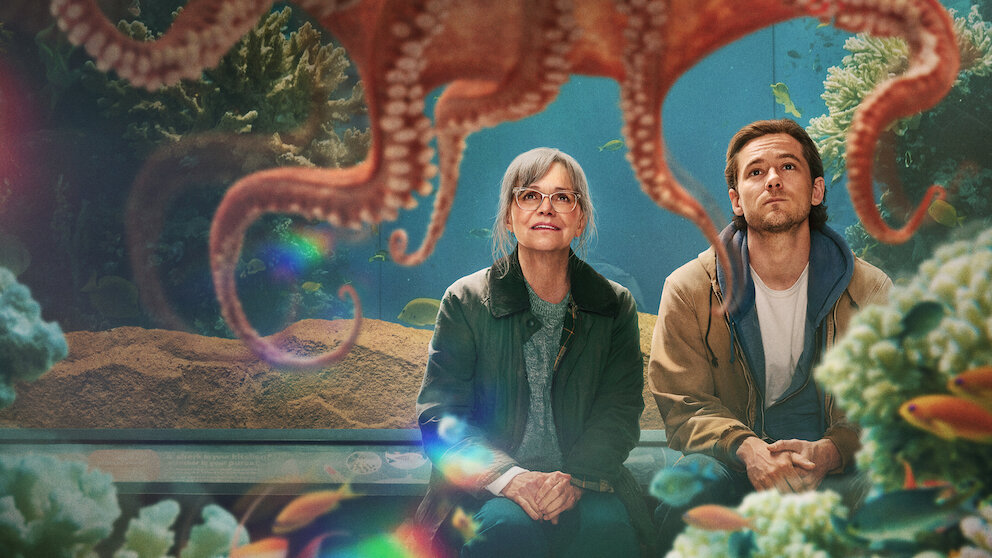
Originally published in 2022, author Shelby Van Pelt's debut novel, “Remarkable intelligent creatures“, returns to the public's attention with the release, in May, of the film adaptation made by Netflix. The novel quickly established itself as an international publishing phenomenon, with over two million copies sold and dozens of reprints, being present for a long time in the New York Times list.
- In turn, the film is in the top 10 worldwide of the most watched films of this period on Netflix, according to the reference site FlixPatrol, which monitors in real time the popularity of various films and series available on the major streaming platforms.
In an exclusive interview with HotNews, writer Shelby Van Pelt told what it was like to write this novel during the pandemic, when she was behind a glass screen for a long time, just like Marcellus. She talked about our captive relationship with technology or how literature can influence ethical behavior towards other life forms – many of her readers said they stopped eating octopus after reading Remarkable Intelligent Creatures.
In Romania, the book was translated and published by Trei Publishing House, and the story follows the unexpected relationship between a widow and a “remarkably intelligent” octopus.
After her husband died, Tova Sullivan began working the night shift at the Sowell Bay Aquarium, washing floors and cleaning. She took refuge in this work in order not to be overwhelmed by loneliness, but also to forget another tragedy in her life – Erik, her son, mysteriously disappeared one night when the boat went out to sea, 30 years ago, when she was 18 years old. Tova gets to know better and better Marcellus, a giant Pacific octopus, who lives in one of the tanks at the aquarium. A wonderful, impossible friendship grows between the two. Always ready to play detective, Marcellus knows what happened the night Tova's son disappeared. And now he must use every trick to reveal the truth to his friend before it's too late.
A funny detail now comes from the author herself, who says that before publication, her agent's assistant noted in the margin of the manuscript that it was “either brilliant or ridiculous”. Four years later, the novel was turned into a Netflix movie directed by Olivia Newman, and the cast includes Sally Field (as Tova), Lewis Pullman (as Cameron), and Alfred Molina is the voice of the octopus Marcellus.
Director Olivia Newman said of her new film that it “deals with heavy themes like grief and the need for connection, but it's also a joyous film…it makes you laugh and cry, and ultimately leaves you with a sense of hope.”
When you watch the world move through a glass wall
Hot News: –You wrote this novel during a period of deep isolation. How did that feeling of living in an “aquarium” turn into a narrative engine, and are there any moments in the book directly inspired by your family life during that time?
Shelby Van Pelt: – Writing much of the novel in the early months of the pandemic, when I was at home with my two young children, certainly had an influence. I remember one day, taking a break from writing, I stood at the front window (my “office” at that time was sometimes the kitchen table, sometimes the living room sofa) and watched the neighbors walk or jog, often with their dogs, as they moved around the neighborhood. I then had a moment of closeness to Marcellus, watching the world move beyond the glass wall.
One of my favorite things about Marcellus is that while he's sort of a classic misanthrope, there's also something wonderfully curious, almost childish about him. I think I picked this up from my own kids, especially my son, who was a classic “but why?” type of kid, always curious to understand the world around him. (He's ten now and still a “but why?” and that's awesome!) Trying to explain things to him and use precise language made me reflect on the fact that people, especially adults, don't always say what they mean.
“He must have been a grumpy old man in a previous life”
– Was it difficult to write from the perspective of a non-human, and does it carry any part of your inner voice?
– I'm not sure it's possible to write from an animal's perspective without anthropomorphizing it at least a little. But I wanted Marcellus to look realistic as an octopus. And even though he has a serious dose of “grumpy old man,” I was always on the lookout for what words and ideas he might know given his non-human status and limited environment. Everything Marcellus does in his physical world is possible for an octopus; I made sure of that. The material from his inner monologue is where I took artistic liberties.
I sometimes joke that I must have been a grumpy old man in a previous life because Marcellus' voice came very naturally to me. Maybe we all have a bit of a whiner in us? It's a lot of fun to judge people when you've cut yourself off from humanity.
Octopuses are creatures of unknown complexity
– The central relationship in the story is unusual, but deeply human. What interests you more: the extraordinary of the situation or the universal need for connection?
– The relationship between Tova and Marcellus is unusual, to be sure, but when it comes to emotional connection, I think anyone who has had a beloved pet that provided comfort will recognize certain dynamics. When I'm sad, my cats come to me and sit with me, as if they share my mood. We humans, I think, want to be heard, to share without judgment, to open up to another being who accepts our vulnerability without immediately trying to “fix” things.
In Tova's case, she is surrounded by people who care about her, but she keeps them at a distance because they are always trying to “fix” her, and that makes her uncomfortable. With Marcellus, she finally finds someone who just listens without judgment—a delicious irony, given how judgmental he is.
What makes the relationship between Tova and Marcellus different from a typical human-animal relationship is that octopi are creatures of unknown complexity. We know they are very intelligent, but their neurological structure is foreign to other intelligent vertebrates (primates, dolphins, etc.), and there is still much to discover about them. It seemed reasonable to give Marcellus this role as a detective, almost “Holmesian” observer who gathers clues and has an almost photographic memory. Could an octopus really do this? We don't know. But we also don't know that they couldn't.
“Technology puts us in a glass box”
– The theme of captivity appears throughout the book. Do you think that modern life, especially our relationship with screens, has created a kind of “invisible aquarium” in which we are constantly observed, but increasingly isolated?
– I really like this wording and I think there is a grain of truth. Our technology puts us in a glass box.
My favorite metaphor is “going around the fishbowl”. When you visit an aquarium, you can notice patterns in captive animals, how they tend to follow the same routes in their confined spaces. And we humans do the same. A habit becomes a harmful pattern. We rely too much on routines. We fear change. But change is coming anyway.
– Some readers have said that your novel changed the way they look at animals, even their diet (they stopped eating octopus). Do you think that literature can really influence ethical behavior towards other forms of life, similar to the impact of the movies “My Octopus Teacher” or “Okja”?
– If pop culture can't change our behavior, I don't know what can! And I love that octopuses have had this great cultural visibility in recent years and that people are reevaluating their consumption, their environmental footprint, or their impact on the world.
However, I didn't set out to write a moralizing book, mostly because that almost never works. Who likes a preachy book? Furthermore, in my view, the ethics of animal consumption is complex. Personally, I don't eat octopus, but I do eat other animals and animal products. There are also ethical questions about keeping animals in captivity for educational, scientific or “humanitarian” purposes. In my experience, these questions are nuanced. I wanted readers to be left with a desire to analyze them, not a forced conclusion.
– How did you feel after seeing the screening? Did you feel that something of the inner world of the book was lost in the adaptation or vice versa?
– I love the movie. It made me cry, and you'd think I should be immune to it by now!
Naturally, the story deviates a bit from the book, because it has to be compressed into less than two hours. But they captured the characters perfectly, and that was the most important thing for me. Watching the film, I felt like I was discovering my own characters better, as if it were an extended exploration of them. It's an amazing movie and I hope you enjoy it as much as I did!