The era of pour and debts is coming. “It will be even worse”

The turn of the year was to bring relief. On January 1, the Spanish government reduced VAT on many food products to help the poorest households in the inflationary crisis. In the middle of the year, Spanish consumers will no longer have to pay VAT on basic food products, such as vegetables, bread, rice and cheese. A reduced tax will be imposed on other groceries – like meat and fish.
Prime Minister Pedro Sanchez reacts to an increasingly uncertain situation of many households. Prices of basic food products, such as milk and bread, increased in Spain by almost a third.
This is a special burden on low -income households, which the government in Madrid provides additional food assistance. In fact, consumers and voters in other European countries are also afraid of their standard of living. This is indicated by a number of tests.
Dramatic increases
According to the Eurobarometer, no other issue is currently worried about people in Europe as much as the loss of purchasing power. In a study at the request of the European Parliament, 93 percent respondents said that they are afraid of increasing prices, including food and energy. This is associated with a second fear: 82 percent Europeans are afraid of poverty and social fall.
It is only for these fears that issues such as climate change, the danger of escalation of war in Ukraine to other countries and an accident or nuclear attack are. In contrast to partially abstract phenomena, price increases were tangible by people in the examined months – in October and November. Then as much as 45 percent The surveyed Europeans have found that they are barely doing or barely coping with the current income.
The rest of the text is under video material.
However, these difficulties are unevenly distributed on the continent. For example, in Germany, more than two out of three respondents could comfortably live from the income of their household. Peace is even more felt in the Scandinavian countries, the Netherlands and Luxembourg.
The approaching crisis of poverty
In those countries that traditionally have high costs of living, 80 or more percent of the population said that it can live comfortably from the current household income. In Sweden and Denmark, these indicators amounted to 87 and 86 percent, respectively.
The situation is completely different in the south -western part of the continent. Signs of the upcoming poverty crisis extend from Slovakia through Hungary and the Balkans to the Aegean Sea. In this region, only the minority of respondents is able to cope with their own income.
Especially in Bulgaria and Greece, the inflationary crisis reached the center of society. Only every fifth respondent in these countries claims that he can comfortably live on the income of his household.
Difficulty paying bills
39 percent Europeans have difficulty paying bills at the end of the month – according to the study. It is an increase of six percentage points compared to the previous survey in the spring of 2022.
Only 14 percent The Greeks surveyed have never or almost never have problems with money at the end of the month. In Italy, Portugal and Bulgaria, the same applies to just over a third. The middle class in a safe financial situation seems to disappear in these countries.

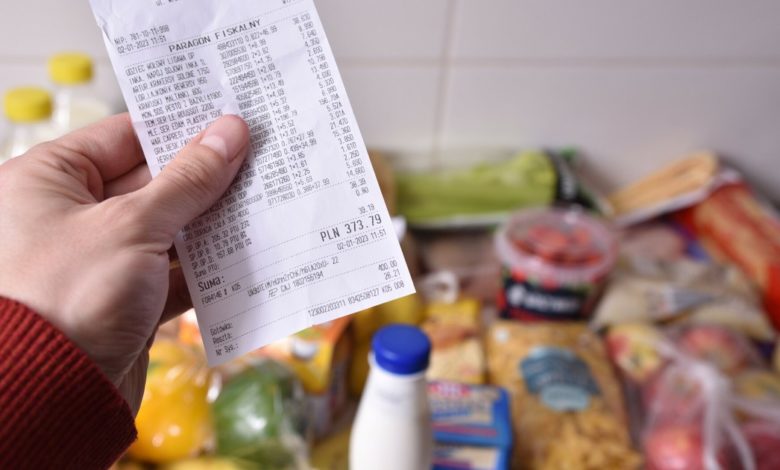
Receipt, illustrative photo
People affected by this problem have two options: either they limit expenses or indebted. Already two out of three Greeks had to ask relatives for money or loans to make ends meet.
This is the result of a study conducted by the French organization Secours Populaire, which aims to fight poverty. The IPSOS Public Opinion Research Institute examined 6,000 in the summer of last year. people in six European countries.
Every fourth participant stated that he is currently in an uncertain financial situation. However, this study showed a similar division of the continent as in the current study. While 51 percent respondents in Greece stated that it would not be able to cope with unexpected expenses, in Germany it was only one in five, although this percentage is high.
Pessimistic perspectives
The perspectives remain critical: inflation will probably stay at a high level. Although in December in the euro area it dropped to 9.2 percent, it is still a high level. In addition, the increase in food prices achieved new maximum in December.
Many households are under double pressure in this situation. They suffer not only because of high inflation, which was additionally fueled by last year's war in Ukraine, but and because of the growing interest rates that the European Central Bank fights with inflation.
For example, the Spanish central bank in late autumn warned that a double burden – high inflation and growing interest rates – can lead many Spanish households to ruin. Over 40 percent have allocated over 1.5 million households in the country. your income for paying off debts.
Drastic cuts
One of the reasons for this is the fact that a standard Spanish mortgage has a variable interest rate, which is also based on the development of Euribor, interest rates between banks for current mortgage loans. The rapid increase in interest rates caused that the service of existing mortgage loans became more expensive for households. This turns the financial plans upside down from low and negative interest rates, not only in Spain.
Also in Great Britain, a country of property owners, a significant part of mortgage loans have variable interest rates. There, what the British press calls “cost of living crisis” particularly hard. According to the British Economic Institute, the percentage of British households, which have a small or no income, have doubled from 20 to 40 percent over the past year.
One of the foundations in the summer warned that in previous months seven million families completely or temporarily gave up basic things – such as heating, cosmetics and even a shower. To save money.