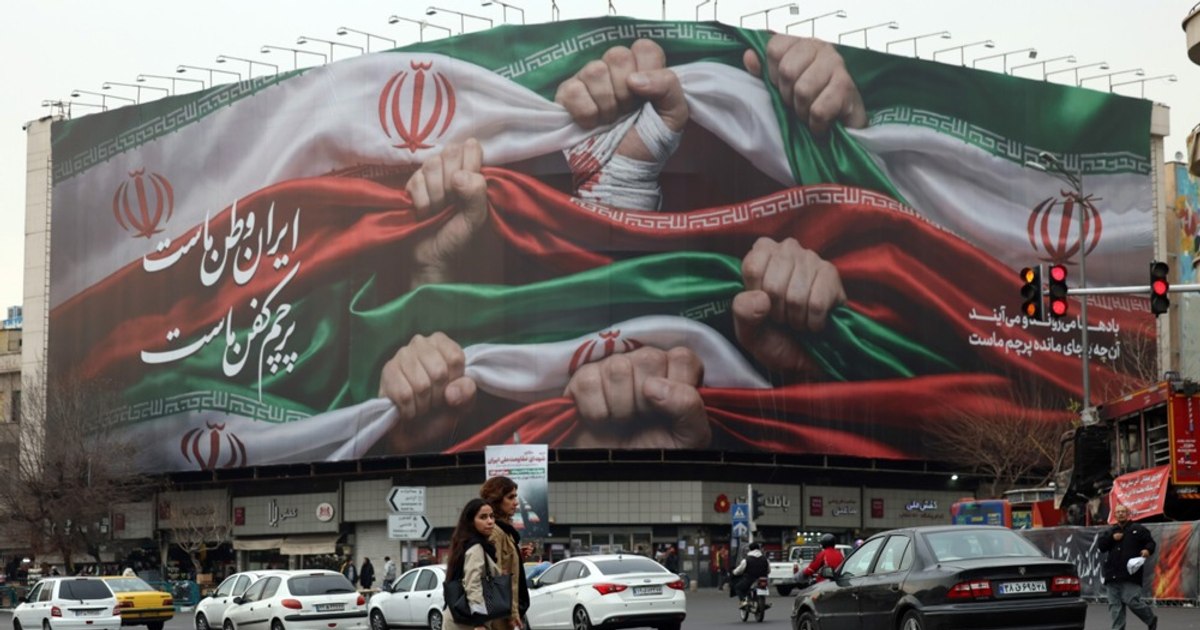
A US attack on Iran seems imminent, but if the potential targets are largely predictable, the consequences are not as predictable, the BBC writes. In the absence of a last-minute agreement between Tehran and Washington, and the US decides on an attack, seven scenarios can be envisioned.
1. Surgical strikes, minimal civilian casualties, a transition to democracy
The US Air Force and Navy are carrying out limited, precision strikes targeting the military bases of the Revolutionary Guards Corps (IRGC) and its paramilitary wing, the Basij Unit, along with ballistic missile launch and storage sites, and Iran's nuclear program.
An already weakened regime is overthrown and a transition to genuine democracy follows.
However, this would be an extremely optimistic scenario. Western military intervention in both Iraq and Libya has by no means led to a smooth transition to democracy. Although the US ended brutal dictatorships in both cases, the intervention led to years of chaos and bloodshed.
By contrast, Syria, which launched its own revolution, ousting President Bashar Al-Assad without Western military support in 2024, has fared much better so far.
2. The regime survives but moderates its policies
This could broadly be considered the “Venezuelan model”: swift and forceful US action leaves the regime intact, but its policies moderated.
In the case of Iran, this would mean that the Islamic Republic survives, which will not satisfy a large number of Iranians, but it will be forced to reduce its support for violent militias in the Middle East, halt or scale back its nuclear and ballistic missile programs, and crack down on protests.
But even this scenario has a low probability, considering that the leadership of the Islamic Republic has remained defiant and resistant to change for 47 years. He is not expected to change course now.
3. Collapse of the regime, replaced by a military government
Many believe this is the most likely scenario.
Although the regime is clearly unpopular with the population, and is weakening with each wave of protests, there is a deep security apparatus that has every interest in maintaining the status quo.
The main reason why the protests have so far failed to topple the regime has been precisely because there have been no significant defections on their part, while those in control are prepared to use unlimited force and brutality to stay in power.
But in the confusion that would follow American attacks, it is perfectly conceivable a scenario in which Iran is led by a strong military government, composed mostly of important figures of the IRGC.
4. Iran retaliates by attacking US forces and its neighbors
Iran has vowed to retaliate against any US attack, threatening to have its 'finger on the trigger'
Obviously, Iran's capability cannot match that of the US Navy and Air Force, but it could still attack with its arsenal of ballistic missiles and drones, many of which are hidden in caves, underground or on remote mountain slopes.
The US has US bases and installations along the Arab side of the Gulf, particularly in Bahrain and Qatar, but Iran could target the critical infrastructure of any nation it deems complicit in a US attack, such as Jordan.
The devastating missile and drone attack on Saudi Aramco's petrochemical facilities in 2019, attributed to an Iran-backed militia in Iraq, showed the Saudis how vulnerable they are to Iranian missiles.
So Iran's neighbors in the Persian Gulf, all allies of the US, are rightly worried at the moment about a US military action that would affect them.
5. Iran retaliates by placing mines in the Gulf
This scenario has long been a potential threat to shipping and global oil supplies since the Iran-Iraq war of 1980-1988, when Iran mined shipping routes.
The Strait of Hormuz, between Iran and Oman, is a critical artery. About 20% of world exports of liquefied natural gas (LNG) and between 20-25% of oil and petroleum products pass through this strait annually.
Iran has already conducted rapid sea mine placement exercises. If he followed through on the threat, it would inevitably have a strong impact on world trade and oil prices.
6. Iran retaliates by sinking a US warship
The biggest concerns in such a scenario would be that Iran would launch a drone swarm attack — such an attack would be so large and rapid that even the US Navy's formidable defense systems would not have the ability to take them all out in time.
The IRGC Navy has long since replaced the conventional Iranian Navy in the Gulf. Iranian naval crews have focused heavily on unconventional or “asymmetric” warfare, seeking ways to overcome or circumvent the technical advantages enjoyed by their main adversary, the US Navy's Fifth Fleet.
The sinking of an American warship, and possible capture of the surviving crew, would be a huge humiliation for the US.
While this scenario is considered unlikely, there is precedent: the USS Cole, a USS destroyer, was damaged by an Al-Qaeda suicide attack in the port of Aden in 2000, killing 17 US sailors.
7. The regime collapses, replaced by chaos
This is a very realistic scenario and one of the main concerns of neighbors like Qatar and Saudi Arabia.
In addition to a possible outbreak of civil war, as in Syria, Yemen and Libya, there is also the risk that amid the chaos and confusion, ethnic tensions could escalate into armed conflict as Kurds and other minorities seek to protect their own people amid a national power vacuum.
Much of the Middle East would surely be glad to see the Islamic Republic's supporting forces disbanded, none more so than Israel, which has already dealt heavy blows to Iran's allies in the region and perceives an existential threat from Iran's alleged nuclear program.
But no one would want to see the Middle East's largest nation by population – around 93 million – descend into chaos, a humanitarian and refugee crisis.
The greatest danger now is that President Trump, having amassed a powerful force close to Iran's borders, decides he must act or lose credibility, and a war begins without a clear end goal, with unpredictable and potentially damaging repercussions.