
The behavior of the employee in the relationship with the workplace differs depending on the generation of which he is a part, as well as their expectations from employers vary according to the needs of the age, it appears from a wide research on the labor market.

The employee's behavior differs depending on the generation of which he belongs. Photo archive
According to her, almost all Romanian employees want their competitive salaries and appreciation, while young people up to 28 years old change their jobs and are considered a minority at the office.
The salary and benefits remain the main factors that describe the ideal employer for Romanian employees, regardless of age, equity and inclusion being essential for attracting and retention of the young generation. On the other hand, Millennials (ie people between 29 and 44) and X (45-60 years old) attach greater importance to the safety of the job, mention in the Randstad Romania Employer Brand Research 2025.
Almost three quarters of Romanian employees feel involved in the current role, and 56% are more motivated than last year. Salary and benefits are the main reason for lack of involvement, while appreciation is crucial for motivation. 78% of employees consider the recalification important, without noting significant differences between various age categories.
Gen X (45 – 60 years) is especially motivated by recognition, while Gen Z and Millennials are influenced by a more varied range of factors, which suggests that multifactorial involvement strategies are more effective for these groups. The balance between personal and professional life is particularly important for digital talents, while employees in professional and operational fields place more emphasis on the initiatives dedicated to equity.
The research highlights an interesting gap between the main elements that define the profile of the ideal employer and the evaluation of the current employer, with a major difference between the two situations regarding the position of the attractive salary and the benefits.
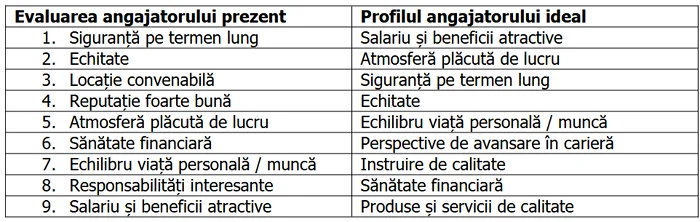
Employees want to change their job but hesitates to act
The intentions to change the job increased by 2% compared to 2024, but the effective fluctuation of the employees remained stable, indicating a balanced labor market. It is therefore a good time for employers to invest in long -term retention strategies, rather than react to short -term changes. The insufficient wage package is consolidated as the main reason why employees take into account the job change. At the same time, other motivational factors decreased in importance in 2025. These trends emphasize the importance of a correct and competitive remuneration for talent retention.
Regarding the change or search for the job, the study shows that Gen Z (young people up to 28) most often changes the employer (21%), while Baby Boomers (people over 61) changes him the rarest (4%), reflecting other age priorities and a different degree of risk tolerance.
Behaviors related to looking for a job differ between generations: they all use job platforms, but young people up to 28 are more resorting to Google and Social Media, Millennials (29 – 44) prefer LinkedIn, and X (45 – 60 years) are based on personal relationships.
Digital talents do not often leave the current employer but they want to do it the most, which can indicate a latent dissatisfaction, which has not yet manifested.
Optimism to AI decreases while diversity concerns increase
The adoption will remain the highest among young generations, but its regular use has decreased in all age categories than 2024. Employees become less optimistic about the impact on their work.
5% of the respondents expect to lose their job because of AI in the next 5 years, a percentage that reaches 10% in transport and logistics, but descends to 1.39% in administration, secretariat and HR.
Regarding equity, the study shows that the share of minority employees who face obstacles because of their identity increased by 4% compared to last year. 18% of the Romanian employees are identified as a minority, with genus having the highest representation (28%).