The electricity market in Europe, again with two speeds. Increase concerns about a new energy crisis


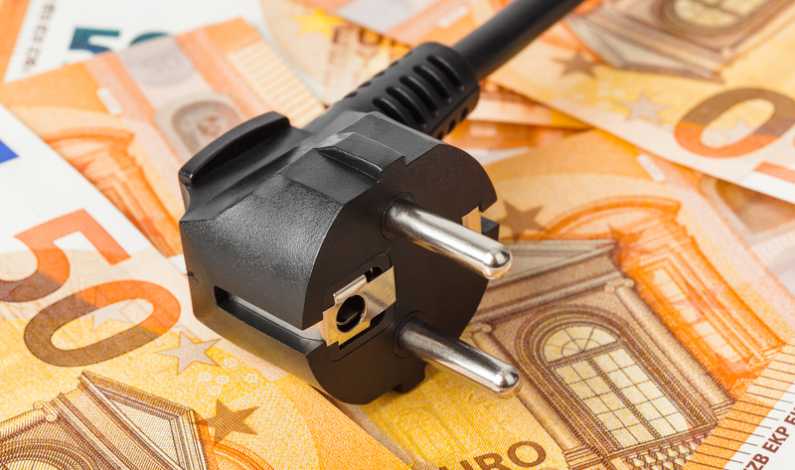
Money, Electricity – Photo: Nikolai Sorokin | Dreamstime.com
In the last two days, the prices of electricity in the wholesale markets in southeastern Europe have transmitted the first worrying signals of a possible repetition of the energy mini-crisis that took place last summer, writes the Greek press.
In the geographical area that extends from Poland to the north, Austria in the center, Romania in the east and to Greece in the south, electricity markets seem as vulnerable to demand fluctuations, as nothing has changed last summer in terms of interconnections.
It is expected that an increase in demand caused by high temperatures to exert additional pressure
In June last year, in the context of a prolonged heat in the Balkans, which led to an explosion of electricity demand, Greece and other countries in the region, instead of being supported by cheap imports that would normally have to reach Romania through Austria and Hungary and then pass through Bulgaria to the Greek system, they were to send energy to the Energy.
What happened? The cheap energy from the nuclear production of France and from the renewable sources in the North Sea has blocked in the Austrian electric network. The demand has grown abruptly in Hungary and Romania, countries by which the European network sends energy to the Ukrainian market, deficient due to Russian bombings, and prices throughout the South-East European region have increased vertiginously, reaching up to 1,000 euros/megawatt in the top hours of the evening.
The problem was raised within the EU by a letter sent by Greek Prime Minister Kyriakos Mitsotakis to the president Ursula von der Leyen. He made a clear reference to the need to strengthen the interconnections, while suggesting that the incident that divided the European market into two was not caused by a technical problem.
A similar scenario was observed on Tuesday, bringing to the market situations reminiscent of last year's energy mini-crisis. The imports of energy from Western Europe to Romania through Hungary have been reduced, causing tension in the South-East European market. This, combined with the fact that a unit from the Kozlodui nuclear power plant has been closed since May 5, has increased prices in the region.
The price on the Serbian market in the peak hours of the evening reached 400 euros/megawatt-time, and on the interconnected markets in Greece, Bulgaria and Romania, for 355 euros/megawatt-hour.
The average price of a megawatt-time on the Greek market reached yesterday at 154.94 euros, registering an increase of 40.5% compared to the previous day. The price dropped today to 98.16 euros/megawatt-time, and in the larger region to just over 100 euros. But the deviation from the markets of the rest of Europe is still big and even much larger than yesterday, which reflects serious distortions of the European market, otherwise unique. The average price of a megawatt in Germany is currently 61.22 euros, in France 20.74 euros, in Spain of 3.35 euros and in Portugal of 6.92 euros.
The conditions that are outlined are evaluated by the market and energy analysts as being particularly worrying for the evolution of prices, as we enter the summer, and the increase of demand due to the high temperatures is expected to exert additional pressure.
“The question is what will happen in the summer,” points out the players on the market, adding in the equation, in addition to the increase of demand, and the risks of the stability of the electrical systems in the Balkans due to the volatile production from renewable energy sources, but also because of the vulnerable networks. Beyond the problem of prices, there are also concerns about possible large -scale power feathers, as happened last summer in the Balkans. (Material made with the support of Rador Radio Romania)