The pared-down Victory Day parade exposes Russia's deep vulnerability in the war. For most of Vladimir Putin's seemingly endless reign, Victory Day parades have been a grandiose display of Russian military might, staged with pomp and imperial symbolism.
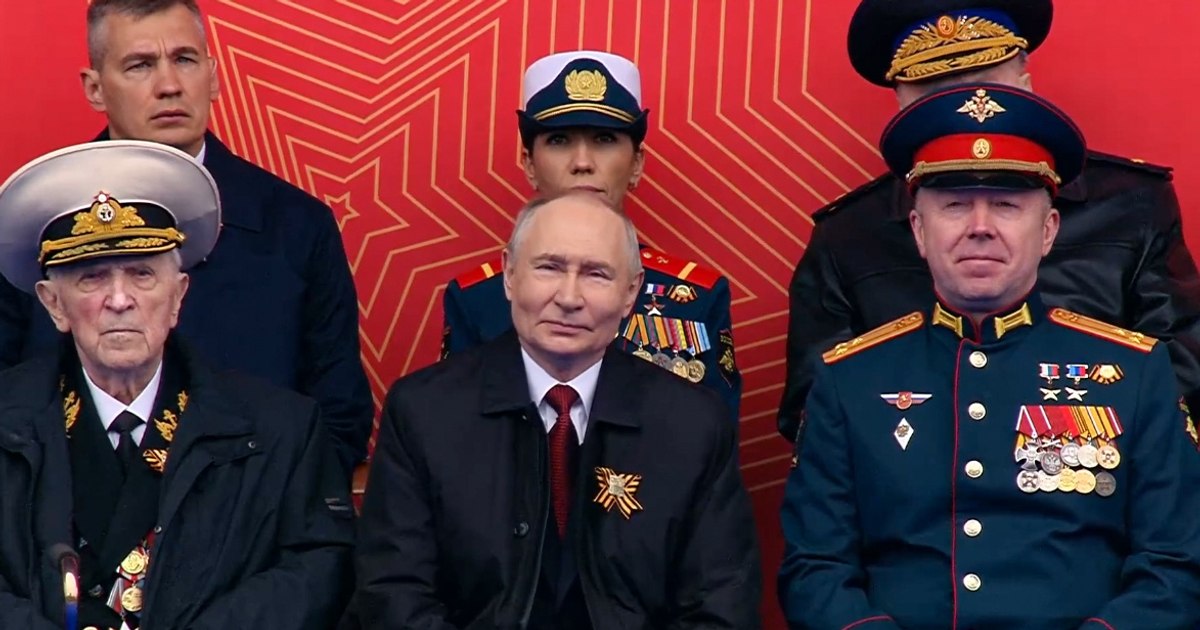
Vladimir Putin watching the poor Victory Day parade/PHOTO:X
This year, however, the Moscow procession sent a completely different message: the fragility of the Kremlin regime, writes The Telegraph.
The impeccable ranks of Russian soldiers who paraded beneath the Kremlin walls retained the same rigid discipline and the same aesthetic of power. But beyond the carefully staged military choreography, the anxiety running through Russia's war machine was impossible to hide.
The reason is obvious. The Ukrainian campaign of strikes deep into Russian territory has become so effective that even the center of Moscow can no longer be considered safe from the drones and missiles launched by Kiev.
In fact, the parade could only take place after Vladimir Putin convinced Donald Trump to support the negotiation of a temporary truce between Russia and Ukraine. Without this tactical pause, the most important event in the Russian Federation's political calendar was in danger of being disrupted.
No wonder the visibly aging and increasingly isolated Russian leader appeared diminished as he greeted the troops.
In previous years, May 9 parades offered Putin an opportunity to rekindle nostalgia for Soviet superpower status. Tanks, rocket launchers and strategic weaponry rolled across Red Square in a spectacle designed to intimidate opponents and reaffirm Moscow's ambitions.
The peak of this show of force came last year, marking the 80th anniversary of the end of World War II. Then, nearly 200 tanks and armored vehicles paraded in front of 29 international leaders invited by the Kremlin.
At that time, the Kremlin still had reason to display confidence. Russia was slowly but visibly advancing on the Ukrainian front, and Donald Trump's return to the White House seemed to pave the way for a rapprochement between Washington and Moscow. American financial support for Kiev had diminished, and the American administration was sending signals of reconciliation. Twelve months later, the situation is radically different.
Last month Russia lost more territory than it managed to conquer for the first time in almost two years
The Russian offensive stalled. According to the Institute for the Study of War in Washington, last month Russia lost more territory than it managed to conquer for the first time in nearly two years.
Worse for the Kremlin, the staffing shortage no longer only affects Ukraine. Since the beginning of the year, Russia — frequently facing more than 1,000 casualties a day — has been unable to recruit enough soldiers to cover losses, according to Ukrainian intelligence and Western military think tanks.
The most serious challenge for Moscow, however, comes from strengthening Ukraine's long-range strike capabilities.
Until recently, Kiev relied heavily on Western allies to strike targets inside Russia — support often limited by political restrictions and a lack of resources.
Moscow accuses Ukraine of violating the ceasefire by attacking Russia and the Crimean peninsula
“A new instrument of pressure on Putin”
Today, Ukraine's investments in its own drone and long-range missile program are beginning to produce visible results. The most notable example is the FP-5 Flamingo, a cruise missile capable of carrying a warhead of over one ton over a distance of nearly 3,200 kilometers.
The scale of operations has increased dramatically. If at the beginning of 2024 Ukraine carried out about 110 strikes of this type, in March last year their number exceeded 7,300.
What was once a symbolic and sporadic campaign has turned into a systematic strategy aimed at directly affecting Russia's economic and military infrastructure and preventing the Kremlin from taking full advantage of the rise in oil prices caused by the conflict between the United States and Iran.
Former Ukrainian Foreign Minister Dmytro Kuleba recently described the development as “a new tool of pressure on Putin,” at a time when the Trump administration is avoiding direct confrontation with Moscow and Europeans lack sufficient leverage.
The psychological effect
Perhaps the most important consequence is the psychological one. According to sources close to the Kremlin, quoted by the Financial Times, Vladimir Putin is spending more and more time in underground bunkers, fearing the vulnerability of the Russian security infrastructure. He and his family would have significantly reduced travel to residences outside of Moscow.
This state of insecurity also explains the low-key tone of this year's parade. Even under the terms of the armistice, the Russian authorities did not dare to display heavy military equipment or missile systems in Red Square, for fear that they could become targets.
In their place, images of military equipment were projected on giant screens.
Strategic humility
Few international leaders accepted the Kremlin's invitation, and the event was shortened to just 45 minutes.
At the same time, Moscow was placed under an extensive digital blackout. Internet and communications have been restricted in much of the capital in an attempt to reduce the accuracy of Ukrainian drones — a strategy many residents have described as a “digital iron curtain.”
Why Russia does not have the ability to protect its refineries from Ukrainian attacks
Even so, one drone managed to evade Russian S-300 and S-400 defense systems and recently struck a luxury residential complex just a few kilometers from the Kremlin and the headquarters of the Russian Ministry of Defense.
Vladimir Putin is not only an authoritarian leader, but also a master of political spectacle. Throughout his career, he understood the importance of image and displays of strength.
All the more painful is the message conveyed by his inability to stage a triumphalist parade designed to project power and invincibility.
Moreover, the fact that the event could only take place with the tacit approval of Volodymyr Zelensky — his fiercest opponent — represents, for the Kremlin, a strategic humiliation that is hard to ignore.
Vladimir Putin has been in power for 9,770 days, including his four-year interlude as prime minister. Few of these seem to have been as oppressive as today, concludes The Telegraph.