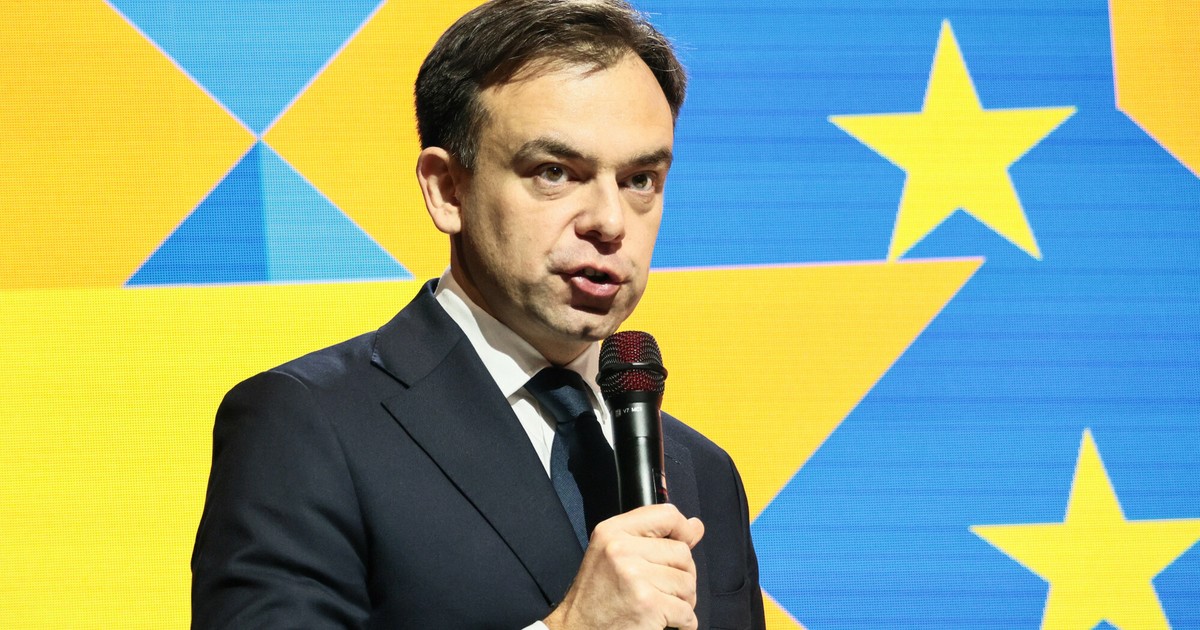
The starting point of the conversation between Grzegorz Kowalczyk and Bartek Godusławski is the trip of the Minister of Finance, Andrzej Domański, to Ukraine.
Kowalczyk poses the issue as a question about Poland's strategy towards Ukraine after the war – or even during it. Because although military operations are still ongoing, the race for future contracts has already begun.
Formally, the mission focuses on energy, green transformation and energy security, but – as Business Insider journalists emphasized – its meaning is broader. The point is whether Poland will be able to create conditions for private companies, especially small and medium-sized ones, that would like to participate in the reconstruction of Ukraine, but they are afraid of legal, corruption and financial risks.
Bartek Godusławski pointed out that this time it is not only about the largest State Treasury companies, which usually have political support and greater resistance to risk.
– This is not a visit where the minister, a representative of the Polish government, takes the largest State Treasury companies and tries to arrange contracts with these companies. NO. This is primarily about the private sector. (…) State Treasury companies will cope. The government always gives them some support. They are a partner for Ukraine, and I suspect a reliable one. However, it is more difficult to pave the way for small and medium-sized private companies so that they can also take part in this large project, which will be the reconstruction of Ukraine, he says.
The problem is that Polish companies do not compete in a vacuum. There will be a long queue to rebuild Ukraine: Germany, France, Great Britain, the United States, Spain, Italy, and perhaps also Arab countries and China. Poland has the advantage of location, regional experience and relationships, but this may not be enough if it does not offer financing, guarantees and the ability to conduct large turnkey projects.
Grzegorz Kowalczyk recalled a conversation with a diplomat of one of the large Western countries, which clearly shows the scale of the challenge.
— He said it was good that Poles were preparing to rebuild Ukraine, very good. Only when I asked him about Poland's competition with entrepreneurs from wealthier Western countries, he said: what can you actually sell there? Metal roof tiles? On such a large scale? To what extent are you actually able to operate there? Which banks will lend it to you? – he reported.
He pointed out that Kredobank, owned by PKO BP, already operates in Ukraine. However, it is only the 13th largest bank in this country – its size on the market is somewhat equivalent to the Polish BOŚ Bank.
Therefore – as the interlocutors pointed out – Poland must look for niches in which it has real competences.
Ukrainian risk: big money on one side, arbitration and corruption on the other
Companies interested in investing ask about insurance, legal stability, the possibility of enforcing judgments and real security of running a business.
The case was mentioned in this context Control Process, which is implementing an investment in waste processing in Lviv. As he points out, the company won in international arbitration, but still encounters difficulties in the dispute with the city. This is an example that may capture the imagination of other entrepreneurs considering entering Ukraine.
— On one scale there are a lot of contracts, a lot of money that will be spent on this reconstruction, and on the other scale there is a risk that many of these companies can bear. The role of the Polish government in cooperation with the Ukrainian government is to mitigate these risks and provide some framework in which these Polish companies will operate.. Without the risk of corruption, without the risk of someone expelling them or imposing any undue penalties, and where there will be a court, an arbitrator who will resolve potential disputes in a way that both parties can accept them – says Bartek Godusławski.
This may be the most important condition for Polish business to enter Ukraine. Without it, Polish companies may be reduced to the role of subcontractors of Western consortiums.
Drones: A quick win from collaboration
In addition to energy, there is another area of real effects of cooperation – drone technologies.
— This visit includes one more, I think, very important element, i.e. the issue of drones, because together with Minister Domański, representatives of the Polish drone industry will be there. This is also a dynamically developing industry. And Ukrainians are today the leading exporter of drone technologies around the world. (…) Importing technology from Ukraine, know-how and so on could be a tangible and relatively quick effect of the minister's visit – emphasizes Bartek Godusławski.
The full episode is available here and on streaming platforms:
Business and Money. Business Insider videocast
Are you wondering what changes in the economy, finances and business really mean to you? How do they translate into prices, investments and the household budget? In the Business and Money videocast, Bartek Godusławski and Grzegorz Kowalczyk from Business Insider Polska analyze the most important phenomena every week and show what they really mean for companies, Poles' wallets and your everyday decisions. Reliable, clear and practical. Stay up to date.
New episodes every Friday available on Onet Audio, on YouTube, Spotify and ApplePodcasts.
Bartek Godusławski, Grzegorz Kowalczyk, Business Insider journalists.