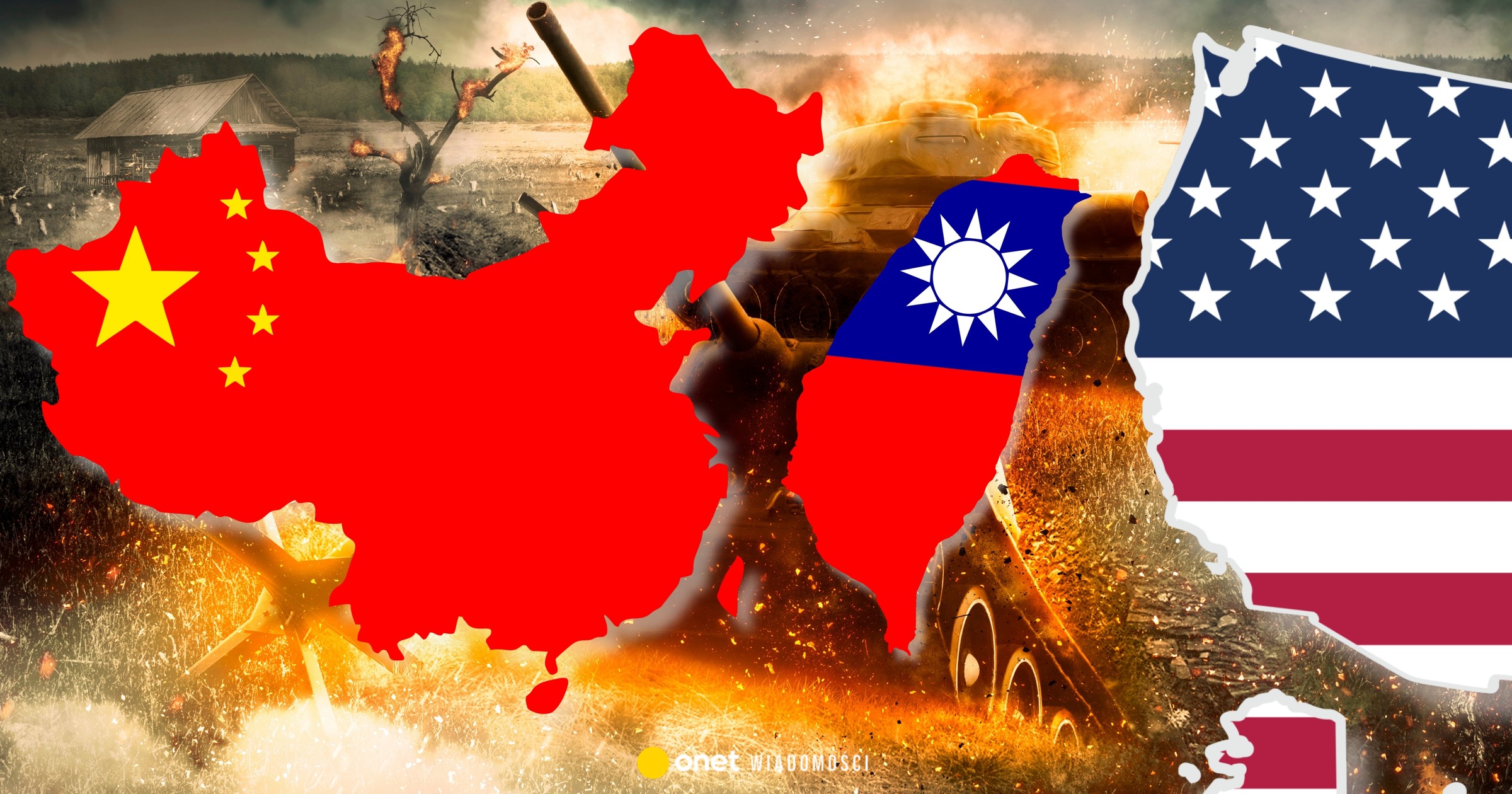
“Grey zone tactics”. China wants to outsmart Taiwan and America

POLITICO: Ahead of Trump's summit with Xi, the White House said the issue of Taiwan's status and U.S.-Taiwan relations would not be discussed during the summit. But then it was widely discussed. Were you surprised?
Alexander Tah-ray Yui: It wasn't a surprise. It would be unacceptable for the people of China if Xi Jinping did not mention Taiwan because, of course, the island is one of their main targets. So they were going to mention Taipei. What was interesting was that Xi Jinping actually spent a lot of time talking about Taiwan – Xi Jinping just wouldn't stop talking about Taiwan.
However, President Trump's visit to Beijing did not change anything in the United States' long-standing position towards Taipei. From President Trump down – from Secretary Rubio still in [środę]UN Representative Mike Waltz, various members of the Cabinet, US Trade Representative Jamieson Greer – when asked about Taiwan, all replied that there had been no change in US policy towards Taiwan.
What was your reaction to Trump's statement that the pending approval of arms sales to Taiwan worth $14 billion? (PLN 51.5 billion at the current exchange rate) is it a “bargaining chip” in negotiations with China?
I am not worried that we are in any way used as a bargaining chip against the Chinese. There are many things happening between the United States and Taiwan, not only in terms of security, but also in trade, investment, science and education. There are many things happening that do not indicate any reduction in U.S. interest or concern.
President Trump is the leader who has sold the most weapons to Taiwan to date. During his first term, he sold weapons worth approximately $18 billion to Taiwan. (PLN 66.2 billion), and at the end of last year announced arms sales worth $11 billion. (PLN 40.5 billion). We will respect the pace at which they announce a $14 billion sale.
Why is this sale important and what are the consequences if it is delayed even further?
We have conveyed to the US side that we need these arms purchases in the face of growing aggression from mainland China. The United States is selling weapons to Taiwan in proportion to the level of threat we face, so it is understandable that this set of fairly close purchases and planned purchases of American weapons — $11 billion. and USD 14 billion — is historic and unprecedented.
But it shows the degree of concern both on our part and among our American friends about the level of threat Taiwan faces. This purchase is intended to improve our self-defense capabilities, especially preparations for asymmetric warfare, defense against Chinese missiles, and better communications.
The Chinese side will always want this sale to fail. Their basic position is: “don't sell weapons to Taiwan.” However, I want to emphasize that US arms sales to Taiwan are proportional to the level of threat we face. As the threat level increases, the United States will sell us more weapons as needed.
You sometimes use references to American pop culture to explain Taipei's dual plight: its marginalized diplomatic status and its existential struggle against Beijing's threats to annex Taiwan. Why?
I try to refer to things that the American audience can relate to. When we watch “Star Trek,” we, the audience – the United States, Taiwan, like-minded partners – root for Captain Kirk. For us he is a positive figure. He's the one doing the right thing. The Borg are like the Chinese Communist Party. They only repeat: “Resistance is futile.” The spokesman of the Chinese Ministry of Foreign Affairs constantly tells the world that Taiwanese independence is futile because ultimately, whatever Taiwan does, it will one day become part of the PRC. This is the Borg mantra.
And like Hogwarts in Harry Potter, Taiwan was once a place that was sort of invisible. It is there, but it is not there. And you have to go through this special platform to get there. But once you get there, you discover: “Oh, Taiwan is a wonderful place!” However, people now know and understand where Taiwan is and what Taiwan is.
Trump has said he will call Taiwanese President Lai Ching-te to discuss arms sales, but recent reports indicate that won't happen anytime soon. Do you think this conversation will ultimately take place and do you want the presidents to talk to each other?
With President Trump, anything is possible. He is a president who works outside the box. He doesn't like to be limited. I think that since Taiwan is involved – we are an interested party between Beijing and Washington – we should be involved, don't you think?
Therefore, Washington's talks with Taipei at this level are completely justified. Of course, if there was a conversation, it would be a big deal. But this is completely reasonable when you consider that Taiwan is a self-governing republic. We are not subject to the People's Republic of China. The world should treat us as a self-governing, independent country.
It is almost a cliché that there is solid, bipartisan support for Taiwan on Capitol Hill. But are you worried that Congress won't be able to stop Trump if he decides to upend long-standing policies in U.S.-Taiwan relations?
Following President Trump's visit to Beijing, there was a flurry of comments from congressional leaders, representatives and senators. Even Chairman Johnson came forward to speak on behalf of Taiwan and the entire congressional leadership. It was just overwhelming. Secretary of State Rubio's hearings in the Senate and House of Representatives obviously focused on U.S. international affairs, but a significant portion of those hearings focused on Taiwan. This means that support for Taiwan remains very strong.
How concerned are you that Taiwan has not been mentioned in key administration documents such as the National Defense Strategy or by senior US officials such as Elbridge Colby and Pete Hegseth at high-profile events such as the Shangri-La Dialogue [międzyrządowa konferencja poświęcona bezpieczeństwu, uczestniczą w niej zazwyczaj ministrowie obrony, stali szefowie ministerstw i szefowie sił zbrojnych, głównie państw Azji i Pacyfiku]?
There were many reports about what a big deal it was that Hegseth didn't mention Taiwan during his speech. But the thing is, he mentioned the first island chain. So my interpretation is that this issue is not unique to Taiwan.
We have long said that Chinese aggression is not solely focused on Taiwan, although that is an important part of it. This concerns the entire first chain of islands. He therefore stressed the importance of keeping the first island chain strong and defensible. I actually feel more encouraged because they have included us in this partnership that includes Japan, the Philippines and other countries.
Beijing's goal is to weaken the resolve of the people of Taiwan by fueling the narrative that the United States will not support them in the event of a Chinese invasion attempt. Does delaying arms sales help reinforce this narrative and undermine Taiwanese morale about U.S. support?
This idea of ”doubt America” is something the Chinese spread as part of their gray zone tactics. Of course, they want to drive a wedge between the United States and Taiwan, trying to create the perception that the United States is not a reliable partner. That the US is just a capitalist country that makes our money, and when it makes our money, it will exhaust our industry, move it to Washington, and simply throw us out. Therefore, we should ally with our enemy, welcome him with open arms, so that he does not hit us so hard. This is a very twisted concept, but it is supported by some in Taiwan.
However, I think most people in Taiwan understand that the United States is a long-time friend and ally of Taiwan. The US is a Pacific country, so it has a lot to lose when it comes to security in the region. Many of us, including myself, were educated in the United States, so we align ourselves with the United States and the values we hold dear. So all this propaganda may make some people question it, but most rational people don't think that way.
Xi Jinping recently announced that a program called “Journey Together: China-American Youth Friendship Program” has brought 50,000 to China since 2023. young Americans through exchange and study programs. What concerns do you have that Beijing is fighting for the favor of the United States using soft power that Taiwan cannot compete with?
It is good that people interact with each other because better understanding between nations reduces conflicts. But it's like North Korea. You can pretend that these fake villages exist and that everything is fine, but when you go there and they try to show that Pyongyang is wonderful, the people who go there see it and understand what is happening. I mean, they're not stupid. So go to Beijing, go to China and see it. But I think they will somehow feel that if it was this friendly, they wouldn't have to take their prepaid phones with them to Beijing. They wouldn't have to throw away everything they received in Beijing and put it in the trash before boarding the plane because it might be overheard.
I have even seen reports of young people from the United States returning from such trips and saying that they were somehow forced to participate in propaganda. So it's probably good that 50 thousand. young American high school students went to China. But I would also encourage the Chinese to come – not as spies – to really get to know what America or Taiwan is about. Of course, we encourage people-to-people contacts between the United States and Taiwan and have various educational programs. The demand for learning and teaching Mandarin is still quite high in the United States, so many institutions are turning to Taiwan to fill the gap.
People should go to Taiwan. You don't feel any pressure there; you don't feel like you're being watched or followed by agency people [bezpieczeństwa]. It's a free society. That's why I think I would rather encourage those who went to Beijing – the 50,000. people – to also go to Taiwan.
What was the biggest surprise you encountered in this job?
We have not had access to federal buildings since 1979, when the United States and Taiwan severed diplomatic relations. We had to meet with [amerykańskimi urzędnikami] outdoors, in restaurants. But now we regularly hold meetings in US federal buildings. And when we meet American officials, we talk like friends, even though we do not have diplomatic relations.
This kindness and concern for Taiwan and what we can do for each other – this is no surprise to me, but I feel real warmth. There are no diplomatic relations, but we are treated as friends. And wherever I go, I am a “representative” because we are obviously not an embassy. But actually, the first day I walked into the federal building, someone said, “Oh, you're the new representative of Taiwan — can I call you ambassador?”
I think it's surprising how many people like to call me “ambassador.”