
A few hundred meters from the Black Sea coast, in front of the Kadorr residential complex in Odesa, residents and intervention teams move among the rubble, in bitter cold. A wall of an office building on the 25th floor was ripped off by a Russian drone. Below, pieces of masonry and glass are hastily picked up as homeowners watch their cars crushed by falling debris.
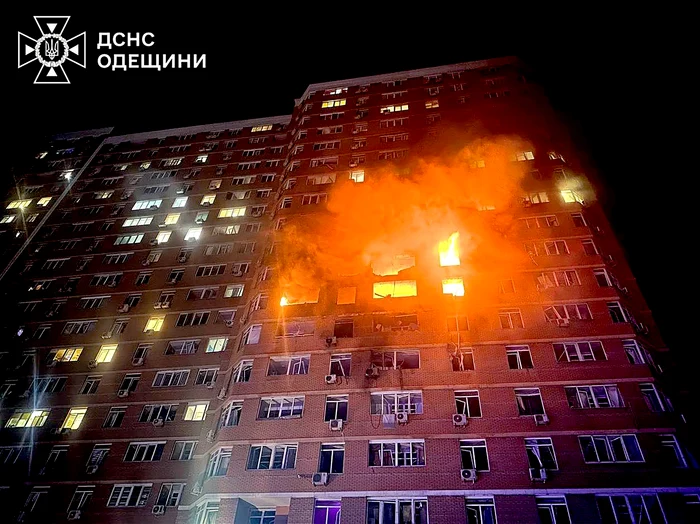
Block in Odessa hit by drones/PHOTO: X
Anastasia, 35, lives in a nearby block of flats. He took refuge in Odesa from Donetsk after the Russian invasion and occupation of eastern Ukraine. Now he's wondering if he can stay any longer.
“I was sleeping. At first I thought I was dreaming, the building was shaking. I didn't hear the explosion, but I heard the Shahed drone – it was extremely noisy. It had been relatively quiet here until recently. Now it's getting more and more dangerous. I don't know if I should leave, but I'm afraid,” she says.
The sentiment is widespread. In recent months, Russian attacks on Odessa have visibly intensified, amid the relaunch of the confrontation in the Black Sea area, after a period of relative deadlock, writes The Guardian.
Putin's threats
Ukrainian strikes late last year on oil tankers in Russia's “ghost fleet” and the Russian naval base at Novorossiisk coincided with Moscow's renewed focus on Ukraine's main port. Vladimir Putin has repeatedly claimed Odessa as “Russian” and in December openly threatened to cut off the city's access to the sea.
An occupation of Odessa or even a naval blockade remain, however, inaccessible objectives for Russia. Early in the war, Ukraine managed to push the Russian fleet out to sea, sinking several warships, including the cruiser Moskva. Lacking an effective naval presence, Moscow has resorted to long-range attacks with missiles and drones.
The largest recent attack, on December 13, involved 160 missiles and drones aimed specifically at energy infrastructure. Large areas of the city were left without water, electricity and heating for days, marking the beginning of a series of almost daily strikes.
In his office in Odessa, Ukrainian Navy spokesman Dmytro Pletenciuk flips through a January calendar. “Shahed. Shahed. Shahed… It's only two days without an attack,” he says on January 19. “Other than that, missiles and drones, day in and day out.”
25,000 square kilometers of sea become a battlefield
“Russia is hitting energy infrastructure night after night because it's cold and betting on capitulation,” says Pletenciuk. “The situation in the Black Sea is like a blocked chessboard. Russian ships are withdrawn to Novorossiisk, but Russian aviation still controls large parts of the airspace. A gray area has appeared – 25,000 square kilometers of sea have become a battlefield.”
This reality led to a war fought at a distance, but no less violent. Ukraine is targeting Russian oil shipments, and Moscow is trying to hit one of Kiev's main economic lifelines: agricultural exports by sea.
Odesa Region Governor Oleh Kiper says the Black Sea is both an advantage and a vulnerability. “On the one hand, it is a natural defense barrier. On the other hand, unlike inland cities, we cannot build an air defense system in depth. We are exposed to drone and missile attacks launched from occupied Crimea.”
“The worst attack was on December 13. Then more than 60% of the region was left without electricity, water and heat. Even now there are neighborhoods without power for up to 10 hours a day”Kiper says.
For the Ukrainian army, the pressure is not only military, but also psychological
Lieutenant Colonel Denis Nosikov, in charge of territorial defense in the south, says Russia is combining drone and missile attacks with online influence operations. “The aim is to weaken our morale. Every day we have Shahed attacks.”
The strategic importance of Odesa was also recently emphasized by the Chief of the Ukrainian General Staff, Oleksandr Sîrski, who stated that Russia aims to completely cut off Ukraine's access to the sea. President Volodymyr Zelensky reiterated the message, warning that Moscow is trying to hit both the population and the economy by reducing export capacity through the maritime corridor.
With around 90% of Ukraine's agricultural exports going through ports in the Odesa region, sea routes have become a battleground. “The Black Sea, which feeds us and is vital for the economy, is also our weak point,” Ukrainian military analysts warn.
Meanwhile, civilians bear the direct cost of the attacks. At the Construction and Architecture High School in central Odesa, principal Igor Cernenko oversees repairs after the building was hit by three Shahed drones. Without heating, the smell of smoke lingers in the offices.
“The attack happened at 2.40 in the morning. When we arrived, the building was burning. I can't understand why they hit here. Maybe they don't want us to train people to rebuild Ukraine”he says.
The school archive, kept since 1945, was destroyed. “Before we had attacks once a week. Now they are every night. Odessa is a pearl in the sea, and Russia still thinks it belongs to it. The Kremlin leader thinks like a terrorist,” says Chernenko.
For Ukraine, the message is clear: the Russian threat remains active on all fronts – land, air and sea – and Odessa remains one of the central stakes of the war.