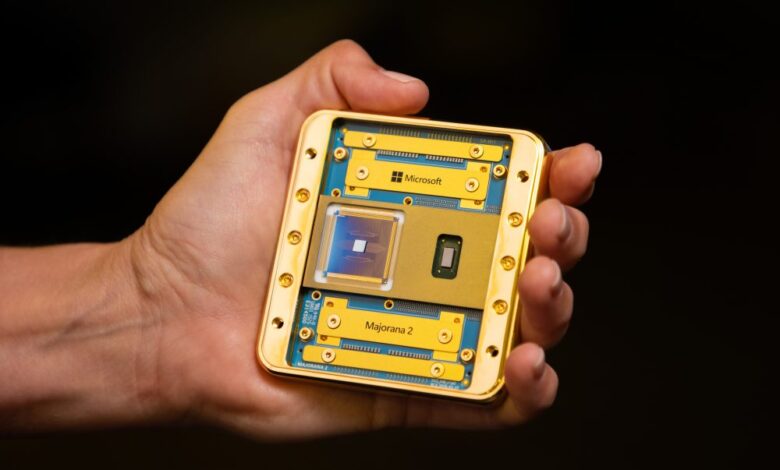
Microsoft says its new quantum chip is far more reliable than the previous version and paves the way for a quantum computer capable of solving useful problems in no more than three years, the BBC reports.
Scientists predict that quantum computers will be able to perform calculations that would take millions of years on current systems, with the potential to revolutionize fields such as medicine, chemistry and other sciences that involve an almost infinite number of molecular combinations.
At the heart of quantum computing are qubits, fundamental processing units that researchers believe will be able to provide answers to questions that current machines cannot. But qubits are notoriously fragile and unstable.
Microsoft claims that the qubits on Majorana 2, its new chip, last an average of 20 seconds, compared to the milliseconds offered by Majorana 1. Microsoft introduced the chip last February.
That means the new chip is 1,000 times more reliable – a performance improvement that the tech giant compares to the difference between a phone that needs to be charged every day and one that needs to be charged once every few years.
Microsoft promises a quantum computer that can solve problems in three years
“We will have a quantum machine in 2029 that will be able to viably solve commercial and relevant problems,” said Zulfi Alam, vice president of Microsoft Quantum, the quantum computing division of the company founded by Bill Gates.
The BBC notes that this would require huge further advances, however, as such a device would need millions of qubits. Alam specified that the current chip only uses 12.
Assessing the company's claims is difficult because it does not release all the details of its findings, citing industrial secrecy.
There is a worldwide race to develop this technology, given its potential to tackle tasks currently considered too complex for even the most powerful traditional computers.
The big problem of quantum computing
Quantum computers were first thought of in the 1980s. If a regular computer stores information in bits, a quantum computer stores information in quantum bits – or qubits.
An ordinary bit can have the value 0 or 1, but a quantum bit (due to the laws of quantum mechanics, which govern very small particles) can have a combination of both. If a regular bit is thought of as an arrow that can point either up or down, a qubit is an arrow that can point in any direction (or what's called a “superposition” of up and down).
This means that a quantum computer would be much faster than a regular computer for certain types of calculations – especially those related to deciphering codes and simulating highly complex natural systems.
But building real qubits and extracting information from them is extremely difficult, because interactions with the outside world can destroy the fragile quantum states inside.
Researchers have tried lots of different technologies to make qubits, using things like atoms trapped in electric fields or current eddies spinning in superconductors.
Microsoft's revolutionary approach to quantum chips
Microsoft has taken a very different approach to building “topological” qubits for quantum chips. The company's researchers used so-called Majorana particles, first theorized in 1937 by the Italian physicist Ettore Majorana.
Majorana particles are not naturally occurring particles like electrons or protons. Instead, they only exist in a rare type of material called a topological superconductor (which requires advanced design of the material and its cooling to extremely low temperatures).
In fact, Majorana particles are so exotic that they are usually only studied in universities, not used in practical applications.
The Microsoft team says it used a pair of tiny wires, each with a Majorana particle attached to the ends, to act as a qubit. They measure the value of the qubit – expressed by the presence of an electron in one wire or another – using microwaves.
By changing the positions of Majorana particles (or measuring them in a certain way), they can be “entwined” so that they are measured without error and are resistant to external interference. This is the “topological” part of “topological qubits”.
In theory, a quantum computer built with Majorana particles can be completely free of the errors that plague other models.