Ukraine has confirmed that it has begun equipping some of its attack drones with Soviet-era S-5 unguided missiles, in an initiative that reflects the rapid transformation of technologies used on the battlefield.
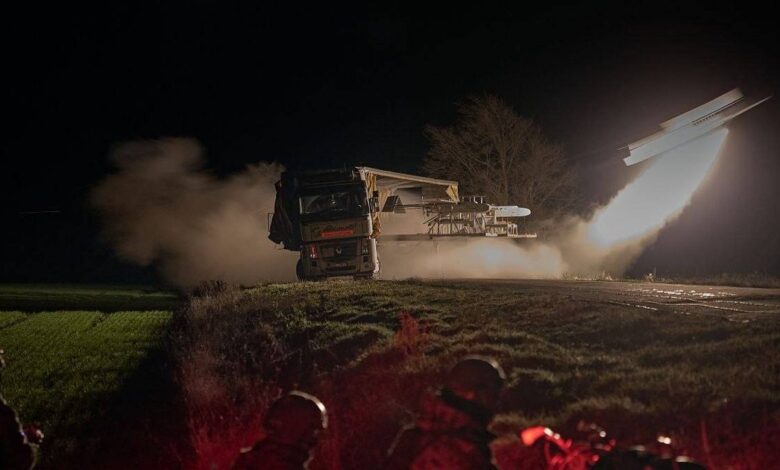
Launch of a Ukrainian drone FP-1/FOTO:X
The announcement comes in the context of the intensification of Ukrainian attacks on Russian logistics infrastructure tens or even hundreds of kilometers behind the front line, kyivpost.com writes.
A new use for old weapons
According to Denis Stilierman, co-founder of the Ukrainian arms company Fire Point, the integration of S-5 missiles has been completed on the FP-1 and FP-2 drones, used for medium and long-range missions.
Each drone can carry up to eight S-5 missiles, ammunition that has remained in military stockpiles since the days of the Soviet Union.
“We have a large number of such missiles that are practically no longer used on the front. The idea was to find a way to exploit them”explained Stilierman in an interview with the Ukrainian publication New Voice of Ukraine.
The S-5 missile family includes 55 mm projectiles launched through 57 mm tubes. Originally designed for military aircraft and helicopters, they have been used for decades in numerous conflicts.
From airplanes to drones
The adaptation of traditional weaponry to unmanned platforms is one of the most important trends observed in the war in Ukraine.
According to the developers, the S-5 missiles are not effective against heavy armor, but can be used against less protected targets such as logistics vehicles, warehouses, fortified positions or military infrastructure.
The new configuration offers an important advantage: the drone no longer has to be sacrificed in a single kamikaze attack.
“If we identify a train carrying several tanks, we can simultaneously hit several vehicles and the locomotive, instead of destroying a single target with a single-use drone,” explained Știlerman.
Images of in-flight launches
In mid-May, the Unmanned Systems Forces of Ukraine released images showing drones launching missiles in flight.
The footage captures the projectiles being launched at targets identified by the drone's sighting systems. According to the Ukrainian army, the attack was carried out near the town of Mirnyi in occupied Crimea.
“There are no more safe places for Russians.” Kiev's drones strike deep behind the front, including in the Luhansk region
Thermal images released later showed explosions in the area of the hit targets.
The Ukrainian military stated that the system allows hitting targets at an operational distance of up to 500 kilometers.
Pressure on Russian logistics
The new capability is part of a larger strategy by which Kiev seeks to affect Russian logistics lines far behind the front.
Although the range of an S-5 missile is relatively limited — estimated at about 3-4 kilometers — its mounting on drones significantly expands the possibilities of use.
According to Fire Point, the FP-1 and FP-2 drones can operate autonomously at distances of up to 1,300 kilometers, and in controlled mode via satellite communications they can reach about 500 kilometers.
This combination allows the use of existing munitions without exposing manned aircraft to heavily contested airspace.
Changing nature of drone warfare
In recent years, drones have evolved from simple observation platforms to systems capable of carrying and launching various types of weaponry.
The United States has long used MQ-9 Reaper drones equipped with AGM-114 Hellfire missiles, and Turkey has demonstrated the effectiveness of Bayraktar TB2 drones in combination with precision-guided munitions.
However, the conflict in Ukraine has accelerated the emergence of a new category: kamikaze drones converted into reusable platforms capable of launching missiles or other munitions before returning to base.
Both Ukraine and Russia are experimenting with such solutions, in a technological race marked by quick adaptations and relatively low costs.
A competition of innovation on the battlefield
For military analysts, the integration of S-5 missiles on drones is yet another example of how the conflict in Ukraine is redefining the use of conventional weapons.
Far from introducing a revolutionary weapon, the new system demonstrates the ability of both camps to combine old and new technologies to extend strike range and increase pressure on an adversary's military infrastructure.
As warfare enters a phase increasingly dominated by unmanned systems, the difference between attack drones, stray munitions, and conventional weapons platforms is becoming increasingly difficult to define.