
The artificial intelligence boom is driving the records of Samsung, SK Hynix and Micron

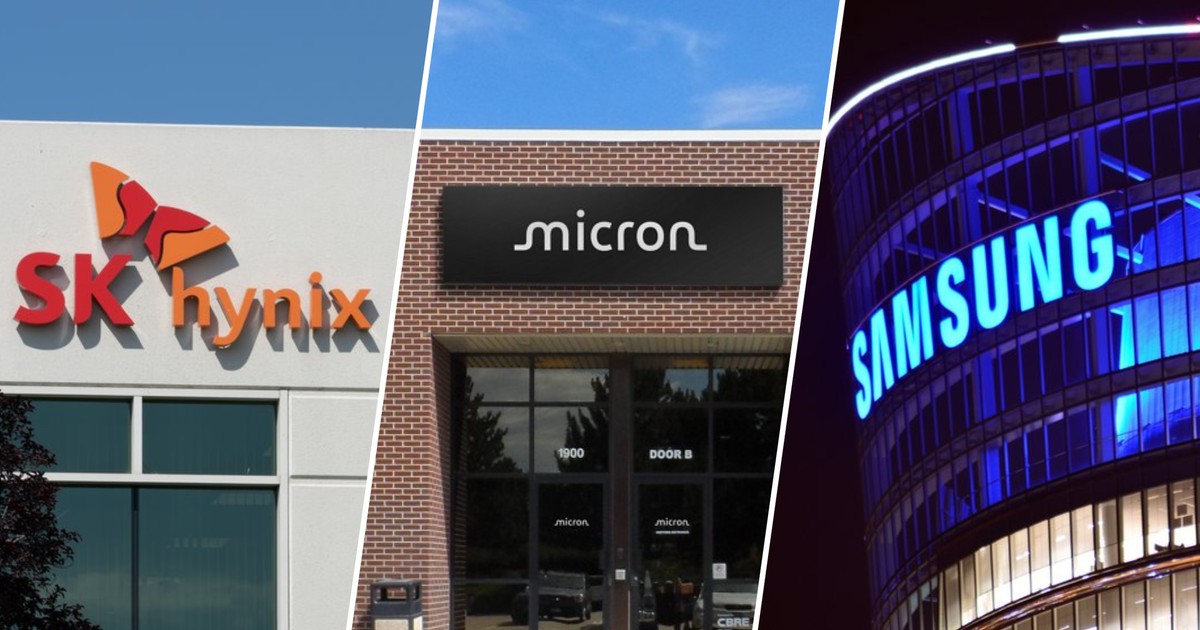
Just over a year ago, the capitalization of Micron and SK Hynix was less than USD 100 billion, i.e. within a dozen or so months it increased more than tenfold. Samsung's history is not that spectacular, but we are still talking about a several-fold increase in its stock market value.
Why such a historic leap? It's easy to guess that it has something to do with the artificial intelligence boom, however the explanation “because AI” is definitely an oversimplification.
Until recently, computer memory was one of the most cyclical and unforgiving segments of the semiconductor industry. Manufacturers made fortunes during periods of shortage, only to fall into crisis when delayed production capacity came to market after demand weakened. This created a kind of sine wave that kept many investors awake at night.
The same investors – and those who previously steered clear of computer memory companies due to their unpredictability – now seem to believe that we are not dealing with another typical “hill”, but with something more. With what exactly?
As Monika Wilk, vice-president of Wilk Elektronik, the owner of the Goodram brand and the only European manufacturer of memory modules and data carriers with semiconductor memory, explained to us:
— It's not a wave, it's a tsunami. A structural change that will not reverse until the investment trend of hyperscalers reverses.
Its basis is, of course, the drastic increase in demand for new data centers resulting from the implementation of artificial intelligence. But in the case of computer memory, this increase is even greater than for other types of chips or components.
First, any AI server – especially a server designed to host AI agents – needs more memory than “classic” servers. In addition, AI accelerators use special HBM memory, which uses up to 3 to 4 times more silicon for each gigabyte of memory than more typical types of memory. So we get the multiplier multiplied by the multiplier.
These inconspicuous chips are currently one of the most sought-after products in the world of technology.
However, this exponential increase in demand is only part of the story. The other side of this silicon coin is that how this situation influenced customer behavior, especially the behavior of the largest memory buyersi.e. hyperscalers like Amazon, Google, Meta and Microsoft.
Memory becomes a strategic commodity
Last June, they started coming to Koreans and Americans with orders that were once unimaginable. However, there were more and more orders of this type, and they were followed by specific actions and money that were supposed to overcome the initial skepticism of suppliers:
– The largest customers began to say not only that they were sure of these amounts, but that they were ready to prepay them – emphasizes Monika Wilk.
In practice, this is the biggest difference compared to previous semiconductor cycles. In the past, manufacturers operated under conditions of great uncertainty: they invested billions in new factories, and demand could disappear in the meantime, as, for example, it did recently shortly after the end of the pandemic. Today, the largest clients are increasingly taking on some of this risk, thus changing the rules of the game.
— At this point, the market has switched to the fact that memory manufacturers expect prepayments, and the final price will certainly not be revised down, but it may be revised up upon receipt of the order.
Typical for this market shorter contracts are replaced by longer-term contracts. This year's entire memory production was booked several months ago and the vast majority of it will go to the above-mentioned hyperscalers, who have started treating computer memory as a strategic commodity.
As Monika Wilk explains – We are dealing with a new hierarchy. Hyperscalers are at the top because they pay more and give producers a guarantee of receipt. Then there are the big OEMs, and then everyone else.
From the perspective of Samsung, SK Hynix and Micron this means shifting business towards larger clientswho are more predictable and willing to secure supplies in advance. And this is regardless of price, which means that these chipmakers are now enjoying record margins and revenues.
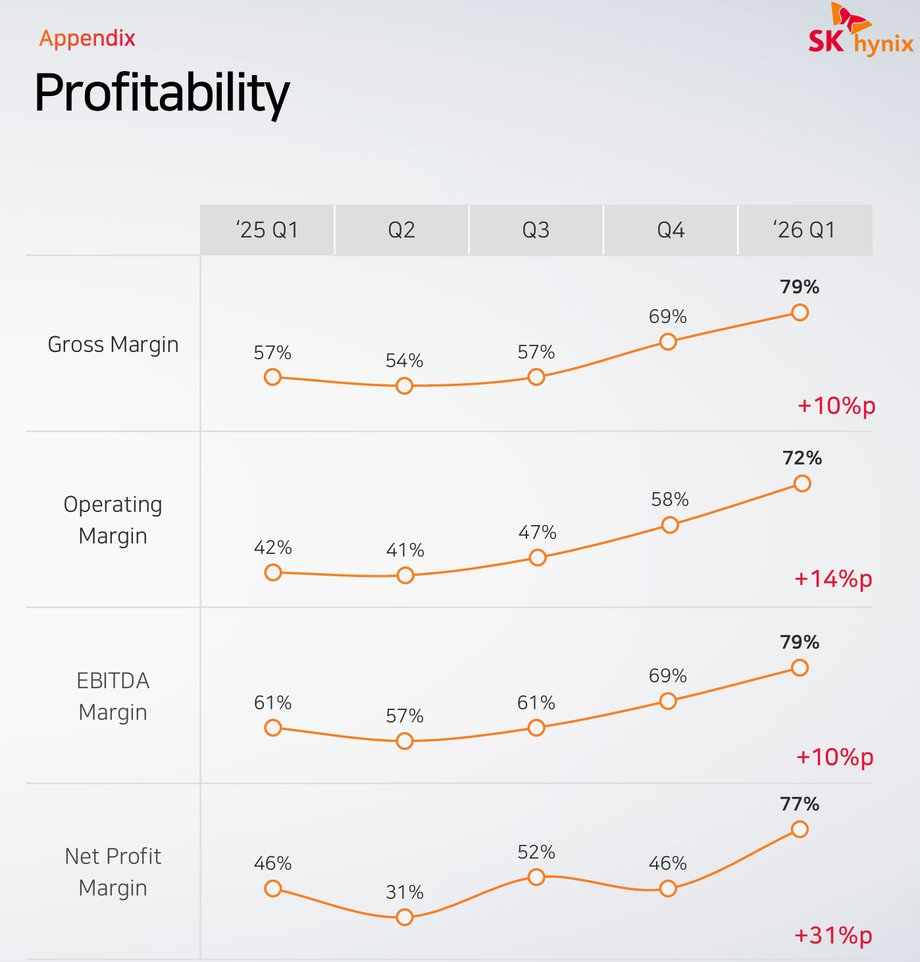
Excerpt from the financial statements of SK hynix. The company's margins clearly show that we are currently dealing with a market heavily tilted in favor of suppliers, with customers willing to pay almost any price just to receive memory supplies.
It is therefore not surprising that investors, seeing all this, chose Samsung, SK Hynix and Micron, i.e. the three largest producers of computer memory and the only suppliers of the latest generations of HBM memory for AI accelerators.
Not just Samsung, SK Hynix and Micron
Although the rise of the “big three” is the most noticeable, These aren't the only companies benefiting from bottlenecks in memory supplies.
The memory tsunami also took with it companies that do not produce DRAM memory, but produce memory for semiconductor media. The most important of them are Japanese Kioxiawhose valuation increased by nearly 3,000 percent during the year, and the American one SanDiskwhich increased by approximately 4,000 percent.
Smaller manufacturers of RAM memory chips, such as Taiwanese, are also undergoing a kind of renaissance Nanya (+600% year-on-year) i Winbond (+800%), semiconductor controller suppliers such as Phison (+400 percent) i SiliconMotion (+350%), as well as producers of end products, such as those operating in Poland Goodram.
Read also: The only memory factory in Europe is located in Poland
What probably captures investors' imagination the most is the IPO announcements of two Chinese champions, i.e YMTC and CXMT. In current market conditions these may be one of the largest Asian stock exchange debuts in recent years.
How long will it take and where is the ceiling?
Now a lot of people are asking themselves: how long will it take and where is the ceiling? Because even if the current cycle looks different from the previous ones, it does not mean that the memory industry has suddenly stopped being cyclical and the demand for chips of this type will never return to the times of the sine wave.
— The cyclical nature of the memory market will not disappear, only the axis of this sinusoid will shift. It may be bigger or smaller, but navigating it will still require the experience that we have been collecting for 35 years. – explains Vice President Goodram.
It is also difficult to imagine a situation in which the current margins of new members of the trillion club will remain with us forever.
For now though the industry does not see a quick path to balance and there is no shortage of analysts who claim that the shares of SK Hynix and Micron are still undervalued. The “Big Three” are building factories as fast as they can, but no amount of money can overcome the laws of physics and supply chain constraints that dictate that the production lines being created will not start operating at full speed until late 2027 and 2028. However, with the current trajectory, these closest factories may not be enough and, among others, the head of SK Hynix has already mentioned that the return of a greater balance between demand and supply is more a matter of around 2030.
But no one knows exactly where the metaphorical ceiling is. If AI turns out to be less profitable than the market currently assumes, or if the largest customers limit their investments in data centers because, for example, they will not be able to provide them with power, the current boom may quickly lose some fuel.
So there is one certainty: people who decided a year ago to take a risk and surf the rising wave of the historically very capricious memory market definitely have nothing to complain about.


