A worse scenario for the Polish economy. Three main effects of the war in Iran and expensive oil

“Once again this year, we are shifting our forecasts for the Polish economy towards higher inflation and slightly weaker economic growth. This is, first of all, due to the inflow of new economic data, which surprised us with weaker than expected GDP growth in the first quarter of this year. and a larger-than-expected scale of price increases in April, including in base categories, and secondly, from the prolonged blockade of the Strait of Hormuz, which shifts up the expected trajectory of energy raw material prices in the following months,” Erste economists wrote in the monthly report “Makrooskop”.
They still assume that the base scenario is the de-escalation of the dispute in the coming weeks. Lower-than-expected GDP growth in the first quarter (3.4% year-on-year) largely attributed to the effects of an exceptionally harsh winter that froze economic activity in January and February. A large part of this effect should be made up for in the coming months, but due to the increased uncertainty and risks resulting from the prolonged conflict in the Middle East, the rebound may be insufficient to fully return to the previously predicted growth trajectory. “As a result, we are lowering our forecast for this year's GDP growth from 3.8%. up to 3.6 percent – they wrote. In 2025, the economy grew by 3.6% and in 2024 by 3.2%.
Inflation, despite the government's reduction in fuel taxes, rose to 3.2% in April. year to year. Erste economists wrote that if in the coming months oil prices behave in line with the current forward curve, they expect a further increase in CPI to approximately 4 percent. in May-June, stabilizing close to this level for the next two-three quarters and returning to approximately 3%. at the end of 2027 Therefore, their forecast of average annual inflation in 2026 moves to approximately 3.5%. from 2.8 percent a month ago and approx. 2.5 percent in March.
|
ERSTE
They added that the labor market remains in quite good shape – the number of people working in the national economy increased in the first quarter, while wage growth is slightly slowing down, although still clearly above inflation. This allows us to maintain consumption forecasts above 3%. At the same time, they still assume a clear acceleration of investment growth in the final phase 2 of the use of KPO funds, despite the probably quite weak first quarter, burdened with downtime in the winter.
The market is pricing in rate increases. Economists think otherwise
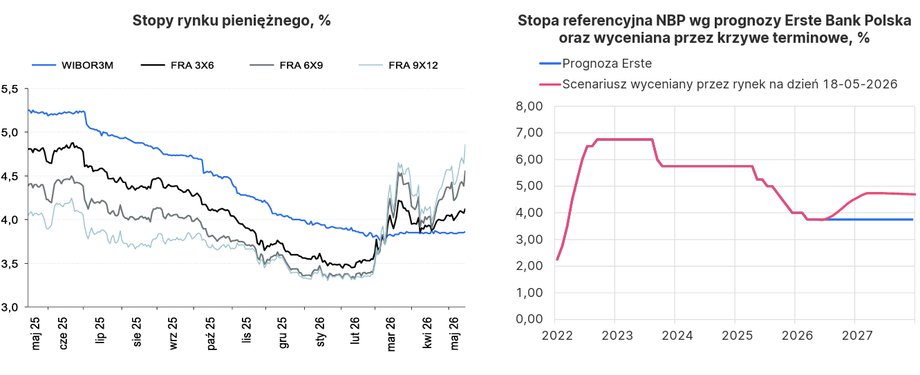
What about interest rates? At the beginning of the year, it was expected that the cuts would continue. Even in March – when the Iran war was already underway and oil prices were rising significantly – the Monetary Policy Council decided to reduce rates by 0.25 percentage points, to 3.75%. (this level is 2 percentage points lower than a year ago).
However, in April and May, the Monetary Policy Council not only did not lower the rates, but there are even voices that it may even have to raise interest rates, at least as a “signal”, showing that it has its finger on the pulse and will not allow prices to accelerate or inflation expectations to fall away.
See also: Inflation in Poland is rising again. The chances for rate cuts have almost disappeared
“The Monetary Policy Council remains in the mode wait-and-seeobserving the development of the situation, but the statements of its representatives show increasing concern about the deteriorating inflation prospects. NBP President Adam Glapiński said at the conference after the May meeting of the Monetary Policy Council that the probability of rate increases had increased, and the reason to tighten monetary policy would be the central bank's forecasts indicating inevitable inflation increase above the permissible fluctuation band. He did not specify how long a deviation above the band would force the Council's decision,” Erste economists wrote.
|
ERSTE
They added that in their opinion, the most likely scenario is still to keep interest rates unchanged this and next year. “Although we predict that CPI inflation will rise significantly above 3.5% from May, at least for 6-8 months, we assume that new NBP projections, showing inflation returning close to the target in the second half of 2027, while reducing the economic growth trajectory, will allow the central bank to keep monetary policy unchanged“- they noted.
See also: What's next for interest rates? Disturbing words were spoken by the MPC
They added that the likelihood of rate increases would increase in the event of a further increase in energy commodity prices, further boosting inflation forecasts, and significant interest rate increases by the ECB in the following months (going beyond the single increase in June, which they currently treat as the base scenario).
The futures market is currently pricing in a larger scale of rate increases – by almost 100 basis points over the horizon of the year. However, it is worth remembering that market expectations have changed several times in recent weeks, along with the change in the dominant mood regarding the development of the situation in the Middle East. What happens next will be determined by the actual development of events – the longer the blockade of the Strait of Hormuz persists, the greater the risk of fuel and gas shortages in Europe in the coming months and maintaining high energy prices for longer. In such a situation, further revisions of economic scenarios should be expected, Erste economists said.