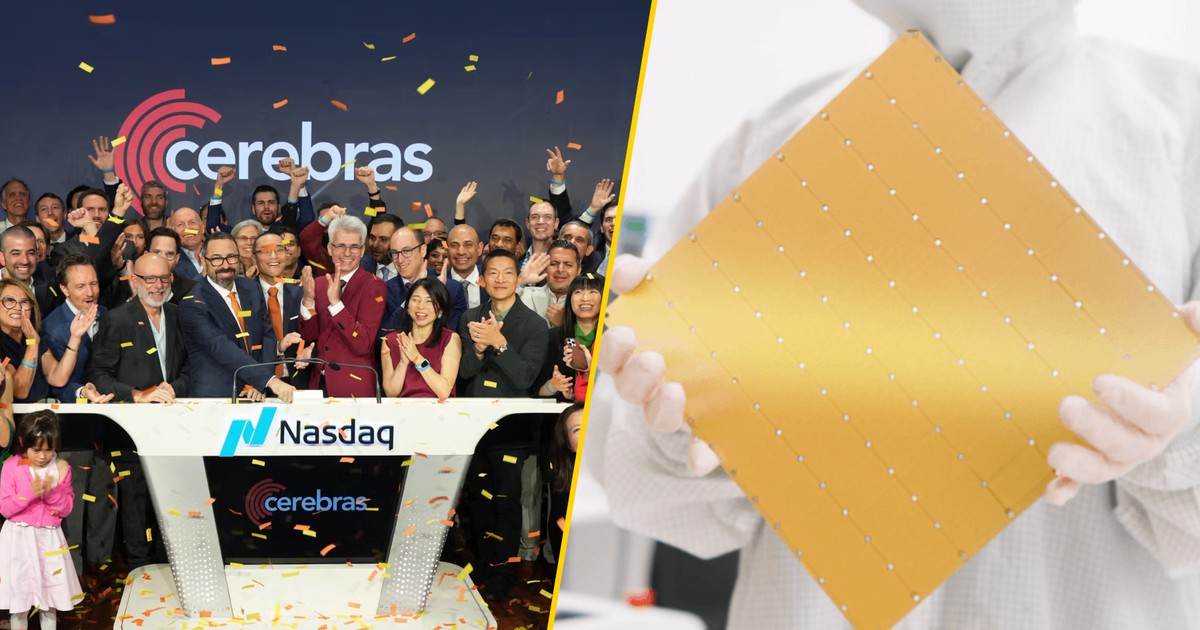
Cerebras conducted a public offering on May 14, selling 30 million shares for $185. each, thus collecting USD 5.55 billion from the market. — the most of all this year's American IPOs. However, at the opening of trading, it turned out that many investors considered these amounts to be too low. The Cerebras share price shot up to approximately $350, temporarily reaching even above $380, which meant almost doubling the price compared to the starting offer and increasing the company's stock market value to approximately USD 90-100 billion. Ultimately, the price stayed a little lower, at just over $300.
The mere doubling of the share price on the first day of trading is an unusual situation, and it becomes even more interesting when the above-mentioned amounts are compared to the financial statements presented by Cerebras. It follows that last year, this company recorded approximately USD 510 million. revenue. In other words, on the day of its debut, the market valued it at over 100-200 times annual sales — a level that has historically occurred mainly during periods of market euphoria.
Backlog as a foundation for optimism
What makes you believe that Cerebras is worth it? The company showed investors a huge order portfolio, i.e. the so-called backlog (in reports as remaining performance obligations), amounting to approximately USD 24-25 billion. — that is, a multiple of current annual revenues. In theory this means that Cerebras has contracted to supply computing power for the next few yearswhich are expected to translate into a very rapid increase in revenues.
If these assumptions come true, today's valuation will no longer seem completely disconnected from reality. If the backlog was fully materialized, the company could reach the level of several billion dollars in annual revenues in a relatively short time, which would significantly reduce the current extreme multiplier.
Read also: The US army buys the most glitter. This is how the glitter mystery began
A customer who also finances the supplier
This optimism, however, has one fundamental problem. Much of this backlog is based on a relationship with one customer – OpenAI. In addition, the contract between these companies has a very specific structure. OpenAI has committed to purchasing computing power worth more than $20 billion. over several years, with the option to expand orders up to a level equivalent to 2 GW of data center capacity. At the same time, it granted the company approximately USD 1 billion. financing for the construction of infrastructure – that is, it de facto co-finances the production capacity of its supplier.
In return OpenAI received the right to acquire 33.4 million Cerebras shares at a symbolic price on the order of one ten-thousandth of a cent, i.e. almost for free. However, these rights are not granted in full at once. Some of the shares were granted at the very beginning, the next tranche depends on achieving a specific market capitalization of the company or the level of payment, and the largest part depends on the actual delivery of computing power and the scale of orders – that is, on the extent to which OpenAI will implement the contract itself. At the current share price around USD 310-330. the full package of these shares corresponds to amounts of over USD 10 billion.
This leads to a situation where revenue, backlog and valuation start to reinforce each other in a way that is difficult to separate. So while the numbers themselves may justify investors' optimism, it is their structure that makes them so it is difficult to clearly assess how much of this value results from the real strength of the business and how much from the structure of the agreement between the companies.
Read also: They named the ships after Trump. Now they will produce 15 of them
An engineering masterpiece with its own architecture
However, the problems with Cerebras do not end with financial issues, but also concern technological issues.
To begin with, it must be honestly admitted that the WSE accelerators (short for Wafer Scale Engine) created by this company, which it has been developing for several years and for three subsequent generations, are masterpieces of semiconductor engineering. Typically, chips are cut from silicon wafers and for technical reasons their size does not exceed just over 800 mm². Sometimes several such chips are connected to create one accelerator.
In the case of Cerebras accelerators, the entire silicon wafer is one chip.
Whereas Cerebras does not cut its chips from silicon wafers because the entire wafers are one large chip. This is the result of years of engineering work and close cooperation with TSMC. In addition to making it work, Cerebras also had to create a completely unique cooling system, power supply system and enclose it all with self-designed server racks, which in practice means that these solutions do not function as standard equipment for installation in typical data centers, but rather as part of their own service infrastructure.
Speed at the expense of versatility
Thanks to this unique structure and architecture, in some situations, Cerebras systems actually demolish the competition in terms of performancewhich is also confirmed by independent tests. This is most visible when using a specially prepared variant of the OpenAI model run on this equipment, referred to in the analyzes as GPT-5.3-Codex-Spark.
Associations with Nvidia automatically come to mindwhich spent USD 20 billion at the end of last year to implement Groq accelerators in its systems, similar in some respects to Cerebras products. They are intended to serve the most demanding AI users who pay a fortune for faster response generation speed. These associations are further strengthened by the fact that Amazon has announced the pairing of its Trainium accelerators with Cerebras accelerators in a similar way to Nvidia and Groq, i.e. to accelerate selected stages of artificial intelligence support.
Unfortunately, associations with Nvidia are not entirely accuratebecause what makes Cerebras accelerators so unique also imposes very specific limitations on them.
Restrictions that are difficult to get around
Without getting too technical, the biggest problem is this they are currently not equipped to efficiently run the largest language models in their standard form — the same ones that have fueled the AI agent boom in recent years and are behind the rapid growth in revenues of companies such as OpenAI and Anthropic.
In practice, it comes down to a relatively prosaic barrier – Cerebras accelerators have a relatively limited amount of memory (approx. 44 GB) and do not offer such efficient communication between systems as GPU-based architectures. This makes the largest models of the current generation simply too big for them. The previously mentioned GPT‑5.3‑Codex‑Spark model, while impressive in terms of speed, actually has little in common with the full version of GPT‑5 and is closer to the much smaller OSS series models.
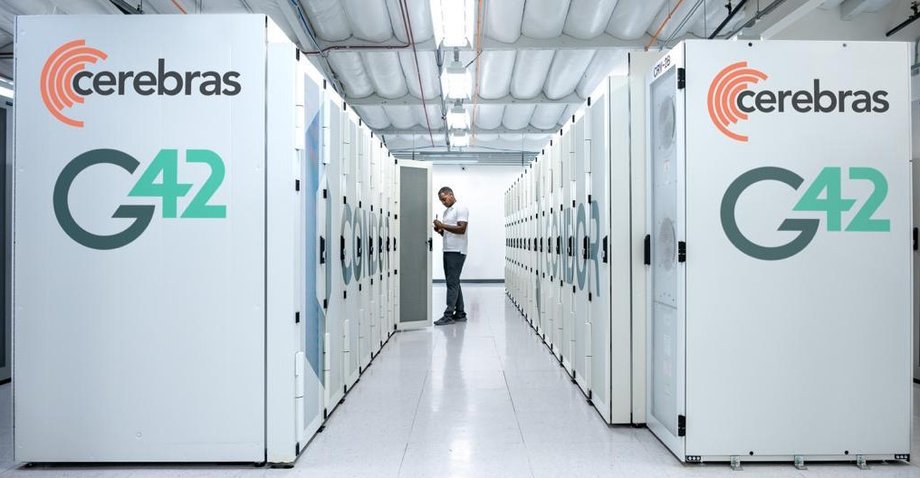
Before OpenAI, there was a company called G42 from the United Arab Emirates.
|
mat. press releases
The development of models, such as the high memory compression introduced in the new DeepSeek, as well as close cooperation with their creators, allow us to gradually shift this barrier, but not necessarily remove it completely. And even if the largest existing models can be run on Cerebras servers, the economic sense of this solution remains questionable. This means that The future of Cerebras largely depends on how many users will be willing to pay a premium to use a model that can do less than the most advanced ones, but is much faster. Such people exist, as evidenced by the popularity of fast versions of OpenAI and Anthropic services, but the scale and final shape of this phenomenon remains unknown – especially in the context of the onslaught of cheap Chinese language models.
Structural limitations of technology
It is also important that not all of Cerebras' technological limitations are something that can be easily “fixed” by the next iteration of the product. There are ways to increase the memory and communication speed of WSE accelerators, but implementing them would require solving very difficult engineering problems and significantly increasing costs.
Cerebras has been showing for years that it has very talented engineers who can do the impossible. However, looking at the list of challenges facing this company and how quickly the world of AI is changing, it is hard not to get the impression that its valuation is at least partly based on dreams, and not on cold calculation – a bit like in the times of the dotcom bubble. This is probably also a very interesting announcement of the rest of the year, when SpaceX, Anthropic and OpenAI will appear on the stock exchange.