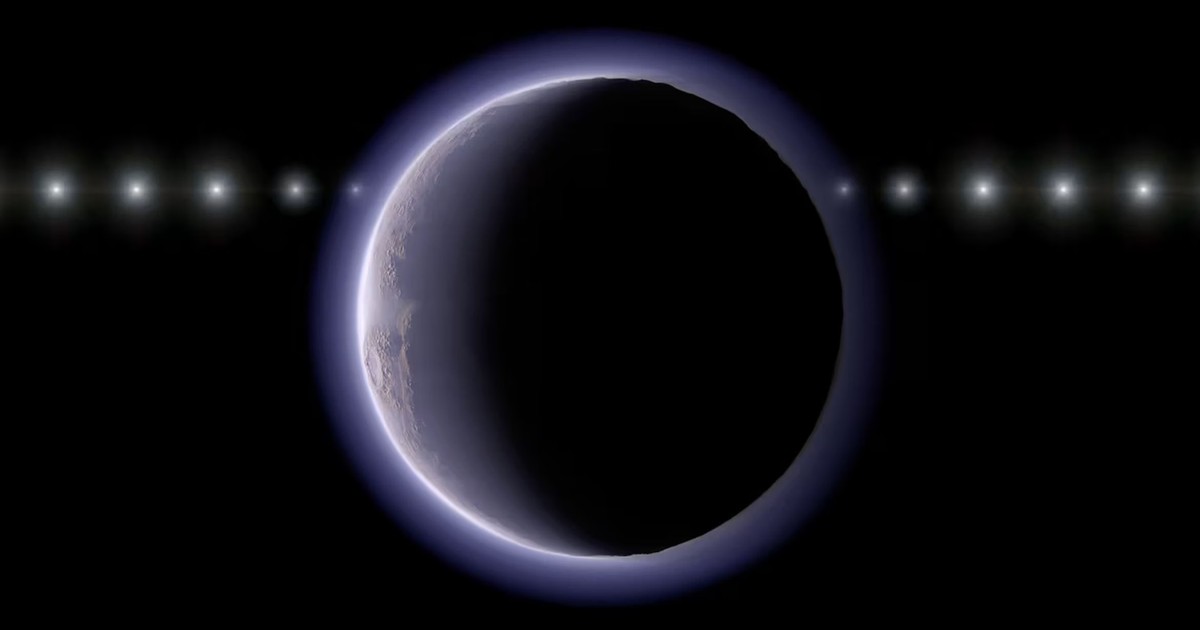
Scientists have found evidence that even the smallest, extremely cold bodies can surprise with their activity. The research results, published in Nature Astronomy, completely change our idea of the furthest reaches of the solar system.
The discovery was made thanks to a rare phenomenon – stellar occultation. On January 10, 2024, the object (612533) 2002 XV93 passed directly in front of the bright star. Three telescopes in Japan, including one amateur in Fukushima Prefecture, recorded unusual behavior of light. Instead of a sudden disappearance, there was a delicate blur lasting about 1.5 seconds and a gradual darkening.
- Read also: Mysterious asteroid remains near Earth. A new discovery by scientists
The analysis showed that the star's light was refracted in the very thin layer of gas surrounding the object. The pressure of this atmosphere is extremely low – only 100-200 nanobars, which is millions of times lower than on Earth. For comparison, on Pluto it is about 10 microbars. Scientists speculate that the gas may consist mainly of methane, nitrogen or carbon monoxide.
There are two main explanations for the origin of this atmospheric haze. The first assumes cryovolcanism – the slow release of gases from the deeper layers of an object thanks to the remains of internal heat. The second indicates a single collision with another body that “thrown” frozen substances to the surface. In this case, the atmosphere could dissipate within a few hundred years.
The solar system is still unexplored
This find destroys previous ideas about icy objects on the outskirts of the solar system. Until recently, it was believed that only larger bodies like Pluto were capable of retaining even a trace of an atmosphere. Object 2002 XV93, with a radius of only 250 km, shows that this limit is much lower than previously thought.
- Read also: NASA discovered a giant space explosion. The source surprised scientists
It also suggests that the Kuiper Belt is not a dead collection of rock and ice, but a place where geological processes can take place, even if at a very slow pace. This means that many other small objects in this region may periodically have their own volatile gas envelopes. This in turn influences our understanding of the evolution of dwarf planets and the material that formed our solar system – including compounds that may have played a role in the origin of life.
Some scientists doubt the discovery
However, not all researchers share the enthusiasm for (612533) 2002 XV93 and its alleged atmosphere. These include: Spanish astronomer Jose-Luis Ortiz, quoted by the AFP agency.
— I still have some doubts whether we are dealing with a real atmosphere here. We need more data, says the quoted scientist, who adds that it would be best to point the James Webb Space Telescope at this object.
The role of amateur observations
Researchers are planning further observations to check whether atmospheric pressure is decreasing or remaining stable. There are also high hopes for the James Webb Space Telescope – its spectroscopy may reveal the exact composition of gases in the future.
But the discovery shows how much can be achieved even without expensive space missions and building-sized telescopes. Sometimes it is enough to look at the sky at the right moment – even with amateur equipment – to change the image of deep space.
- Read also: An extraordinary discovery of scientists. An interstellar comet full of alcohol. “Outside the Solar System”
The Kuiper belt is slowly ceasing to be just a distant, stationary reservoir. Thanks to observations like these, we begin to see that even on its cold outskirts, there is more going on than we ever imagined. The coming years will probably bring new, exciting surprises from this distant corner of our solar system.